Sarga 57
विश्वामित्रस्य दक्षिणतपः तथा त्रिशङ्कोः स्वशरीरेण स्वर्गगमनाभिलाषः (Visvamitra’s Southern Austerity and Trisanku’s Bodily Ascent Aspiration)
बालकाण्ड
Sarga 57 pivots from Viśvāmitra’s humiliation-driven resolve into the Trīśaṅku episode. First, Viśvāmitra—remembering his disgrace and the enmity formed with Vasiṣṭha—moves south with his chief queen and undertakes severe tapas, living on fruits and roots with controlled senses. After a millennium of austerity, Brahmā acknowledges him only as a rājaṛṣi, which intensifies Viśvāmitra’s dissatisfaction and prompts renewed, higher penance aimed at elevated spiritual status. In parallel, the Ikṣvāku king Trīśaṅku, truthful and self-restrained, conceives an unprecedented goal: to reach heaven with his physical body via a great sacrifice. Vasiṣṭha refuses the project as impossible; Trīśaṅku then approaches Vasiṣṭha’s hundred ascetic sons in the southern region, respectfully seeks refuge, and petitions them to officiate a yajña enabling embodied ascent. The chapter thus juxtaposes ascetic merit, ritual authority, and the limits of sanctioned religious ambition.
Shlokas
Verse 1
ततस्सन्तप्तहृदय: स्मरन्निग्रहमात्मन:। विनिश्श्वस्य विनिश्श्वस्य कृतवैरो महत्मना।।1.57.1।।स दक्षिणां दिशं गत्वा महिष्या सह राघव ।तताप परमं घोरं विश्वामित्रो महत्तप:।।1.57.2।। फलमूलाशनो दान्तश्चकार सुमहत्तप:।
Thereafter, with his heart burning—remembering his own humiliation—and sighing again and again, Viśvāmitra, having formed enmity with the great-souled Vasiṣṭha, turned away (to pursue austerity).
Verse 2
ततस्सन्तप्तहृदय: स्मरन्निग्रहमात्मन:। विनिश्श्वस्य विनिश्श्वस्य कृतवैरो महत्मना।।1.57.1।।स दक्षिणां दिशं गत्वा महिष्या सह राघव ।तताप परमं घोरं विश्वामित्रो महत्तप:।।1.57.2।। फलमूलाशनो दान्तश्चकार सुमहत्तप:।
Then, his heart burning as he recalled his own humiliation, and sighing again and again—having brought upon himself enmity with the great-souled one—Viśvāmitra, O Rāghava, went south with his chief queen. There he undertook exceedingly fierce austerity; living on fruits and roots, with senses mastered, he performed the most intense penance.
Verse 3
अथास्य जज्ञिरे पुत्रास्सत्यधर्मपरायणा:।हविष्यन्दो मधुष्यन्दो दृढनेत्रो महारथ:।।1.57.3।।
After that, sons were born to him—devoted to truth and dharma: Haviṣyanda, Madhuṣyanda, Dṛḍhanetra, and Mahāratha.
Verse 4
पूर्णे वर्षसहस्रे तु ब्रह्मा लोकपितामह:।अब्रवीन्मधुरं वाक्यं विश्वामित्रं तपोधनम्।।1.57.4।।
When a thousand years had been completed, Brahmā, the grandsire of the worlds, addressed Viśvāmitra—whose wealth was austerity—with gentle words.
Verse 5
चिता राजर्षिलोकास्ते तपसा कुशिकात्मज।अनेन तपसा त्वां तु राजर्षिरिति विद्महे।।1.57.5।।
O son of Kuśika, by your austerity you have won the worlds of the royal seers; and by this very austerity we recognize you as a Rājarṣi.
Verse 6
एवमुक्त्वा महातेजा जगाम सह दैवतै:।त्रिविष्टपं ब्रह्मलोकं लोकानां परमेश्वर:।।1.57.6।।
Having spoken thus, the great radiant Lord of the worlds departed together with the gods, returning to the heavens—to Brahmaloka.
Verse 7
विश्वामित्रोऽपि तच्छ्रुत्वा ह्रिया किञ्चिदवाङ्मुख:।दु:खेन महताऽऽविष्टस्समन्युरिदमब्रवीत् ।।1.57.7।।
Hearing those words, Viśvāmitra—his face lowered a little in shame—overwhelmed by deep sorrow and stirred by anger, spoke as follows.
Verse 8
तपश्च सुमहत्तप्तं राजर्षिरिति मां विदु:।देवास्सर्षिगणास्सर्वे नास्ति मन्ये तप:फलम्।।1.57.8।।
“I have undertaken exceedingly great austerities; yet all the gods, along with the hosts of seers, know me only as a royal sage. I think there is no fruit in my penance.”
Verse 9
इति निश्चित्य मनसा भूय एव महातपा:।तपश्चकार काकुत्स्थ परमं परमात्मवान्।।1.57.9।।
Having thus resolved in his mind, that great ascetic—O descendant of Kakutstha—steadfast in spirit, once again undertook austerities of the highest order.
Verse 10
एतस्मिन्नेव काले तु सत्यवादी जितेन्द्रिय:।त्रिशङ्कुरिति विख्यात इक्ष्वाकुकुलवर्धन:।।1.57.10।।
At that very time, there was a celebrated king named Triśaṅku—an enhancer of the Ikṣvāku line—truthful in speech and self-restrained.
Verse 11
तस्य बुद्धिस्समुत्पन्ना यजेयमिति राघव ।गच्छेयं स्वशरीरेण देवानां परमां गतिम्।।1.57.11।।
O Rāghava, a thought arose in him: “Let me perform a sacrifice, and with this very body attain the supreme realm of the gods.”
Verse 12
स वसिष्ठं समाहूय कथयामास चिन्तितम्।अशक्यमिति चाप्युक्तो वसिष्ठेन महात्मना।।1.57.12।।
He summoned Vasiṣṭha and told him what he had resolved; but the great-souled Vasiṣṭha replied that it was not possible.
Verse 13
प्रत्याख्यातो वसिष्ठेन स ययौदक्षिणां दिशम्। ततस्तत्कर्मसिद्ध्यर्थं पुत्रां स्तस्य गतो नृप:।।1.57.13।।
Refused by Vasiṣṭha, the king went toward the southern direction; thereafter, seeking success in that undertaking, he approached Vasiṣṭha’s sons.
Verse 14
वासिष्ठा दीर्घतपसस्तपो यत्र हि तेपिरे।त्रिशंङ्कुस्सुमहातेजा श्शतं परमभास्वरम्।।1.57.14।।वसिष्ठपुत्रान् ददृशे तप्यमानान् यशस्विन:।
Triśaṅku, of great splendour, reached the place where Vasiṣṭha’s sons had long been practising austerities; there he beheld Vasiṣṭha’s sons—famous, radiant, and a hundred in number—engaged in penance.
Verse 15
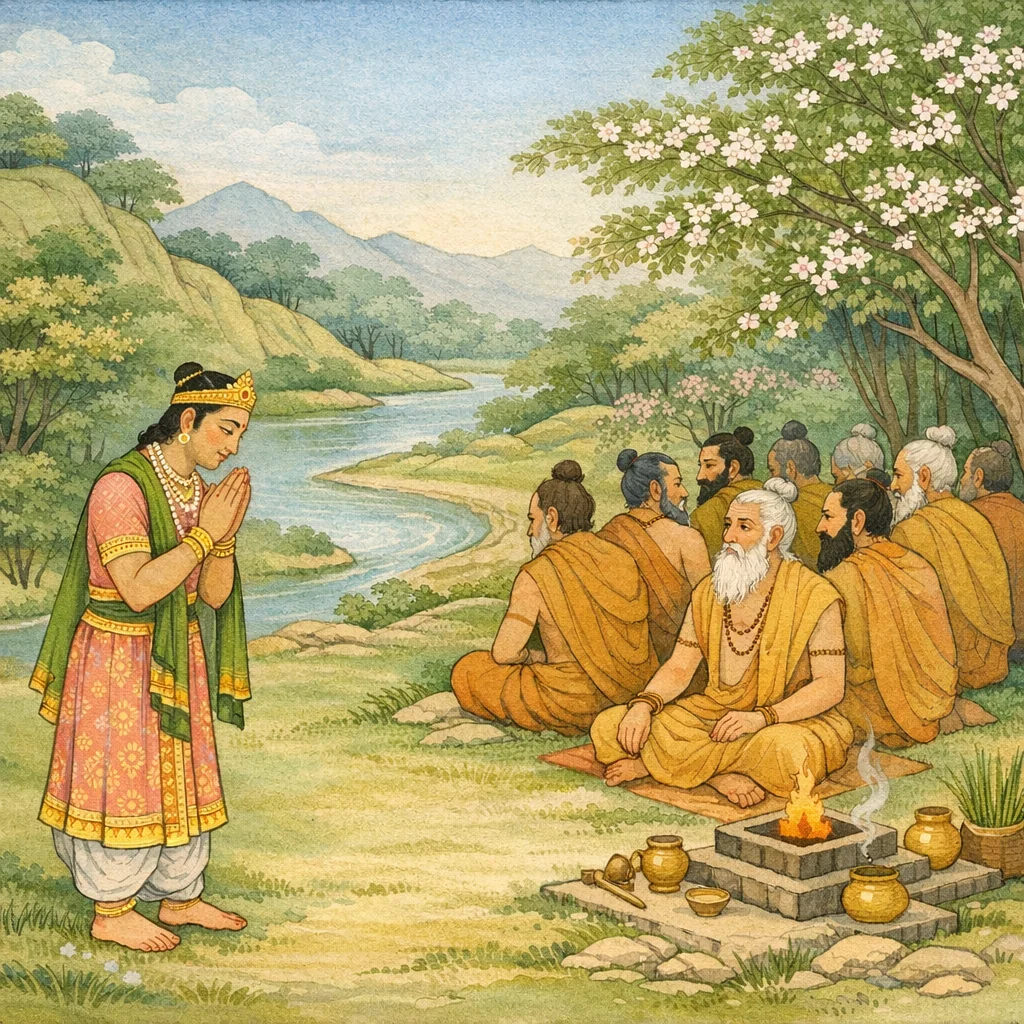
सोऽभिगम्य महात्मनस्सर्वानेव गुरोस्सुतान्।।1.57.15।।अभिवाद्यानुपूर्व्येण ह्रिया किञ्चिदवाङ्मुख:।अब्रवीत्सुमहाभगान्सर्वानेव कृताञ्जलि:।।1.57.16।।
Approaching all the great-souled sons of his guru, he paid homage to them in due order; then, with modesty, his face slightly lowered, and with hands folded, he addressed all those highly fortunate sages.
Verse 16
सोऽभिगम्य महात्मनस्सर्वानेव गुरोस्सुतान्।।1.57.15।।अभिवाद्यानुपूर्व्येण ह्रिया किञ्चिदवाङ्मुख:।अब्रवीत्सुमहाभगान्सर्वानेव कृताञ्जलि:।।1.57.16।।
After respectfully greeting them in order of seniority, with modesty and his face slightly lowered, he spoke to all those highly distinguished ones with folded hands.
Verse 17
शरणं व: प्रपद्येऽहं शरण्यान् शरणागत:।प्रत्याख्यातोऽस्मि भद्रं वो वसिष्ठेन महात्मना।।1.57.17।।
I come to you as one seeking refuge, O you who are protectors of the refuge-seeker. Blessings upon you. I have been turned away by the great-souled Vasiṣṭha.
Verse 18
यष्टुकामो महायज्ञं तदनुज्ञातुमर्हथ।गुरुपुत्रानहं सर्वान्नमस्कृत्य प्रसादये।।1.57.18।।
Desiring to perform a great sacrifice, I ask you to grant your consent for it. Having bowed to all of you, the sons of my teacher, I seek to win your favor.
Verse 19
शिरसा प्रणतो याचे ब्राह्मणान् तपसि स्थितान्।ते मां भवन्तस्सिद्ध्यर्थं याजयन्तु समाहिता:।।1.57.19।।सशरीरो यथाऽहं हि देवलोकमवाप्नुयाम्।
With my head bowed, I beg you Brahmins, steadfast in austerity: with focused minds, guide me in performing the sacrifice for the fulfillment of my aim—so that I may attain the world of the gods in this very body.
Verse 20
प्रत्याख्यातो वसिष्ठेन गतिमन्यां तपोधना:।।1.57.20।।गुरुपुत्रानृते सर्वान्नाहं पश्यामि काञ्चन।
Rejected by Vasiṣṭha, O you whose wealth is austerity, I see no other course at all—except the sons of my teacher.
Verse 21
इक्ष्वाकूणां हि सर्वेषां पुरोधा: परमा गति:।।1.57.21।।पुरोधसस्तु विद्वांसस्तारयन्ति सदा नृपान्।तस्मादनन्तरं सर्वे भवन्तो दैवतं मम।।1.57.22।।
For all the Ikṣvāku kings, indeed, the royal priest is the highest refuge. Learned preceptors ever guide kings across (to welfare and right conduct). Therefore, after him, all of you are my very deities.
Frequently Asked Questions
Two linked actions frame the dilemma: Viśvāmitra responds to dishonor by escalating tapas to transform status, while Trīśaṅku pursues an embodied ascent to heaven through yajña—an aim judged “impossible” by Vasiṣṭha—raising questions about legitimate aspiration versus the boundaries set by ritual and tradition.
The sarga highlights that spiritual titles and outcomes are not merely products of effort but also of recognized legitimacy within a moral-ritual order; it also shows how desire (even when paired with truthfulness and restraint) must be evaluated against dharmic feasibility and the authority of qualified preceptors.
The “southern quarter” (dakṣiṇā diś) functions as a ritual-ascetic landscape where both Viśvāmitra and Vasiṣṭha’s sons perform austerities; culturally, the chapter emphasizes guru-śiṣya protocol (approaching, bowing by seniority, folded hands) and the centrality of the purohita/preceptor in Ikṣvāku royal religion.