Sarga 54
शबलाहरणम् — The Attempted Seizure of Sabalā (Kāmadhenu) and the Triumph of Brahmic Power
बालकाण्ड
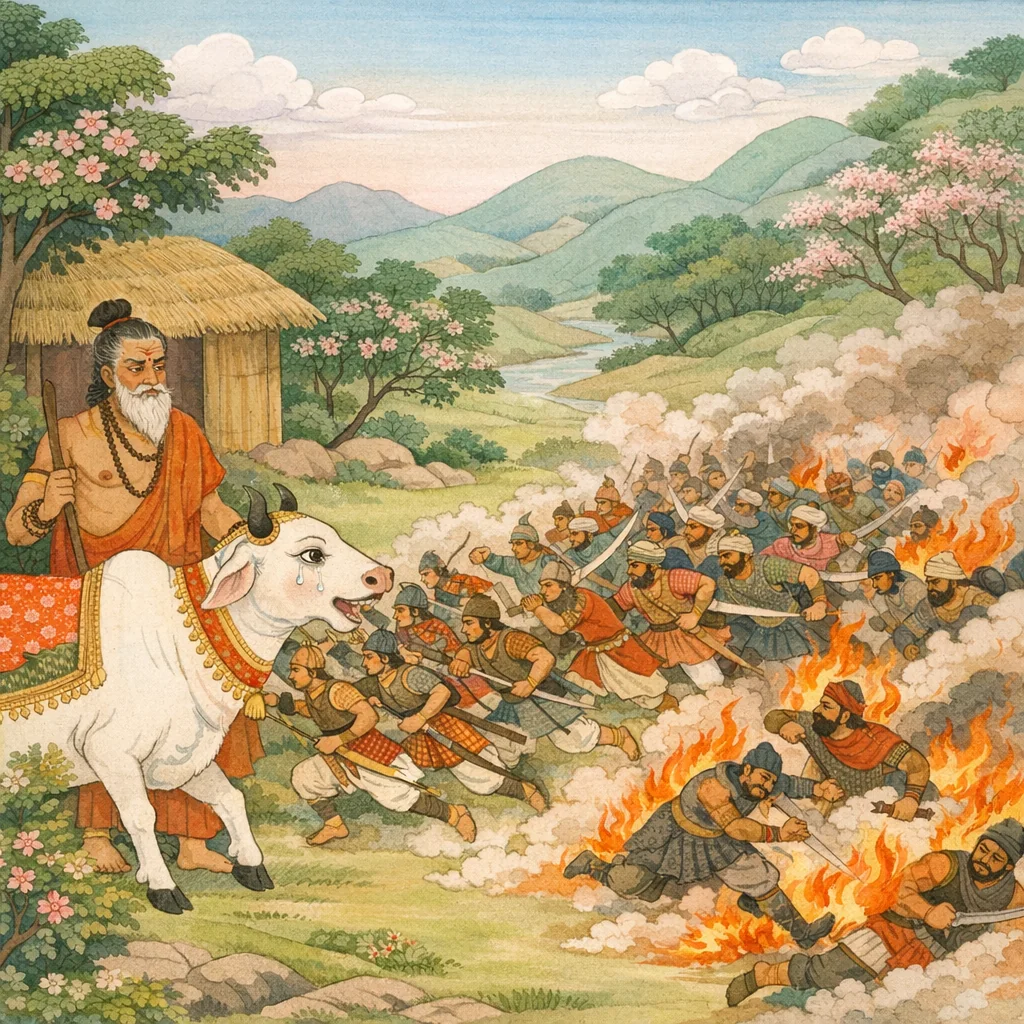
This sarga stages a juridical and spiritual contest between kṣātra-bala (the coercive power of kingship) and brahma-bala (the ascetic and ritual authority of a brahmarṣi). When Vasiṣṭha refuses to relinquish the wish-fulfilling cow Kāmadhenu (Sabalā), Viśvāmitra forcibly drags her away. Sabalā, distressed, reflects on whether she has been abandoned, then breaks free from the king’s attendants and appeals directly to Vasiṣṭha. Vasiṣṭha clarifies that he has not forsaken her; rather, the king is acting with force. He also acknowledges the asymmetry of worldly might—Viśvāmitra’s royal status and akṣauhiṇī—while implicitly pointing to a higher register of power. Sabalā responds with doctrinal clarity: brahminic power is held superior to kṣatriya strength, being ‘divine’ and immeasurable. At Vasiṣṭha’s command, she generates forces that rout Viśvāmitra’s army: first Paplavas arising from her “humbhā” lowing, then (when those are struck down) Śakas mixed with Yavanas, who burn through the remaining host. Viśvāmitra counters by releasing astras, scattering these created troops. The chapter thus articulates a layered power-theory—political force, miraculous generation, and weaponized mantra-astra—while sharpening Viśvāmitra’s motivation to seek brahmarṣi status.
Shlokas
Verse 1
कामधेनुं वसिष्ठोऽपि यदा न त्यज्यते मुनि:।तदास्य शबलां राम विश्वामित्रोऽन्वकर्षत।।।।
O Rāma, when the sage Vasiṣṭha would not relinquish the wish-fulfilling cow, then Viśvāmitra dragged Śabalā away by force.
Verse 2
नीयमाना तु शबला राम राज्ञा महात्मना।दु:खिता चिन्तयामास रुदन्ती शोककर्शिता।।।।
O Rāma, as Śabalā was being carried away by the great king, she wept in distress—worn down by grief—and reflected within herself.
Verse 3
परित्यक्ता वसिष्ठेन किमहं सुमहात्मना।याहं राजभटैर्दीना ह्रियेय भृशदु:खिता।।।।
“Have I been abandoned by the great-souled Vasiṣṭha— I who, pitiable and deeply distressed, am being carried off by the king’s attendants?”
Verse 4
किं मयाऽपकृतं तस्य महर्षेर्भावितात्मन:।यन्मामनागसं भक्तामिष्टां त्यजति धार्मिक:।।।।
“What wrong have I done to that great seer of purified soul, that the righteous one would cast off me—innocent, devoted, and dear?”
Verse 5
इति सा चिन्तयित्वा तु विनिश्श्वस्य पुन:पुन:।निर्धूय तांस्तदा भृत्यान् शतशश्शत्रुसूदन ।जगामानिलवेगेन पादमूलं महात्मन:।।।।
Thus thinking, and sighing again and again, she shook off those servants by the hundreds and, O slayer of foes, sped like the wind to the feet of the great-souled one (Vasiṣṭha).
Verse 6
शबला सा रुदन्ती च क्रोशन्ती चेदमब्रवीत्।वसिष्ठस्याग्रतस्स्थित्वा मेघदुन्दुभिराविणी।।।।
That Śabalā—weeping and crying out—stood before Vasiṣṭha and spoke, her voice resounding like thunder and kettle-drums.
Verse 7
भगवन् किं परित्यक्ता त्वयाऽहं ब्रह्मणस्सुत।यस्माद्राजभृता मां हि नयन्ते त्वत्सकाशत:।।।।
“Venerable one, O son of Brahmā—have you abandoned me? Why are the king’s servants taking me away from your very presence?”
Verse 8
एवमुक्तस्तु ब्रह्मर्षिरिदं वचनमब्रवीत्।शोकसन्तप्तहृदयां स्वसारमिव दु:खिताम्।।।।
Thus addressed, the Brahmarṣi spoke these words to her—distressed like a sister, her heart scorched by sorrow.
Verse 9
न त्वां त्यजामि शबले नापि मेऽपकृतं त्वया।एष त्वां नयते राजा बलोन्मत्तो महाबल:।।।।
“I do not abandon you, O Śabalā; you have done me no wrong. It is this mighty king—intoxicated with power—who is taking you away by force.”
Verse 10
न हि तुल्यं बलं मह्यं राजा त्वद्य विशेषत:।बली राजा क्षत्रियश्च पृथिव्या: पतिरेव च।।।।
‘I have no strength equal to the king’s—especially today. The king is powerful; he is a kṣatriya, and indeed the lord of the earth.’
Verse 11
इयमक्षौहिणी पूर्णा सवाजिरथसङ्कुला।हस्तिध्वजसमाकीर्णा तेनासौ बलवत्तर:।।।।
‘Here is a full akṣauhiṇī—dense with horses and chariots, crowded with elephants and banners; therefore he is the stronger.’
Verse 12
एवमुक्ता वसिष्ठेन प्रत्युवाच विनीतवत्।वचनं वचनज्ञा सा ब्रह्मर्षिममितप्रभम्।।।।
Thus addressed by Vasiṣṭha, that eloquent cow replied with humility to the brahmarṣi of immeasurable radiance and power.
Verse 13
न बलं क्षत्रियस्याहुर्ब्राह्मणो बलवत्तर:।ब्रह्मन् ब्रह्मबलं दिव्यं क्षत्रात्तु बलवत्तरम्।।।।
“O Brahmin! It is not said that a kṣatriya’s might is the greater; the brāhmaṇa is stronger. The brāhmaṇa’s power is divine—indeed, stronger than kṣatriya force.”
Verse 14
अप्रमेयबलं तुभ्यं न त्वया बलवत्तर:।विश्वामित्रो महावीर्यस्तेज स्तव दुरासदम्।।।।
“Your power is immeasurable; none is stronger than you. Even the mighty hero Viśvāmitra cannot approach your splendor—your spiritual radiance is unassailable.”
Verse 15
नियुङ्क्ष्व मां महाभाग त्वद्ब्रह्मबलसम्भृताम्।तस्य दर्पबलं यत्तन्नाशयामि दुरात्मन:।।।।
“Command me, O noble one; I am sustained by your brahminical power. I will destroy that wicked man’s arrogant might.”
Verse 16
इत्युक्तस्तु तया राम वसिष्ठ स्सुमहायशा:।सृजस्वेति तदोवाच बलं परबलार्दनम्।।।।
Thus addressed by her, O Rāma, the highly renowned Vasiṣṭha then said: “Create an army—one that can crush the enemy’s strength.”
Verse 17
तस्य तद्वचनं श्रुत्वा सुरभिस्साऽसृजत्तदा।।।।तस्या हुम्भारवोत्सृष्टा: पप्लवाश्शतशो नृप।नाशयन्ति बलं सर्वं विश्वामित्रस्य पश्यत:।।।।
Hearing his command, Surabhi (Śabalā) then brought forth an army. O king, from her ‘humbhā’ bellow sprang Paplavas by the hundreds, and they destroyed Viśvāmitra’s entire host as he looked on.
Verse 18
तस्य तद्वचनं श्रुत्वा सुरभिस्साऽसृजत्तदा।।1.54.17।।तस्या हुम्भारवोत्सृष्टा: पप्लवाश्शतशो नृप। नाशयन्ति बलं सर्वं विश्वामित्रस्य पश्यत:।।1.54.18।।
This is a repeated/overlapping recensional presentation of the preceding event: Surabhi, hearing Vasiṣṭha’s words, produced Paplavas by the hundreds from her bellow, and they destroyed all of Viśvāmitra’s army as he watched.
Verse 19
बलं भग्नं ततो दृष्ट्वा रथेनाक्रम्य कौशिक:।स राजा परमक्रुद्धो रोषविस्फारितेक्षण:।पप्लवान्नाशयामास शस्त्रैरुच्चावचैरपि।।।।
Seeing his army shattered, Kauśika (Viśvāmitra) mounted his chariot in fury. With eyes widened in rage, the king destroyed the Paplavas too, using weapons of many kinds.
Verse 20
विश्वामित्रार्दितान् दृष्ट्वा पप्लवाञ्छतशस्तदा।भूय एवासृजत्कोपाच्छकान् यवनमिश्रितान्।।।।
Seeing the Paplavas in the hundreds being crushed by Viśvāmitra, she again—out of anger—created Śakas, mingled with Yavanas.
Verse 21
तैरासीत् संवृता भूमि श्शकैर्यवनमिश्रितै:।प्रभावद्भिर्महावीर्यैर्हेमकिञ्जल्कसन्निभै:।।।।
The earth was covered by those Śakas, mingled with Yavanas—radiant, of great prowess, and gleaming like golden filaments.
Verse 22
दीर्घासिपट्टिशधरैःमवर्णाम्बरावृतै:।निर्दग्धं तद्बलं सर्वं प्रदीप्तैरिव पावकै:।।।।
Armed with long swords and lances, clad in yellow garments, they consumed that entire force—like blazing fires.
Verse 23
ततोऽस्त्राणि महातेजा विश्वामित्रो मुमोच ह।तैस्तैर्यवनकाम्भोजा: पप्लवाश्चाकुलीकृता:।।।।
Then the great-splendored Viśvāmitra loosed his weapons; by those various missiles, the Yavanas, Kāmbojas, and Paplavas were thrown into confusion and distress.
Frequently Asked Questions
The pivotal action is Viśvāmitra’s coercive seizure of Sabalā despite Vasiṣṭha’s refusal, raising a dharma-conflict between royal force (legitimized by power and possession) and the inviolability of the āśrama’s sacred economy and consent-based stewardship.
The sarga teaches a hierarchy of power: kṣatriya strength may dominate materially (army, sovereignty), but brahma-bala—rooted in tapas, mantra, and dharmic authority—is portrayed as divya and ultimately superior; pride-driven governance collapses before disciplined spiritual potency.
Rather than a named tīrtha or city, the chapter highlights cultural institutions: the ṛṣi-āśrama as a protected domain, the akṣauhiṇī as a classical military unit, and the ethnocultural references (Śakas, Yavanas, Kāmbojas) used to map the created forces within an epic-era imagination of frontier peoples.