Sarga 49
अहल्याशापमोक्षः — The Release of Ahalya and Indra’s Restoration
बालकाण्ड
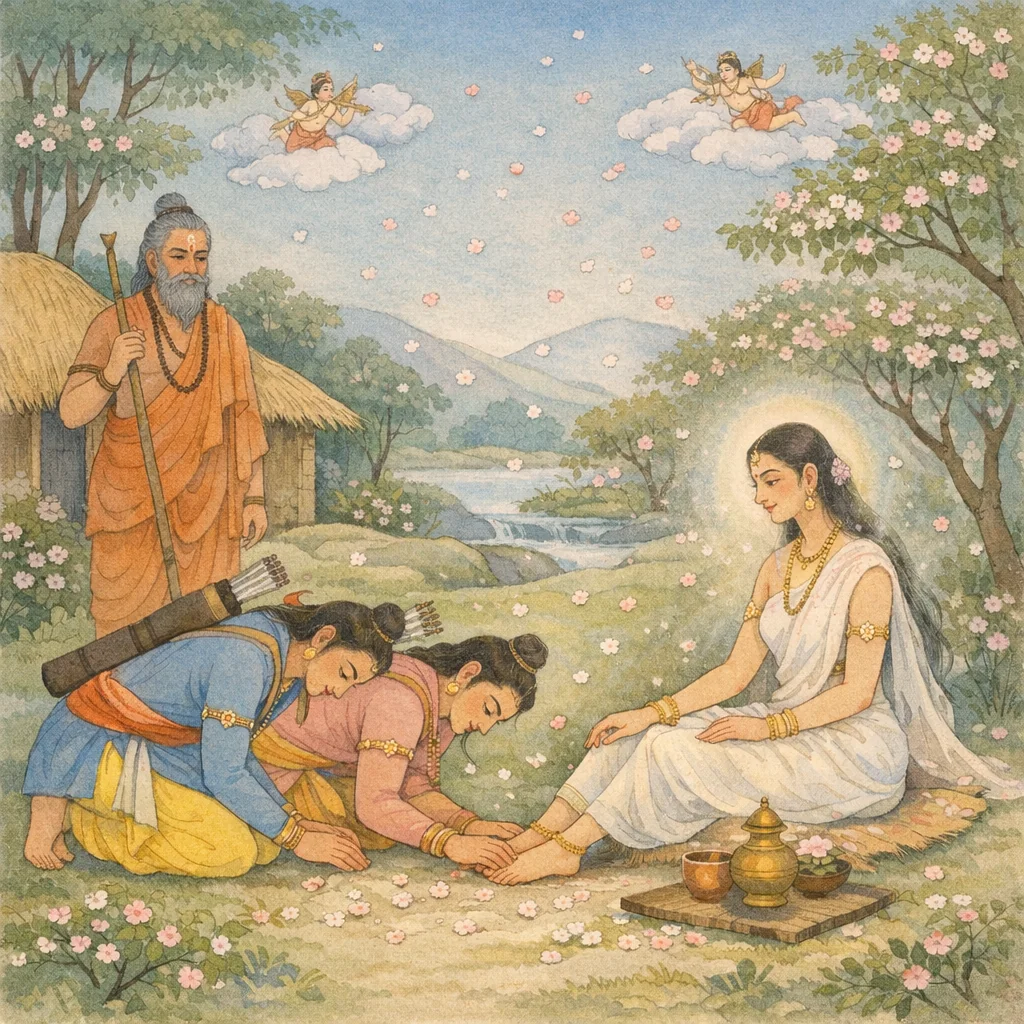
This sarga interweaves a divine-ritual episode with an ethical restoration narrative. Indra, having incurred Gautama’s wrath for obstructing the sage’s tapas and violating marital boundaries, laments his loss and appeals to the devas (with Agni in the lead) for remedial action. The pitṛdevas, responding to Agni’s directive, graft a ram’s testicles onto Indra, establishing a sacrificial convention in which emasculated rams are accepted as offerings thereafter. Viśvāmitra then instructs Rāma to enter Gautama’s hermitage and liberate Ahalyā, whose visibility has been suspended by the curse until Rāma’s advent. Rāma and Lakṣmaṇa, led by Viśvāmitra, behold Ahalyā described through layered similes (moonlight veiled by mist, sunlike brilliance), emphasizing tapas as a purifying radiance. With the curse-period ended, the brothers touch her feet; Ahalyā receives them with traditional hospitality (pādya, arghya, ātithya), and celestial celebration follows (flower-rain, drums, gandharvas and apsarases). Gautama, reunited with Ahalyā, honors Rāma and resumes austerities; Rāma proceeds toward Mithilā.
Shlokas
Verse 1
अफलस्तु ततश्शक्रो देवानग्निपुरोगमान्।अब्रवीत्त्रस्तवदनस्सर्षिस्सङ्घान् सचारणान्।।।।
Thereafter Śakra (Indra), deprived of his manhood and with a frightened face, addressed the gods—Agni at their head—along with assemblies of ṛṣis and the Cāraṇas.
Verse 2
कुर्वता तपसो विघ्नं गौतमस्य महात्मन:।क्रोधमुत्पाद्य हि मया सुरकार्यमिदं कृतम्।।।।
“By creating an obstruction to the austerities of the great-souled Gautama, I provoked his wrath; thus, I have carried out this deed as a service to the gods.”
Verse 3
अफलोऽस्मि कृतस्तेन क्रोधात्सा च निराकृता।शापमोक्षेण महता तपोऽस्यापहृतं मया।।।।
“By his wrath I have been made bereft of my virility; and she too has been cast off. Through this mighty curse and its condition of release, his ascetic power has been diminished because of me.”
Verse 4
तस्मात्सुरवरास्सर्वे सर्षिस्सङ्घास्सचारणा: ।सुरसाह्यकरं सर्वे सफलं कर्तुमर्हथ।।।।
“Therefore, O best of the gods—along with the companies of seers and the Cāraṇas—since I acted for the gods’ benefit, you all should see to it that I am made whole again.”
Verse 5
शतक्रतोर्वचश्श्रुत्वा देवास्साग्निपुरोगमा:।पितृदेवानुपेत्याहु स्सह सर्वैर्मरुद्गणै:।।।।
Hearing Śatakratu’s words, the gods—led by Agni and accompanied by all the hosts of the Maruts—approached the Pitṛ-devas and spoke to them.
Verse 6
अयं मेषस्सवृषणश्शक्रो ह्यवृषण: कृत:।मेषस्य वृषणौ गृह्य शक्रायाऽशु प्रयच्छथ।।।।
“This ram has its testicles, but Indra has been rendered without his. Take the ram’s testicles at once and provide them to Indra.”
Verse 7
अफलस्तु कृतो मेष: परां तुष्टिं प्रदास्यति।भवतां हर्षणार्थाय ये च दास्यन्ति मानवा:।।1.49.7।।
“Though made without testicles, the ram will still bring you great satisfaction—delighting you and those humans who will offer it.”
Verse 8
अग्नेस्तु वचनं श्रुत्वा पितृदेवास्समागता:।उत्पाट्य मेषवृषणौ सहस्राक्षे न्यवेशयन्।।।।
Hearing Agni’s words, the Pitṛdevatās assembled; they uprooted the ram’s testicles and implanted them upon Sahasrākṣa (Indra).
Verse 9
तदा प्रभृति काकुत्स्थ पितृदेवास्समागता:।अफलान् भुञ्जते मेषान् फलैस्तेषामयोजयन्।।।।
“O Kakutstha, from that time onward the assembled Pitṛdevatās have accepted as offerings rams made without testicles, after fitting those testicles onto Indra.”
Verse 10
इन्द्रस्तु मेषवृषणस्तदाप्रभृति राघव।गौतमस्य प्रभावेन तपसश्च महात्मन:।।।।
O Rāghava, from that time onward Indra bore the testicles of a ram—such was the power of the great-souled Gautama’s austerity.
Verse 11
तदागच्छ महातेज आश्रमं पुण्यकर्मण:।तारयैनां महाभागामहल्यां देवरूपिणीम्।।।।
Therefore, O mighty and radiant one, enter the hermitage of the pious Gautama, and deliver this fortunate Ahalyā, a woman of divine beauty, from her bound state.
Verse 12
विश्वामित्रवचश्श्रुत्वा राघवस्सहलक्ष्मण:।विश्वामित्रं पुरस्कृत्य तमाश्रममथाविशत्।।।।
Having heard Viśvāmitra’s words, Rāma—together with Lakṣmaṇa—entered that hermitage, placing Viśvāmitra respectfully in the lead.
Verse 13
ददर्श च महाभागां तपसा द्योतितप्रभाम्।लोकैरपि समागम्य दुर्निरीक्ष्यां सुरासुरै:।।।।प्रयत्नान्निर्मितां धात्रा दिव्यां मायामयीमिव।स तुषारावृतां साभ्रां पूर्णचन्द्रप्रभामिव।।।।मध्येंऽभसो दुराधर्षां दीप्तां सूर्यप्रभामिव।
And he beheld Ahalyā, most blessed, her radiance kindled by austerity—so subtle that even men, gods, and asuras together could scarcely perceive her. She appeared divine, like an illusory form fashioned by the Creator with special care: like the full moon’s light veiled by mist and clouds, and like the sun’s brilliance—unassailable—shining through a watery medium.
Verse 14
ददर्श च महाभागां तपसा द्योतितप्रभाम्।लोकैरपि समागम्य दुर्निरीक्ष्यां सुरासुरै:।।1.49.13।।प्रयत्नान्निर्मितां धात्रा दिव्यां मायामयीमिव।स तुषारावृतां साभ्रां पूर्णचन्द्रप्रभामिव।।1.49.14।। मध्येंऽभसो दुराधर्षां दीप्तां सूर्यप्रभामिव।
This transmission repeats/continues the same descriptive unit: Rāma beholds Ahalyā, radiant through austerity and scarcely perceivable even to assembled beings; she appears divinely fashioned—like moonlight veiled by mist and cloud, and like the unassailable brilliance of the sun shining through water.
Verse 15
सा हि गौतमवाक्येन दुर्निरीक्ष्या बभूव ह।।।।त्रयाणामपि लोकानां यावद्रामस्य दर्शनम्।
For by Gautama’s word she had become impossible to perceive—even for the three worlds—until the moment of Rāma’s appearance.
Verse 16
शापस्यान्तमुपागम्य तेषां दर्शनमागता।।।।राघवौ तु ततस्तस्या: पादौ जगृहतुस्तदा।
When the curse reached its end, she came into their sight. Then the two Rāghavas reverently took hold of her feet (in respectful salutation).
Verse 17
स्मरन्ती गौतमवच: प्रतिजग्राह सा च तौ।।।।पाद्यमर्घ्यं तथाऽऽतिथ्यं चकार सुसमाहिता।प्रतिजग्राह काकुत्स्थो विधिदृष्टेन कर्मणा।।।।
Remembering Gautama’s words, she received them with due honor: she offered water for washing the feet, the arghya of reverence, and proper hospitality with a composed mind. Kakutstha (Rama) accepted these rites as prescribed by tradition.
Verse 18
स्मरन्ती गौतमवच: प्रतिजग्राह सा च तौ।।1.49.17।।पाद्यमर्घ्यं तथाऽऽतिथ्यं चकार सुसमाहिता।प्रतिजग्राह काकुत्स्थो विधिदृष्टेन कर्मणा।।1.49.18।।
Remembering Gautama’s words, she welcomed them with honor—offering foot-water, arghya, and hospitality with full attentiveness; and Kakutstha (Rama) received it through acts sanctioned by tradition.
Verse 19
पुष्पवृष्टिर्महत्यासीद्देवदुन्दुभिनिस्वनै:।गन्धर्वाप्सरसां चैव महानासीत्समागम:।।।।
A great shower of flowers fell amid the resonant sound of divine drums; and there was a grand gathering of Gandharvas and Apsarases as well.
Verse 20
साधु साध्विति देवास्तामहल्यां समपूजयन्।तपोबलविशुद्धाङ्गी गौतमस्य वशानुगाम्।।।।
The gods honored Ahalya, exclaiming “Well done! Well done!”—she whose body was purified by the power of penance, and who now stood in accord with Gautama’s authority and command.
Verse 21
गौतमोऽपि महातेजा अहल्यासहितस्सुखी।रामं सम्पूज्य विधिवत्तपस्तेपे महातपा:।।।।
Gautama too—radiant and greatly ascetic—joyful together with Ahalya, duly honored Rama according to rite, and then continued his austerities.
Verse 22
रामोऽपि परमां पूजां गौतमस्य महामुने:।सकाशाद्विधिवत्प्राप्य जगाम मिथिलां तत:।।।।
Rama too, having duly received the highest honor from the great sage Gautama, then set out from there for Mithilā.
Frequently Asked Questions
The sarga presents the consequences of Indra’s misconduct and interference with a sage’s austerities, showing how transgression against marital and ascetic boundaries triggers curse, social rupture, and the need for restitution within a cosmic-ritual order.
Tapas and dharma are depicted as real forces that shape visibility, honor, and cosmic balance: wrongdoing yields tangible loss, while purification and rightful intervention (Rāma’s touch and Ahalyā’s disciplined hospitality) restore order without erasing accountability.
Gautama’s āśrama functions as the cultural landmark of ascetic authority and ritual hospitality (pādya–arghya–ātithya), while the narrative transition toward Mithilā signals the next socio-political milestone leading to Janaka’s court and the marriage episode.