Sarga 44
गङ्गावतरण-समापनः (Conclusion of the Descent of Gaṅgā)
बालकाण्ड
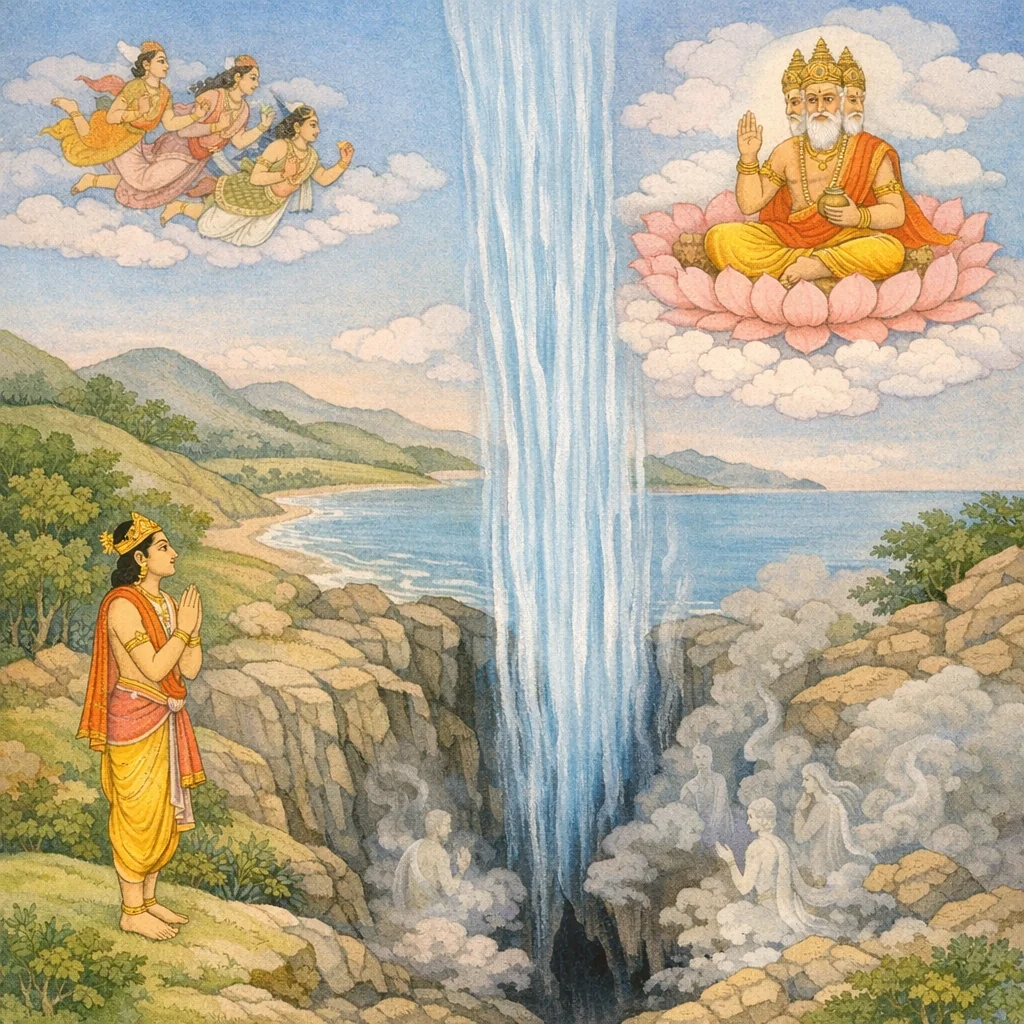
Sarga 44 closes the Gaṅgāvataraṇa cycle by narrating Bhagiratha’s arrival with Gaṅgā at the ocean and his descent into the earth’s lower regions where Sagara’s sons lie reduced to ashes (1.44.1). Once the ashes are inundated by Gaṅgā’s waters, Brahmā appears and confirms their liberation and ascent to heaven (1.44.2–4), linking ancestral salvation to ritual efficacy and cosmic sanction. Brahmā further formalizes Gaṅgā’s identity as Bhāgīrathī and Tripathagā—divine, world-purifying, and socially remembered through Bhagiratha’s vow (1.44.5–6). He instructs Bhagiratha to complete the salila-kriyā (water rites) for all forefathers and explicitly contrasts Bhagiratha’s success with the earlier inability of Sagara, Aṃśumat, and Dilīpa to accomplish the same vow (1.44.7–11). Brahmā praises Bhagiratha’s fulfilled promise, presenting it as an attainment of fame and a ‘great abode in dharma’ (1.44.12–13), and advises ritual bathing and purification in the sacred waters (1.44.14). After bidding farewell and returning to heaven (1.44.15–16), Bhagiratha performs the prescribed rites in due order, returns purified to his capital, and rules with his purpose achieved; the people rejoice, freed from sorrow and anxiety (1.44.17–19). The sarga ends with a phalaśruti: hearing/reciting this auspicious account grants merit, prosperity, longevity, progeny, and the pleasing of gods and ancestors, while destroying sins (1.44.20–23).
Shlokas
Verse 1
स गत्वा सागरं राजा गङ्गयाऽनुगतस्तदा ।प्रविवेश तलं भूमेर्यत्र ते भस्मसात्कृता:।।1.44.1।।
Then that king, followed by the Gaṅgā, went to the ocean and entered the earth’s lower depths—where those (sons of Sagara) had been turned to ashes.
Verse 2
भस्मन्यथाऽप्लुते राम गङ्गायास्सलिलेन वै।सर्वलोकप्रभुर्ब्रह्मा राजानमिदमब्रवीत्।।1.44.2।।
O Rāma, when the ashes had been inundated indeed by the waters of the Gaṅgā, Brahmā—the lord of all the worlds—addressed the king with these words.
Verse 3
तारिता नरशार्दूल दिवं याताश्च देववत्।षष्ठि: पुत्रसहस्राणि सगरस्य महात्मन:।।1.44.3।।
O tiger among men, the sixty thousand sons of the great Sagara—having been delivered—went to heaven like the gods.
Verse 4
सागरस्य जलं लोके यावत्स्थास्यति पार्थिव।सगरस्यात्मजास्तावत्स्वर्गे स्थास्यन्ति देववत्।।1.44.4।।
O king, as long as the ocean’s waters remain in this world, so long will Sagara’s sons remain in heaven like the gods.
Verse 5
इयं च दुहिता ज्येष्ठा तव गङ्गा भविष्यति ।त्वत्कृतेन च नाम्नाऽथ लोके स्थास्यति विश्रुता।।1.44.5।।
This Gaṅgā will become your eldest daughter; and from now on, she will be renowned in the world by the name derived from you (Bhāgīrathī).
Verse 6
गङ्गा त्रिपथगा राजन् दिव्या भागीरथीति च।त्रीन् पथो भावयन्तीति ततस्त्रिपथगा स्मृता।।1.44.6।।
O king, the divine Gaṅgā is also called Bhāgīrathī and Tripathagā. Because she sanctifies the three paths (the three worlds), she is remembered as ‘Tripathagā’.
Verse 7
पितामहानां सर्वेषां त्वमत्र मनुजाधिप ।कुरुष्व सलिलं राजन् प्रतिज्ञामपवर्जय।।1.44.7।।
O lord of men, O king—here you should make the water-offerings for all your ancestors, and thus bring your vow to completion.
Verse 8
पूर्वकेण हि ते राजंस्तेनातियशसा तदा।धर्मिणां प्रवरेणापि नैष प्राप्तो मनोरथ:।।1.44.8।।
O king, even your earlier ancestor—highly renowned and foremost among the righteous—did not, at that time, attain this desired aim.
Verse 9
तथैवांशुमता तात लोकेऽप्रतिमतेजसा।गङ्गां प्रार्थयतानेतुं प्रतिज्ञा नापवर्जिता।।1.44.9।।
So too, dear child—though Aṃśumān possessed unmatched power in the world—when he sought to bring Gaṅgā, his vow still could not be brought to completion.
Verse 10
राजर्षिणा गुणवता महर्षिसमतेजसा।मत्तुल्यतपसा चैव क्षत्रधर्मस्थितेन च।।1.44.10।। दिलीपेन महाभाग तव पित्राऽति तेजसा।पुनर्न शङ्किताऽनेतुं गङ्गां प्रार्थयताऽनघ।।1.44.11।।
O noble one, O sinless Bhagiratha: even Dilīpa—your exceedingly radiant father—virtuous as a royal sage, equal to a great seer in splendor, my equal in austerity, and steadfast in kṣatriya-dharma—could not, despite earnest supplication, bring the Gaṅgā again (to earth).
Verse 11
राजर्षिणा गुणवता महर्षिसमतेजसा।मत्तुल्यतपसा चैव क्षत्रधर्मस्थितेन च।।1.44.10।। दिलीपेन महाभाग तव पित्राऽति तेजसा।पुनर्न शङ्किताऽनेतुं गङ्गां प्रार्थयताऽनघ।।1.44.11।।
O noble one, O sinless Bhagiratha: even Dilīpa—your exceedingly radiant father—virtuous as a royal sage, equal to a great seer in splendor, my equal in austerity, and steadfast in kṣatriya-dharma—could not, despite earnest supplication, bring the Gaṅgā again (to earth).
Verse 12
सा त्वया समनुक्रान्ता प्रतिज्ञा पुरुषर्षभ।प्राप्तोऽसि परमं लोके यश: परमसम्मतम्।।1.44.12।।
O best of men, you have upheld the vow you undertook; and in this world you have attained the highest fame—honour that is widely approved by all.
Verse 13
यच्च गङ्गावतरणं त्वया कृतमरिन्दम।अनेन च भवान् प्राप्तो धर्मस्यायतनं महत्।।1.44.13।।
And since you have brought about the descent of the Gaṅgā, O subduer of foes, by this very act you have gained a great sanctuary of dharma (a lasting spiritual standing).
Verse 14
प्लावयस्व त्वमात्मानं नरोत्तम सदोचिते।सलिले पुरुषव्याघ्र शुचि: पुण्यफलो भव।।1.44.14।।
O best of men, O tiger among men—immerse yourself in these ever-fitting sacred waters; become purified, and let this act yield holy merit as its fruit.
Verse 15
पितामहानां सर्वेषां कुरुष्व सलिलक्रियाम्।स्वस्ति तेऽस्तु गमिष्यामि स्वं लोकं गम्यतां नृप।।1.44.15।।
Perform the water-offerings for all your forefathers. May well-being be yours; I shall depart to my own realm—return now, O king.
Verse 16
इत्येवमुक्त्वा देवेश: सर्वलोकपितामह:। यथाऽऽगतं तथाऽगच्छत् देवलोकं महायशा:।।1.44.16।।
Having spoken thus, the glorious Grandsire of all worlds—the lord of the gods—departed to the world of the gods by the very path he had come.
Verse 17
भगीरथोऽपि राजर्षि: कृत्वा सलिलमुत्तमम्।यथाक्रमं यथान्यायं सागराणां महायशा:।।1.44.17।।कृतोदकश्शुची राजा स्वपुरं प्रविवेश ह।समृद्धार्थो रघुश्रेष्ठ स्वराज्यं प्रशशास ह।।1.44.18।।
Then the famed royal-sage Bhagiratha performed the excellent water-rites for the sons of Sagara, duly following the proper order and the established rule.
Verse 18
भगीरथोऽपि राजर्षि: कृत्वा सलिलमुत्तमम्।यथाक्रमं यथान्यायं सागराणां महायशा:।।1.44.17।।कृतोदकश्शुची राजा स्वपुरं प्रविवेश ह।समृद्धार्थो रघुश्रेष्ठ स्वराज्यं प्रशशास ह।।1.44.18।।
Having completed the water-offerings and become purified, the king entered his own city. O best of the Raghus, his aim fulfilled, he thereafter ruled his kingdom.
Verse 19
प्रमुमोद ह लोकस्तं नृपमासाद्य राघव।नष्टशोकस्समृद्धार्थो बभूव विगतज्वर:।।1.44.19।।
O Rāghava, the people rejoiced on obtaining him as their king. His purpose fulfilled, his grief ended, he became free from inner torment.
Verse 20
एष ते राम गङ्गाया विस्तरोऽभिहितो मया।स्वस्ति प्राप्नुहि भद्रं ते संध्याकालोऽतिवर्तते।।1.44.20।।
O Rāma, this detailed account of the Gaṅgā has been related by me to you. Attain well-being—prosperity be yours; the time of evening-sandhyā is passing.
Verse 21
धन्यं यशस्यमायुष्यं पुत्र्यं स्वर्ग्यमतीव च।यश्श्रावयति विप्रेषु क्षत्रियेष्वितरेषु च।।1.44.21।। प्रीयन्ते पितरस्तस्य प्रीयन्ते दैवतानि च।
Prosperity, fame, long life, the blessing of children, and even heaven—these are granted in abundance to one who has this account recited among brāhmaṇas, kṣatriyas, and others as well. His forefathers are pleased, and the gods too are pleased with him.
Verse 22
इदमाख्यानमव्यग्रो गङ्गावतरणं शुभम्।।1.44.22।।यश्शृणोति च काकुत्स्थ सर्वान् कामानवाप्नुयात्।सर्वे पापा: प्रणश्यन्ति आयु: कीर्तिश्च वर्धते।।1.44.23।।
O Kakutstha (Rāma), whoever listens with an undistracted mind to this auspicious account of Gaṅgā’s descent obtains the fulfillment of all rightful desires.
Frequently Asked Questions
The pivotal action is Bhagiratha’s completion of a multigenerational vow: he brings Gaṅgā to inundate the ashes of Sagara’s sons and then performs the prescribed salila-kriyā, demonstrating that dharma includes responsibility for ancestral restoration, not merely personal achievement.
Brahmā’s commendation frames vow-keeping as dharmic capital: steadfast effort aligned with ritual propriety yields both cosmic effects (liberation of the dead) and social-ethical outcomes (fame, reverence, purification), while the phalaśruti presents attentive hearing/recitation as a disciplined act that shapes character and merit.
Key landmarks include the ocean (sāgara), the earth’s lower regions (bhūmeḥ tala/pātāla) where the ashes lie, and Gaṅgā’s identity as Tripathagā—symbolically mapping her flow through heaven, earth, and the netherworld; culturally, the chapter foregrounds ancestral water rites (salila-kriyā) and sandhyā-time ablutions.