Sarga 43
गङ्गावतरणम् (The Descent of the Gaṅgā and Bhagiratha’s Fulfilment)
बालकाण्ड
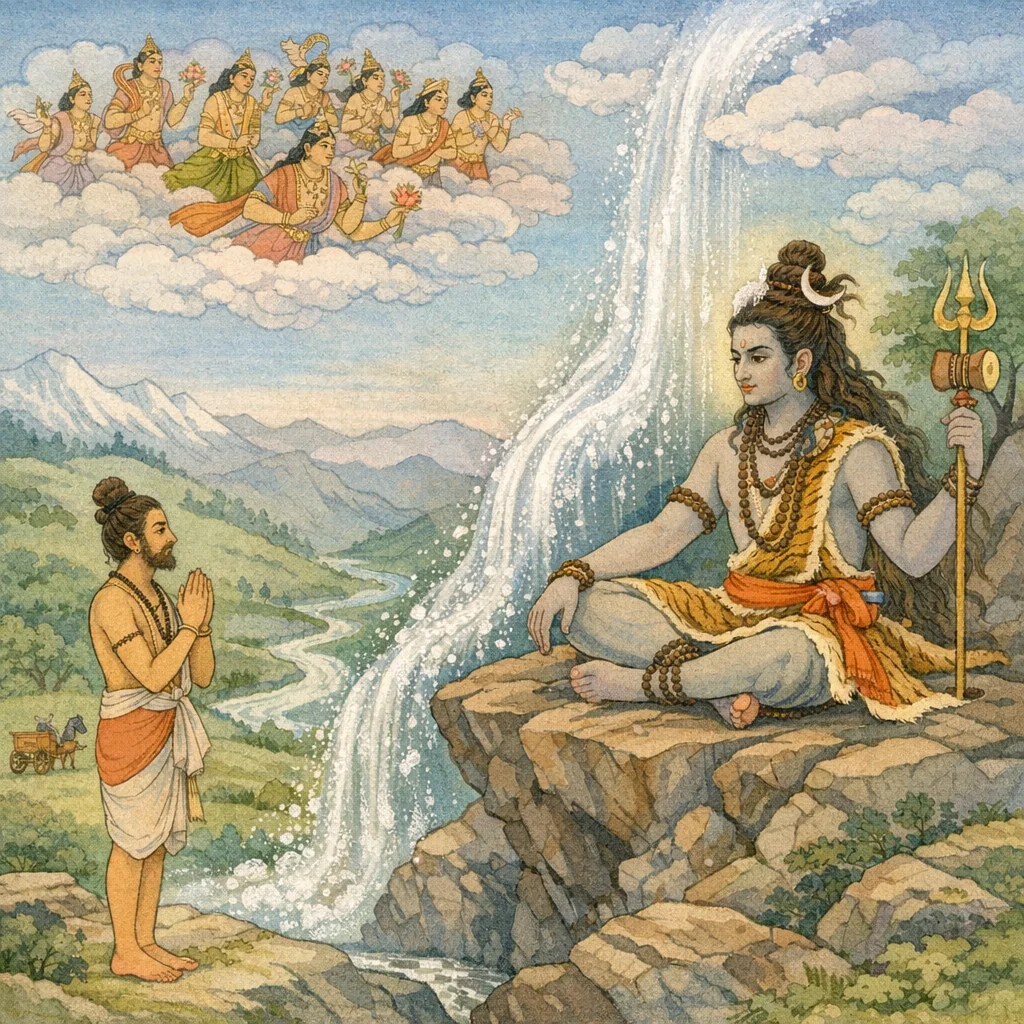
Sarga 43 continues Viśvāmitra’s instruction to Rāma by narrating Bhagiratha’s austerities and the controlled descent of Gaṅgā. After Brahmā departs, Bhagiratha performs severe tapas for a year, standing in a toe-supported posture, seeking Śiva’s mediation for Gaṅgā’s overwhelming force. Śiva, pleased, agrees to bear the mountain-born river upon his head; Gaṅgā, momentarily proud, attempts to seize Śiva and plunge to the netherworld, but is contained within the labyrinth of his matted locks until Bhagiratha renews austerity. Released drop by drop, Gaṅgā becomes Bindusaras and divides into seven streams, three flowing east (Hlādini, Pāvanī, Nalinī) and three west (Sucakṣu, Sītā, Sindhu), while a seventh follows Bhagiratha’s chariot. The descent is witnessed by gods, sages, gandharvas, yakṣas, siddhas, and aquatic beings amid imagery of foams, lightning-like brilliance, and cloudless radiance. Gaṅgā’s course then collides with the sacrifice of sage Jahnu; angered, he drinks her waters, and later releases her from his ears, establishing the epithet Jāhnavī (“daughter of Jahnu”). Finally, Gaṅgā follows Bhagiratha to the ocean and into the nether regions to wash the ashes of Sagara’s sons, granting them purification and ascent to heaven—an explicit linkage of ritual action, sacred water, and soteriological outcome.
Shlokas
Verse 1
देवदेवे गते तस्मिन् सोऽङ्गुष्ठाग्रनिपीडिताम्।कृत्वा वसुमतीं राम संवत्सरमुपासत।।।।
O Rāma, when that God of gods had departed, he (Bhagīratha) undertook austerity for a year, pressing the earth with the tip of his great toe in steadfast meditation.
Verse 2
अथ संवत्सरे पूर्णे सर्वलोकनमस्कृत:।उमापति: पशुपती राजानमिदमब्रवीत्।।।।
When a full year had passed, Paśupati—Umā’s lord, revered by all the worlds—addressed the king (Bhagīratha) with these words.
Verse 3
प्रीतस्तेऽहं नरश्रेष्ठ करिष्यामि तव प्रियम्।शिरसा धारयिष्यामि शैलराजसुतामहम्।।।।
"I am pleased with you, O best of men; I shall do what is dear to you. Upon my head I will bear the daughter of the Mountain-King."
Verse 4
ततो हैमवती ज्येष्ठा सर्वलोकनमस्कृता।तदा सातिमहद्रूपं कृत्वा वेगं च दुस्सहम्।।।।आकाशादपतद्राम शिवे शिवशिरस्युत।
Then Gaṅgā—the eldest daughter of Himavat, revered by all the worlds—assumed an immensely vast form and an irresistible speed, and, O Rāma, fell from the sky onto the auspicious head of Śiva.
Verse 5
अचिन्तयच्च सा देवी गङ्गा परमदुर्धरा।।।।विशाम्यहं हि पातालं स्रोतसा गृह्य शङ्करम्।
That goddess Gaṅgā—hard indeed to restrain—reflected: “Seizing Śaṅkara with the force of my current, I shall plunge into the netherworld.”
Verse 6
तस्यावलेपनं ज्ञात्वा क्रुद्धस्तु भगवान् हर:।।।।तिरोभावयितुं बुद्धिं चक्रे त्रिनयनस्तदा।
Knowing her arrogance, the revered Hara grew wrathful; then the three-eyed Lord resolved to conceal her from view and check her course.
Verse 7
सा तस्मिन् पतिता पुण्या पुण्ये रुद्रस्य मूर्धनि।।।।हिमवत्प्रतिमे राम जटामण्डलगह्वरे।
O Rāma, that sacred Gaṅgā fell there upon Rudra’s holy head—within the cavern-like depths of his matted locks, vast as Himavat.
Verse 8
सा कथञ्चिन्महीं गन्तुं नाशक्नोद्यत्नमास्थिता।।।।नैव निर्गमनं लेभे जटामण्डलमोहिता।
Entangled in the mass of matted locks, she found no outlet; though striving in every way, she could not reach the earth.
Verse 9
तत्रैवाबम्भ्रमद्देवी संवत्सरगणान् बहून्।।।।तामपश्यन्पुनस्तत्र तप: परममास्थित:।
There itself the goddess wandered for many years; and Bhagiratha, not seeing her emerge, once again undertook the highest austerity there.
Verse 10
अनेन तोषितश्चाभूदत्यर्थं रघुनन्दन।।।।विससर्ज ततो गङ्गां हरो बिन्दुसर: प्रति।
O delight of the Raghus, by this austerity Śiva was greatly pleased; then Hara let Gaṅgā flow forth, releasing her toward (the lake called) Bindusaras.
Verse 11
तस्यां विसृज्यमानायां सप्तस्रोतांसि जज्ञिरे।।।।ह्लादिनी पावनी चैव नलिनी च तथाऽपरा।तिस्र: प्राचीं दिशं जग्मु: गङ्गाश्शिवजलाश्शुभा:।।।।
As Gaṅgā was being released, seven streams came into being. Of these, three auspicious currents—Hlādinī, Pāvanī, and Nalinī—flowed eastward, bearing Śiva’s blessed waters.
Verse 12
तस्यां विसृज्यमानायां सप्तस्रोतांसि जज्ञिरे।।1.43.11।। ह्लादिनी पावनी चैव नलिनी च तथाऽपरा।तिस्र: प्राचीं दिशं जग्मु: गङ्गाश्शिवजलाश्शुभा:।।1.43.12।।
As Gaṅgā was being released, seven streams came into being. Of these, three auspicious currents—Hlādinī, Pāvanī, and Nalinī—flowed eastward, bearing Śiva’s blessed waters.
Verse 13
सुचक्षुश्चैव सीता च सिन्धुश्चैव महानदी।तिस्रस्त्वेता दिशं जग्मु: प्रतीचीं तु शुभोदका:।।।।
Suchakṣu, Sītā, and the great river Sindhu—these three, with auspicious waters—flowed on toward the western direction.
Verse 14
सप्तमी चान्वगात्तासां भगीरथमथो नृपम्।भगीरथोऽपि राजर्षिर्दिव्यं स्यन्दनमास्थित:।।।।प्रायादग्रे महातेजा गङ्गा तं चाप्यनुव्रजत्।
The seventh stream among them followed King Bhagīratha. That royal sage, radiant in splendor, mounted a divine chariot and sped ahead—and Gaṅgā followed after him.
Verse 15
गगनाच्छङ्करशिरस्ततो धरणिमाश्रिता।। ।।व्यसर्पत जलं तत्र तीव्रशब्दपुरस्कृतम्।
From the sky it fell upon Śaṅkara’s head, and from there it came to rest upon the earth; the waters surged onward, led as it were by a fierce, resounding roar.
Verse 16
मत्स्यकच्छपसङ्घैश्च शिंशुमारगणैस्तदा।।।।पतद्भि: पतितैश्चान्यैर्व्यरोचत वसुन्धरा।
Then the earth shone, filled with shoals of fish and turtles, with hosts of śiṃśumāras, and with other creatures—some falling, some already fallen—amid that descent.
Verse 17
ततो देवर्षिगन्धर्वा यक्षसिद्धगणास्तदा।।।।व्यलोकयन्त ते तत्र गगनाद्गां गतां तथा।
Then devarṣis and gandharvas, yakṣas and hosts of siddhas, watched there in wonder as Gaṅgā came down from the sky to the earth.
Verse 18
विमानैर्नगराकारैर्हयैर्गजवरैस्तदा।।।।पारिप्लवगतैश्चापि देवतास्तत्र विष्ठिता:।
Then the gods were stationed there—some in aerial cars vast as cities, some upon horses and mighty elephants—restlessly circling in excitement.
Verse 19
तदद्भुततमं लोके गङ्गापतनमुत्तमम्।।।।दिदृक्षवो देवगणा: समीयुरमितौजस:।
To behold that supreme, most wondrous descent of Gaṅgā in the world, hosts of gods—of immeasurable splendor—came together.
Verse 20
सम्पतद्भिस्सुरगणैस्तेषां चाभरणौजसा।।।।शतादित्यमिवाभाति गगनं गततोयदम्।
As throngs of gods arrived swiftly, the cloudless sky blazed with the radiance of their ornaments, as though a hundred suns were shining there.
Verse 21
शिंशुमारोरगगणैर्मीनैरपि च चञ्चलै:।।।।विद्युद्भिरिव विक्षिप्तमाकाशमभवत्तदा।
Then the sky seemed scattered like flashes of lightning—filled, as it were, with restless fish, śiṃśumāras, and multitudes of serpents.
Verse 22
पाण्डरैस्सलिलोत्पीडै: कीर्यमाणैस्सहस्रधा।।।।शारदाभ्रैरिवाकीर्णं गगनं हंससम्प्लवै:।
Scattered in countless ways by the white upsurges of water-foam, the scene looked as though the sky itself were filled with autumn clouds and drifting flocks of swans.
Verse 23
क्वचिद्द्रुततरं याति कुटिलं क्वचिदायतम्।।।।विनतं क्वचिदुद्धूतं क्वचिद्याति शनैश्शनै:।
In places it surged very fast; elsewhere it ran in winding curves; in some stretches it spread broad, in others it dipped low or rose high, and at times it flowed gently, slow and slow.
Verse 24
सलिलेनैव सलिलं क्वचिदभ्याहतं पुन:।।।।मुहुरूर्ध्वमुखं गत्वा पपात वसुधातलम्।
In some places water struck against water itself; again and again the waves leapt upward, only to fall back upon the face of the earth.
Verse 25
तच्छङ्करशिरोभ्रष्टं भ्रष्टं भूमितले पुन:।।।।व्यरोचत तदा तोयं निर्मलं गतकल्मषम्।
Then those waters—having fallen upon Śaṅkara’s head and then fallen again onto the earth—shone forth, perfectly clear, their defilement removed.
Verse 26
तत्र देवर्षिगन्धर्वा वसुधातलवासिन:।।।।भवाङ्गपतितं तोयं पवित्रमिति पस्पृशु:।
There, gods, seers, Gandharvas, and dwellers upon the earth touched the water that had fallen from Bhava’s body, holding it to be sacred.
Verse 27
शापात्प्रपतिता ये च गगनाद्वसुधातलम्।।।।कृत्वा तत्राभिषेकं ते बभूवुर्गतकल्मषा:।
And those who had fallen from heaven to the earth because of a curse—after bathing there—became freed from their taint.
Verse 28
धूतपापा: पुनस्तेन तोयेनाथ सुभास्वता।।।।पुनराकाशमाविश्य स्वान् लोकान् प्रतिपेदिरे।
Their sins washed away by that brilliantly shining water, they entered the sky once more and regained their own worlds.
Verse 29
मुमुदे मुदितो लोकस्तेन तोयेन भास्वता।।।।कृताभिषेको गङ्गायां बभूव विगतक्लम:।
People rejoiced at those shining waters; and, having bathed in Gaṅgā, they became free from fatigue.
Verse 30
भगीरथोऽपि राजार्षिर्दिव्यं स्यन्दनमास्थित:।प्रायादग्रे महातेजास्तं गङ्गा पृष्ठतोऽन्वगात्।।।
Then the royal sage Bhagīratha, radiant with great splendor, mounted a divine chariot and went on ahead; and Gaṅgā followed him from behind.
Verse 31
देवास्सर्षिगणा: सर्वे दैत्यदानवराक्षसा:।।।।गन्धर्वयक्षप्रवरास्सकिन्नरमहोरगा:।सर्वाश्चाप्सरसो राम भगीरथरथानुगाम्।।।।गङ्गामन्वगमन् प्रीतास्सर्वे जलचराश्च ये।
O Rāma, the gods along with hosts of seers—together with Daityas, Dānavas, and Rākṣasas—also the foremost Gandharvas and Yakṣas, Kinnaras and great serpents, and all the Apsarases, joyfully followed Gaṅgā as she moved behind King Bhagīratha’s chariot; and so too did all the creatures of the waters.
Verse 32
देवास्सर्षिगणा: सर्वे दैत्यदानवराक्षसा:।।1.43.31।।गन्धर्वयक्षप्रवरास्सकिन्नरमहोरगा:। सर्वाश्चाप्सरसो राम भगीरथरथानुगाम्।।1.43.32।।गङ्गामन्वगमन् प्रीतास्सर्वे जलचराश्च ये।
O Rāma, all these—gods and seers, Daityas, Dānavas, and Rākṣasas, the foremost Gandharvas and Yakṣas, Kinnaras and mighty serpents, and all the Apsarases—gladly followed Gaṅgā as she went after Bhagīratha’s chariot, along with every aquatic being as well.
Verse 33
यतो भगीरथो राजा ततो गङ्गायशस्विनी।।।।जगाम सरितां श्रेष्ठा सर्वपापप्रणाशिनी।
Wherever King Bhagīratha went, in that very direction went the renowned Gaṅgā—foremost among rivers, the destroyer of all sins.
Verse 34
ततो हि यजमानस्य जह्नोरद्भुतकर्मण:।।।।गङ्गा सम्प्लावयामास यज्ञवाटं महात्मन:।
Then Gaṅgā flooded the sacrificial enclosure of the great-souled sage Jahnu, famed for wondrous deeds, even as he was officiating his sacrifice.
Verse 35
तस्यावलेपनं ज्ञात्वा क्रुद्धो यज्वा तु राघव।।।।अपिबच्च जलं सर्वं गङ्गाया: परमाद्भुतम्।
O Rāghava, perceiving her arrogance, the sacrificer (Jahnu) became enraged and—most astonishingly—drank up all the waters of Gaṅgā.
Verse 36
ततो देवास्सगन्धर्वा ऋषयश्च सुविस्मिता:।।।।पूजयन्ति महात्मानं जह्नुं पुरुषसत्तमम्।गङ्गां चापि नयन्ति स्म दुहितृत्वे महात्मन:।।।।
Thereupon the gods, together with Gandharvas, and the sages—greatly astonished—honoured the noble Jahnu, best among men; and they urged that Gaṅgā be accepted in the status of his daughter.
Verse 37
ततो देवास्सगन्धर्वा ऋषयश्च सुविस्मिता:।।1.43.36।।पूजयन्ति महात्मानं जह्नुं पुरुषसत्तमम्।गङ्गां चापि नयन्ति स्म दुहितृत्वे महात्मन:।।1.43.37।।
Then the gods with the Gandharvas, and the sages, astonished, honoured the great-souled Jahnu, best of men, and petitioned that Gaṅgā be acknowledged as his daughter.
Verse 38
ततस्तुष्टो महातेजाश्श्रोत्राभ्यामसृजत् पुन:।।।।तस्माज्जह्नुसुता गङ्गा प्रोच्यते जाह्नवीतिच।
Pleased, the radiant Jahnu released her again from his two ears; therefore Gaṅgā is spoken of as ‘Jahnu’s daughter’, and also as ‘Jāhnavī’.
Verse 39
जगाम च पुनर्गङ्गा भगीरथरथानुगा।सागरं चापि सम्प्राप्ता सा सरित्प्रवरा तदा।।।।रसातलमुपागच्छत्सिद्ध्यर्थं तस्य कर्मण:।
Gaṅgā once again proceeded, following Bhagīratha’s chariot. Reaching the ocean, that foremost of rivers then entered Rasātala, to bring his undertaking to completion.
Verse 40
भगीरथोऽपि राजर्षि: गङ्गामादाय यत्नत:।पितामहान् भस्मकृतानपश्यद्दीनचेतन:।।।।
Bhagīratha too—though a royal sage—having brought the Gaṅgā with utmost effort, beheld his forefathers lying reduced to ashes, his heart weighed down with grief.
Verse 41
अथ तद्भस्मनां राशिं गङ्गासलिलमुत्तमम्।प्लावयद्धूतपाप्मानस्स्वर्गं प्राप्ता रघूत्तम।।।।
Then, O best of the Raghus, the excellent waters of the Gaṅgā flooded those heaps of ash; cleansed of their sins, they attained heaven.
Frequently Asked Questions
The pivotal action is Bhagiratha’s sustained tapas to channel a beneficent yet potentially destructive force (Gaṅgā). The ethical tension centers on power without restraint: Gaṅgā’s pride is checked by Śiva’s containment, emphasizing that even sacred potency must be governed by humility and right mediation.
The sarga teaches that purification and liberation arise from disciplined intention (tapas) aligned with cosmic order; grace is not arbitrary but is “routed” through dharmic means—vows, mediation, and respect for ritual boundaries (as shown by Jahnu’s yajña and Gaṅgā’s regulated flow).
Key landmarks include Bindusaras (formed as Gaṅgā is released drop by drop), the bifurcation into seven named streams with east/west flows, Jahnu’s sacrificial ground (yajñavāṭa) where Gaṅgā is halted and renamed Jāhnavī, and the river’s culmination at the ocean and Rasātala to redeem Sagara’s sons.