Sarga 40
सगरपुत्राणां रसातलगमनम् — The Descent of Sagara’s Sons and the Wrath of Kapila
बालकाण्ड
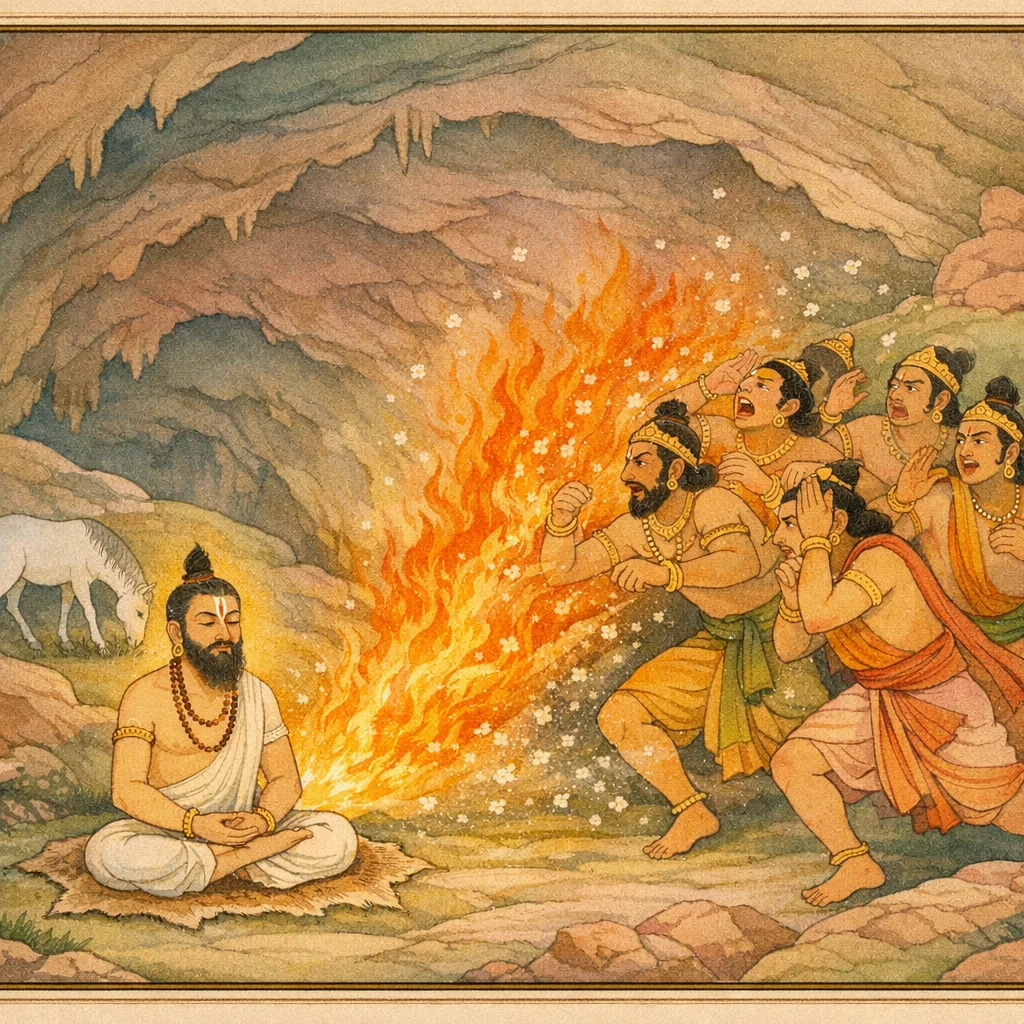
This sarga interweaves divine counsel with a dynastic quest narrative. The frightened devas appeal to Brahmā, who explains a predestined sequence: the earth’s rending and the impending destruction of Sagara’s sons, since the earth is upheld by Vāsudeva assuming Kapila-form; their offense will meet Kapila’s wrath. Brahmā instructs that the horse-thief must be traced by renewed excavation. Sagara’s sixty thousand sons descend toward Rasātala, encountering the four diggajas—Virūpākṣa (east), Mahāpadma (south), Saumanasa (west), and Bhadra (north)—each described as mountain-like and bearing the earth; earthquakes are explained as the head-movement of such a bearer-elephant on sacred days. After honoring each guardian, they dig toward the northeast and find Kapila (identified with eternal Vāsudeva) and the sacrificial horse grazing nearby. Mistaking Kapila for the thief, they rush with tools and weapons, accuse him, and provoke his anger; Kapila’s utterance reduces them to ashes, closing the chapter with a stark lesson on misrecognition, sacrificial urgency, and the peril of adharma toward a realized being.
Shlokas
Verse 1
.देवतानां वचश्श्रुत्वा भगवान्वै पितामह:।प्रत्युवाच सुसन्त्रस्तान्कृतान्तबलमोहितान्।।।।
Hearing the words of the gods—terrified and bewildered by the overpowering force of destiny—the Blessed Grandsire (Brahmā) replied to them.
Verse 2
यस्येयं वसुधा कृत्स्ना वासुदेवस्य धीमत:।कापिलं रूपमास्थाय धारयत्यनिशं धराम्।।।।तस्य कोपाग्निना दग्धा भविष्यन्ति नृपात्मजा:।
This entire earth belongs to the wise Vāsudeva; assuming the form of Kapila, he continually supports the earth. By the fire of his wrath, the king’s sons will be burned.
Verse 3
पृथिव्याश्चापि निर्भेदोऽदृष्ट एव सनातन:।।।।सगरस्य च पुत्राणां विनाशोऽदीर्घजीविनाम्।
Even the rending of the earth was ordained by fate from ancient time—and so too the destruction of Sagara’s sons, those not destined for long life.
Verse 4
पितामहवचश्श्रुत्वा त्रयस्त्रिंशदरिन्दम।।।।देवा: परमसंहृष्टा: पुनर्जग्मुर्यथागतम्।
O subduer of enemies, having heard the words of the Grandsire (Brahmā), the gods—thirty-three in number—were greatly delighted and returned by the same way they had come.
Verse 5
सगरस्य च पुत्राणां प्रादुरासीन्महात्मनाम्।।।।पृथिव्यां भिद्यमानायां निर्घातसमनिस्वन:।
As the earth was being split open by Sagara’s noble sons, there arose a sound like the crash of thunder.
Verse 6
ततो भित्वा महीं सर्वे कृत्वा चाभिप्रदक्षिणम्।।।।सहिता स्सगरास्सर्वे पितरं वाक्यमब्रुवन्।0
Then, after rending the earth and making a reverential circumambulation, all the sons of Sagara together addressed their father with these words.
Verse 7
परिक्रान्ता मही सर्वा सत्त्ववन्तश्च सूदिता:।।।।देवदानवरक्षांसि पिशाचोरगकिन्नरा:।न च पश्यामहेऽश्वं तमश्वहर्तारमेव च।।।।किं करिष्याम भद्रं ते बुद्धिरत्र विचार्यताम्।
“We have scoured the whole earth, and many mighty beings—devas, dānavas, rākṣasas, piśācas, nāgas, and kinnaras—have been slain. Yet we do not see that horse, nor the one who stole it. What should we do now? Prosperity to you—let your judgment decide this matter.”
Verse 8
परिक्रान्ता मही सर्वा सत्त्ववन्तश्च सूदिता:।।1.40.7।।देवदानवरक्षांसि पिशाचोरगकिन्नरा:।न च पश्यामहेऽश्वं तमश्वहर्तारमेव च।।1.40.8।।किं करिष्याम भद्रं ते बुद्धिरत्र विचार्यताम्।
This entry repeats the sons’ report: they have ravaged the earth and slain many beings, yet have found neither the horse nor its thief, and they request Sagara’s considered decision.
Verse 9
तेषां तद्वचनं श्रुत्वा पुत्राणां राजसत्तम:।।।।समन्युरब्रवीद्वाक्यं सगरो रघुनन्दन।
O Rāma, hearing those words of his sons, King Sagara—foremost among kings—replied, his anger aroused.
Verse 10
भूय: खनत भद्रं वो निर्भिद्य वसुधातलम्।।।।अश्वहर्तारमासाद्य कृतार्थाश्च निवर्तथ।
“Dig again—may it be well with you—cleaving the earth’s surface; having found the horse-stealer, return when your purpose is fulfilled.”
Verse 11
पितुर्वचनमासाद्य सगरस्य महात्मन:।।।।षष्टि: पुत्रसहस्राणि रसातलमभिद्रवन्।
Receiving their father Sagara’s command, his sixty thousand sons rushed toward Rasātala, the nether regions.
Verse 12
खन्यमाने ततस्तस्मिन् ददृशु: पर्वतोपमम्।।।।दिशागजं विरूपाक्षं धारयन्तं महीतलम्।
As they excavated that region further, they beheld Virūpākṣa, the quarter-elephant, mountain-like in size, supporting the earth.
Verse 13
सपर्वतवनां कृत्स्नां पृथिवीं रघुनन्दन।।।।शिरसा धारयामास विरूपाक्षो महागज:।
O Raghunandana, the mighty elephant Virūpākṣa bore upon his head the entire earth, with its mountains and forests.
Verse 14
यदा पर्वणि काकुत्स्थ विश्रमार्थं महागज:।।।।खेदाच्चालयते शीर्षं भूमिकम्पस्तदाभवेत्।
O Rāma of the Kakutstha line, when that mighty elephant, on certain sacred days, shakes its head from weariness in order to rest, then an earthquake occurs.
Verse 15
तं ते प्रदक्षिणं कृत्वा दिशापालं महागजम्।।।।मानयन्तो हि ते राम जग्मुर्भित्त्वा रसातलम्।
O Rāma, honoring that mighty elephant—the guardian of the quarter—they circumambulated him, and then, rending the earth, they went down to Rasātala.
Verse 16
तत: पूर्वां दिशं भित्त्वा दक्षिणां बिभिदु: पुन:।।।।दक्षिणस्यामपि दिशि ददृशुस्ते महागजम्।महापद्मं महात्मानं सुमहत्पर्वतोपमम्।।।।शिरसा धारयन्तं ते विस्मयं जग्मुरुत्तमम्।
Then, after breaking through the eastern region, they again broke through into the southern quarter as well. There they beheld the mighty elephant Mahāpadma, a great-souled one, huge like a mountain—bearing the earth upon his head—at which they were struck with the highest astonishment.
Verse 17
तत: पूर्वां दिशं भित्त्वा दक्षिणां बिभिदु: पुन:।।1.40.16।।दक्षिणस्यामपि दिशि ददृशुस्ते महागजम्।महापद्मं महात्मानं सुमहत्पर्वतोपमम्।।1.40.17।।शिरसा धारयन्तं ते विस्मयं जग्मुरुत्तमम्।
Then, after breaking through the eastern region, they again broke through into the southern quarter as well. There they beheld the mighty elephant Mahāpadma, a great-souled one, huge like a mountain—bearing the earth upon his head—at which they were struck with the highest astonishment.
Verse 18
तत: प्रदक्षिणं कृत्वा सगरस्य महात्मन:।।।।षष्टि: पुत्रसहस्राणि पश्चिमां बिभिदुर्दिशम्।
Thereafter, the sixty thousand sons of the great-souled Sagara, having performed circumambulation (in reverence), broke through into the western region.
Verse 19
पश्चिमायामपि दिशि महान्तमचलोपमम्।।।।दिशागजं सौमनसं ददृशुस्ते महाबला:।
And in the western quarter too, those mighty ones beheld the directional elephant Saumanasa—vast and mountain-like.
Verse 20
तं ते प्रदक्षिणं कृत्वा पृष्ट्वा चापि निरामयम्।खनन्त स्समुपक्रान्ता दिशं हैमवतीं तत:।।।।
Having circumambulated him and also inquired after his well-being, they then proceeded—still digging—toward the northern (Himālaya-facing) quarter.
Verse 21
उत्तरस्यां रघुश्रेष्ठ ददृशुर्हिमपाण्डुरम्।।।।भद्रं भद्रेण वपुषा धारयन्तं महीमिमाम्।
O best of the Raghus, in the northern quarter they saw the elephant Bhadra, white as snow, bearing this earth with his auspicious form.
Verse 22
समालभ्य तत स्सर्वे कृत्वा चैनं प्रदक्षिणम्।।।।षष्टि: पुत्रसहस्राणि बिभिदुर्वसुधातलम्।
Then all of them—those sixty thousand sons—having touched him and having circumambulated him, broke through the surface of the earth and pressed onward.
Verse 23
तत: प्रागुत्तरां गत्वा सागरा: प्रथितां दिशम्।।।।रोषादभ्यखनन् सर्वे पृथिवीं सगरात्मजा:।
Then, having gone to the famed north‑eastern quarter, all the sons of Sagara began to dig into the earth, driven by wrath.
Verse 24
ते तु सर्वे महात्मानो भीमवेगा महाबला:।।।।ददृशु: कपिलं तत्र वासुदेवं सनातनम्।हयं च तस्य देवस्य चरन्तमविदूरत:।।।।प्रहर्षमतुलं प्राप्तास्सर्वे ते रघुनन्दन।
But all those great-souled sons of Sagara—terribly swift and immensely strong—beheld there Kapila, the eternal Vāsudeva; and nearby they saw that god’s horse grazing. O Raghunandana, all of them were filled with unparalleled delight.
Verse 25
ते तु सर्वे महात्मानो भीमवेगा महाबला:।।1.40.24।।ददृशु: कपिलं तत्र वासुदेवं सनातनम्।हयं च तस्य देवस्य चरन्तमविदूरत:।।1.40.25।।प्रहर्षमतुलं प्राप्तास्सर्वे ते रघुनन्दन।
All those great-souled, swift, and mighty sons of Sagara saw Kapila there—the eternal Vāsudeva—and close by, the horse of that divine being grazing; and they all felt incomparable joy, O Raghunandana.
Verse 26
ते तं हयवरं ज्ञात्वा क्रोधपर्याकुलेक्षणा:।।।।खनित्रलाङ्गलधरा नानावृक्षशिलाधरा:।अभ्यधावन्त सङ्क्रुद्धास्तिष्ठ तिष्ठेति चाब्रुवन्।।।।
Recognizing that excellent horse, their eyes troubled by anger, they—bearing spades and ploughshares, and carrying various trees and stones—rushed forward in fury, shouting, “Stop! Stop!”
Verse 27
ते तं हयवरं ज्ञात्वा क्रोधपर्याकुलेक्षणा:।।1.40.26।।खनित्रलाङ्गलधरा नानावृक्षशिलाधरा:।अभ्यधावन्त सङ्क्रुद्धास्तिष्ठ तिष्ठेति चाब्रुवन्।।1.40.27।।
Having recognized the best of horses, with anger-disturbed eyes, they rushed forward in fury—bearing spades and ploughshares and carrying trees and stones—crying, “Stop! Stop!”
Verse 28
अस्माकं त्वं हि तुरगं यज्ञीयं हृतवानसि।दुर्मेधस्त्वं हि सम्प्राप्तान् विद्धि नस्सगरात्मजान् ।।।।
“You have stolen our sacrificial horse. O evil-minded one, know that we who have arrived here are the sons of Sagara.”
Verse 29
श्रुत्वा तु वचनं तेषां कपिलो रघुनन्दन।रोषेण महताऽऽविष्टो हुङ्कारमकरोत्तदा।।।।
Hearing their words, Kapila—O Raghunandana—overwhelmed by great wrath, then uttered a fierce ‘huṃ’ sound.
Verse 30
ततस्तेनाप्रमेयेन कपिलेन महात्मना।भस्मराशीकृतास्सर्वे काकुत्स्थ सगरात्मजा:।।।।
Thereafter, O Kakutstha, all the sons of Sagara were reduced to heaps of ash by that great-souled Kapila, whose power was beyond measure.
Frequently Asked Questions
The pivotal action is the sons of Sagara accusing Kapila of stealing the sacrificial horse and rushing to attack without verification; the dilemma centers on whether ritual urgency justifies suspicion and violence, especially toward an ascetic figure.
The sarga teaches that adharma rooted in anger and misrecognition can destroy even powerful agents; true discernment (viveka) and reverence toward realized beings are integral to sustaining both ritual purpose and moral order.
Rasātala and the northeast digging route are emphasized, along with the cosmological ‘landmarks’ of the four diggajas (Virūpākṣa, Mahāpadma, Saumanasa, Bhadra) and the etiological explanation of earthquakes linked to their movement on sacred days.