Sarga 37
कुमारसम्भवः—गङ्गायां तेजोनिक्षेपः (The Birth of Kumāra/Skanda and the Deposition of Śiva’s Energy through Gaṅgā)
बालकाण्ड
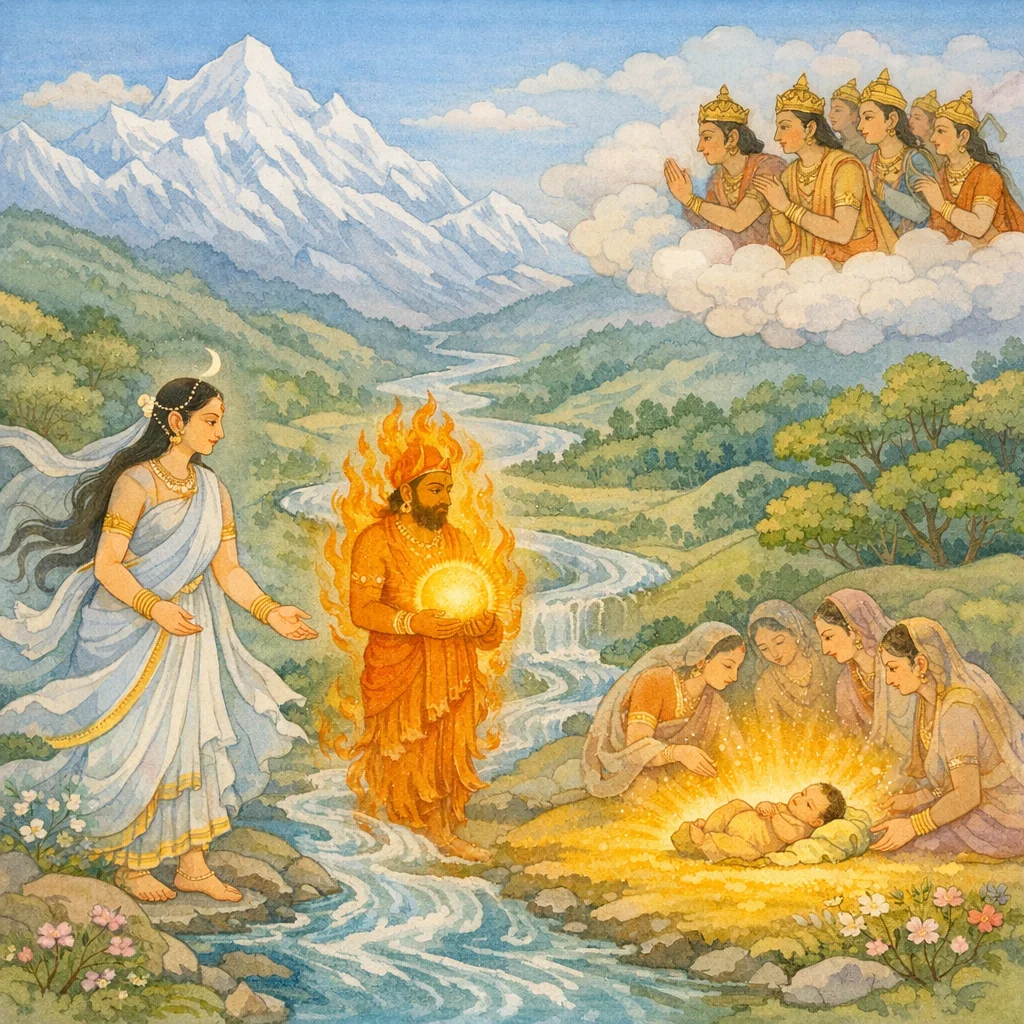
This sarga presents Viśvāmitra’s explanatory myth-history to Rāma: the gods, unable to obtain progeny through their wives due to Umā’s infallible pronouncement, petition Brahmā for a new commander (senāpati). Brahmā prescribes a lawful alternative: Agni will convey Śiva/Īśvara’s tejas and generate a son through the celestial Gaṅgā, with the arrangement being acceptable to Umā. The gods proceed to mineral-adorned Kailāsa and commission Agni to release the divine potency into Gaṅgā. Gaṅgā assumes a divine form yet cannot bear the ever-increasing fiery energy; upon Agni’s instruction she deposits the embryo on Himavat’s slopes and releases it through her streams. The contact with earth yields “jātarūpa” (gold) and other metals/minerals, mythically accounting for the mountain’s golden forest. Kumāra is then born; the Kṛttikās are appointed as nurses, leading to the names Kārttikeya and Skanda (from “skanna,” descended/flowed). Even with a tender body he displays innate prowess by overcoming hosts of demons, and the gods formally install him as commander of their forces. The sarga closes with a devotional assurance: reverence to Kārttikeya grants longevity, progeny, and attainment of Skanda’s world.
Shlokas
Verse 1
तप्यमाने तपो देवे देवा: सर्षिगणा: पुरा।सेनापतिमभीप्सन्त: पितामहमुपागमन्।।1.37.1।।
In ancient times, when the Lord (Īśvara) was engaged in austerities, the gods—together with the hosts of ṛṣis—approached Pitāmaha (Brahmā), desiring a commander of the divine army.
Verse 2
ततोऽब्रुवन् सुरास्सर्वे भगवन्तं पितामहम्।प्रणिपत्य सुरास्सर्वे सेन्द्रास्साग्निपुरोगमा:।।1.37.2।।
Then all the gods—Indra among them, with Agni at their forefront—bowed to the revered Grandfather (Brahmā) and spoke to him.
Verse 3
यो न स्सेनापतिर्देव दत्तो भगवता पुरा।तप: परममास्थाय तप्यते स्म सहोमया।।1.37.3।।
“O Lord, the commander you once granted us in ancient times—having undertaken the highest austerity—now performs penance together with Umā.”
Verse 4
यदत्रानन्तरं कार्यं लोकानां हितकाम्यया।संविधत्स्व विधानज्ञ त्वं हि न: परमा गति:।।1.37.4।।
“Therefore, O knower of right ordinance, prescribe what should be done next, seeking the welfare of the worlds—for you are truly our highest refuge.”
Verse 5
देवतानां वचश्श्रुत्वा सर्वलोकपितामह:।सान्त्वयन्मधुरैर्वाक्यैस्त्रिदशानिदमब्रवीत्।।1.37.5।।
Hearing the gods’ words, Brahmā—the Grandsire of all the worlds—comforted the Thirty (gods) with gentle speech and spoke as follows.
Verse 6
शैल पुत्र्या यदुक्तं तन्न प्रजास्यथ पत्निषु ।तस्या वचनमक्लिष्टं सत्यमेतन्न संशय:।।1.37.6।।
Whatever the Mountain’s daughter (Umā) has declared stands firm: among your wives you shall not beget offspring. Her utterance is unfailing—this is the truth, with no doubt.
Verse 7
इयमाकाशगा गङ्गा यस्यां पुत्रं हुताशन:।जनयिष्यति देवानां सेनापतिमरिन्दमम्।।1.37.7।।
This is Gaṅgā who moves through the heavens; in her the Fire-god will beget a son—an enemy-subduer—who shall become the commander of the gods’ hosts.
Verse 8
ज्येष्ठा शैलेन्द्रदुहिता मानयिष्यति तत्सुतम्।उमायास्तद्बहुमतं भविष्यति न संशय:।।1.37.8।।
Gaṅgā, the eldest daughter of the Lord of Mountains, will honour and foster that son; and this arrangement will be fully agreeable to Umā—there is no doubt.
Verse 9
तच्छ्रुत्वा वचनं तस्य कृतार्था रघुनन्दन।प्रणिपत्य सुरास्सर्वे पितामहमपूजयन्।।1.37.9।।
O Rāma, delight of the Raghus—hearing his words, all the gods felt their purpose fulfilled; bowing down, they worshipped Pitāmaha (Brahmā).
Verse 10
ते गत्वा पर्वतं राम कैलासं धातुमण्डितम्।अग्निं नियोजयामासु: पुत्रार्थं सर्वदेवता:।।1.37.10।।
O Rāma, all the gods went to Mount Kailāsa, adorned with minerals, and commissioned Agni (the Fire-god) for the purpose of begetting a son.
Verse 11
देवकार्यमिदं देव संविधत्स्व हुताशन।शैलपुत्र्यां महातेजो गङ्गायां तेज उत्सृज।।1.37.11।।
“O god, O Hutāśana (Agni), accomplish this divine task: O mighty one, release Śiva’s potent energy into Gaṅgā, the daughter of the Mountain.”
Verse 12
देवतानां प्रतिज्ञाय गङ्गामभ्येत्य पावक:।गर्भं धारय वै देवि देवतानामिदं प्रियम्।।1.37.12।।
Having pledged (his assent) to the gods, Pāvaka (Agni) approached Gaṅgā and said: “O Goddess, indeed bear this embryo—this is what is dear to the gods.”
Verse 13
तस्य तद्वचनं श्रुत्वा दिव्यं रूपमधारयत्।दृष्ट्वा तन्महिमानं स समन्तादवकीर्यत।।1.37.13।।
Hearing his words, she assumed a divine form. Beholding her majesty, that Fire-god spread himself around her on every side.
Verse 14
समन्ततस्तदा देवीमभ्यषिञ्चत पावक:।सर्वस्रोतांसि पूर्णानि गङ्गाया रघुनन्दन।।1.37.14।।
Then Pāvaka (Agni) drenched the Goddess on every side; O Raghunandana, all the streams of Gaṅgā became filled (with that potency).
Verse 15
तमुवाच ततो गङ्गा सर्वदेवपुरोहितम्।अशक्ता धारणे देव तव तेज स्समुद्धतम्।दह्यमानाग्निना तेन सम्प्रव्यथितचेतना।।1.37.15।।
Then Gaṅgā spoke to him—Agni, who stood as the foremost ministering priest of all the gods: “O god, I am unable to bear your surging energy. Burned by that fire, my mind and awareness are greatly afflicted.”
Verse 16
अथाब्रवीदिदं गङ्गां सर्वदेवहुताशन:।इह हैमवती पादे गर्भोऽयं सन्निवेश्यताम्।।1.37.16।।
Then the Fire-god, the receiver of offerings for all the gods, said to Gaṅgā: “Let this embryo be placed here, upon the slopes of Himavat.”
Verse 17
श्रुत्वा त्वग्निवचो गङगा तं गर्भमतिभास्वरम्।उत्ससर्ज महातेज स्स्रोतोभ्यो हि तदानघ ।।1.37.17।।
O mighty and sinless Rāma, having heard the words of Agni, Gaṅgā then released that exceedingly radiant embryo, letting it pass forth through her streams.
Verse 18
यदस्या निर्गतं तस्मात्तप्तजाम्बूनदप्रभम् ।काञ्चनं धरणीं प्राप्तं हिरण्यममलं शुभम्।।1.37.18।।
That which emerged from her, gleaming like molten Jāmbūnada-gold, reached the earth; and from it arose pure, auspicious gold—bright and radiant.
Verse 19
ताम्रं कार्ष्णायसं चैव तैक्ष्ण्यादेवाभ्यजायत।।1.37.19।।मलं तस्याभवत्तत्र त्रपु सीसकमेव च।तदेतद्धरणीं प्राप्य नानाधातुरवर्धत।।1.37.20।।
From its sharp potency there arose copper, and iron as well.
Verse 20
ताम्रं कार्ष्णायसं चैव तैक्ष्ण्यादेवाभ्यजायत।।1.37.19।।मलं तस्याभवत्तत्र त्रपु सीसकमेव च।तदेतद्धरणीं प्राप्य नानाधातुरवर्धत।।1.37.20।।
There, its residue became tin and lead; and when that substance reached the earth, many kinds of minerals increased and spread.
Verse 21
निक्षिप्तमात्रे गर्भे तु तेजोभिरभिरञ्जितम्।सर्वं पर्वतसन्नद्धं सौवर्णमभवद्वनम्।।1.37.21।।
As soon as the embryo was set down, suffused with its radiance, the entire forest-clad mountain became golden in appearance.
Verse 22
जातरूपमिति ख्यातं तदा प्रभृति राघव।सुवर्णं पुरुषव्याघ्र हुताशनसमप्रभम्।।1.37.22।।तृणवृक्षलतागुल्मं सर्वं भवति काञ्चनम्।
From that time onward, O Rāghava—O tiger among men—gold, shining like fire, became famed as ‘Jātarūpa’. In that region, grasses, trees, creepers, and shrubs all appeared golden.
Verse 23
तं कुमारं ततो जातं सेन्द्रास्सह मरुद्गणा:।।1.37.23।।क्षीरसंभावनार्थाय कृत्तिकास्समयोजन्।
Then, when that child Kumāra was born, the gods—together with Indra and the hosts of Maruts—appointed the Kṛttikās to nurse him with their milk.
Verse 24
ता: क्षीरं जातमात्रस्य कृत्वा समयमुत्तमम्।।1.37.24।।ददु: पुत्रोऽयमस्माकं सर्वासामिति निश्चिता:।
Those Kṛttikās, having made a noble agreement—resolved that ‘this child is the son of us all’—gave their milk to the newborn.
Verse 25
ततस्तु देवता स्सर्वा: कार्तिकेय इति ब्रुवन्।।1.37.25।।पुत्रस्त्रैलोक्यविख्यातो भविष्यति न संशय:।4
Thereafter all the gods declared, ‘He shall be called Kārtikeya’; and this son will become renowned across the three worlds—of this there is no doubt.
Verse 26
तेषां तद्वचनं श्रुत्वा स्कन्नं गर्भपरिस्रवे।।1.37.26।।स्नापयन् परया लक्ष्म्या दीप्यमानं यथानलम्।
Hearing the gods’ words, the Kṛttikās bathed the child who had descended as the embryo flowed forth—blazing like fire and radiant with surpassing beauty.
Verse 27
स्कन्द इत्यब्रुवन् देवा: स्कन्नं गर्भपरिस्रवात्।।1.37.27।।कार्तिकेयं महाभागं काकुत्स्थ ज्वलनोपमम्।
‘Skanda’—so the gods called him, since he had descended as the embryo flowed forth. O Kakutstha, that most fortunate Kārttikeya was like a blazing fire in splendour.
Verse 28
प्रादुर्भूतं तत: क्षीरं कृत्तिकानामनुत्तमम् ।।1.37.28।।षण्णां षडाननो भूत्वा जग्राह स्तनजं पय:।
Then the finest milk arose in the Kṛttikās; becoming six-faced, he drew the milk that flowed from the breasts of all six.
Verse 29
गृहीत्वा क्षीरमेकाह्ना सुकुमारवपुस्तदा।।1.37.29।।अजयत्स्वेन वीर्येण दैत्यसेनागणान् विभु:।
Having taken milk for only a single day, though still tender-bodied, the mighty child defeated hosts of demon armies by his innate prowess.
Verse 30
सुरसेनागणपतिं ततस्तमतुलद्युतिम्।।1.37.30।।अभ्यषिञ्चन् सुरगणा स्समेत्याग्निपुरोगमा:।
Then the assembled gods, with Agni at their head, consecrated him—of incomparable radiance—as commander of the divine hosts.
Verse 31
एष ते राम गङ्गाया विस्तरोऽभिहितो मया।।1.37.31।।कुमारसम्भवश्चैव धन्य: पुण्यस्तथैव च।
“O Rāma, I have thus told you in detail this account of Gaṅgā—and also the birth of Kumāra—an auspicious and meritorious tale.”
Verse 32
भक्तश्च य: कार्तिकेये काकुत्स्थ भुवि मानवः।आयुष्मान् पुत्रपौत्रैश्च स्कन्दसालोक्यतां व्रजेत्।।1.37.32।।
“O Kakutstha, any man on this earth who is devoted to Kārttikeya gains long life and the blessing of sons and grandsons; and after death he attains fellowship in Skanda’s world.”
Frequently Asked Questions
The gods face a constraint created by Umā’s truthful pronouncement—no progeny through their wives—yet still need a senāpati for cosmic order; the sarga resolves this dharma-sankat by Brahmā’s lawful prescription: delegated generation through Gaṅgā via Agni, avoiding transgression while fulfilling public welfare.
Power (tejas) must be mediated through appropriate vessels and procedures: even divine potency requires right placement, consent, and cosmic compatibility; thus, dharma is portrayed as ordered process (vidhāna) rather than mere goal-achievement.
Kailāsa (as the divine-ascetic axis), Himavat’s slopes (as the terrestrial receptacle of tejas), and the celestial Gaṅgā (ākāśagā) are central; culturally, the Kṛttikā nursing motif explains Kārttikeya’s epithet and embeds a star-linked devotional memory within epic geography.