Sarga 36
बालकाण्ड सर्ग ३६ — गङ्गा-प्रभवप्रश्नः, शिवतेजोधारणं, कार्त्तिकेय-जन्म, उमाशापः
बालकाण्ड
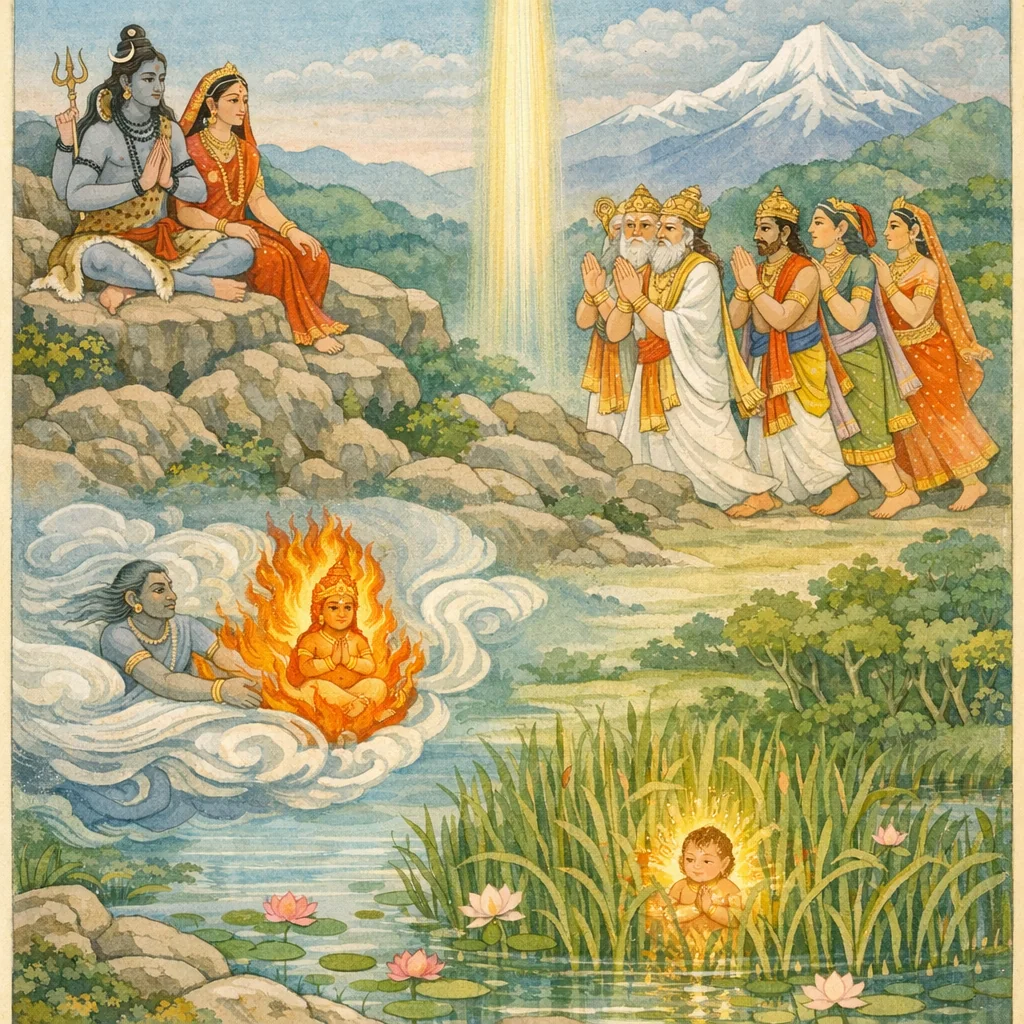
Sarga 36 is structured as a dialogue frame in which Rāma and Lakṣmaṇa, having heard Viśvāmitra’s account, praise it and request a more detailed explanation: why Gaṅgā is famed as Tripathagā (flowing across three realms) and what deeds established her sanctity. Viśvāmitra answers with an etiological narrative centered on Śiva and Umā. After their union endures for a hundred divine years without offspring, the devas—led by Brahmā—fear that the potency of any child born from Śiva’s tejas would be unbearable to the worlds. They petition Śiva to restrain and retain that energy for the welfare of the three worlds. Śiva consents, yet asks who can contain the tejas if it is displaced; the devas designate Earth (Dharā) as the receptacle. Śiva releases the tejas upon the earth; Agni, aided by Vāyu, enters and carries it, transforming it into Śvetaparvata and the blazing Śaravaṇa reed-forest, where the mighty Kārttikeya is born from fire. The devas and ṛṣis worship Śiva and Umā, but Umā—angered at the interruption—curses the devas that their wives will be childless, and curses Earth to take many forms and have many masters, deprived of the joy of bearing a son. The sarga closes with Viśvāmitra indicating that this completes the “mountain-daughter” episode and transitions to the promised account of Gaṅgā’s birth, maintaining the chapter’s function as a theological bridge between divine causality and sacred geography.
Shlokas
Verse 1
उक्तवाक्ये मुनौ तस्मिन्नुभौ राघवलक्ष्मणौ।प्रतिनन्द्य कथां वीरावूचतुर्मुनिपुङ्गवम्।।।।
When that sage had spoken, the two heroes—Rāma and Lakṣmaṇa—delighting in the account, addressed the foremost of ascetics (Viśvāmitra).
Verse 2
धर्मयुक्तमिदं ब्रह्मन् कथितं परमं त्वया ।दुहितुश्शैलराजस्य ज्येष्ठाया वक्तुमर्हसि।।।।विस्तरं विस्तरज्ञोऽसि दिव्यमानुषसम्भवम्।
O Brahman-sage, you have narrated this supreme account grounded in dharma. Since you know the details, you should recount at length the story of the eldest daughter of the Lord of Mountains, and the events that unfolded among gods and humans.
Verse 3
त्रीन् पथो हेतुना केन प्लावयेल्लोकपावनी।।।।कथं गङ्गा त्रिपथगा विश्रुता सरिदुत्तमा।त्रिषु लोकेषु धर्मज्ञ कर्मभि: कैस्समन्विता।।।।
For what reason does Gaṅgā—the purifier of the worlds—flood the three paths? And how did Gaṅgā, famed as Tripathagā and the foremost of rivers in the three worlds, come to be endowed with such power through what deeds, O knower of dharma?
Verse 4
त्रीन् पथो हेतुना केन प्लावयेल्लोकपावनी।।1.36.3।।कथं गङ्गा त्रिपथगा विश्रुता सरिदुत्तमा।त्रिषु लोकेषु धर्मज्ञ कर्मभि: कैस्समन्विता।।1.36.4।।
For what reason does Gaṅgā—the purifier of the worlds—flood the three paths? And how did Gaṅgā, famed as Tripathagā and the foremost of rivers in the three worlds, come to be endowed with such power through what deeds, O knower of dharma?
Verse 5
तथा ब्रुवति काकुत्स्थे विश्वामित्रस्तपोधन:।निखिलेन कथां सर्वामृषिमध्ये न्यवेदयत्।।।।
When the Kakutstha prince spoke thus, Viśvāmitra—whose wealth was austerity—set forth the entire account in full, in the midst of the sages.
Verse 6
पुरा राम कृतोद्वाहो नीलकण्ठो महातपा:।दृष्ट्वा च स्पृहया देवीं मैथुनायोपचक्रमे।।।।
In former times, O Rāma, Nīlakaṇṭha—the great ascetic—having married the Goddess, looked upon her with longing and began to seek conjugal union.
Verse 7
शितिकण्ठस्य देवस्य दिव्यं वर्षशतं गतम्।न चापि तनयो राम तस्यामासीत् परन्तप।।।।
A hundred divine years passed for that god Śitikaṇṭha; yet, O Rāma—tormentor of foes—no son was born in her.
Verse 8
ततो देवास्समुद्विग्ना: पितामहपुरोगमा:।यदिहोत्पद्यते भूतं कस्तत्प्रतिसहिष्यते।।।।
Then the gods, with Brahmā at their head, grew deeply alarmed: “If an offspring is born here and now, who could possibly endure that (overwhelming) power?”
Verse 9
अभिगम्य सुरास्सर्वे प्रणिपत्येदमब्रुवन्।देव देव महादेव लोकस्यास्य हिते रत ।।।।सुराणां प्रणिपातेन प्रसादं कर्तुमर्हसि।
All the gods approached (Śiva) and, bowing down, said: “O God of gods, O Mahādeva—ever intent on the welfare of this world—be gracious to the gods who bow before you.”
Verse 10
न लोका धारयिष्यन्ति तव तेजस्सुरोत्तम ।।।।ब्राह्मेण तपसा युक्तो देव्या सह तपश्चर।त्रैलोक्यहितकामार्थं तेजस्तेजसि धारय ।।।।
“O best of the gods, the worlds will not be able to bear your blazing power. Practise austerity, disciplined by Vedic restraint, together with the Goddess (Umā); for the welfare of the three worlds, hold that tejas within your own tejas.”
Verse 11
न लोका धारयिष्यन्ति तव तेजस्सुरोत्तम ।।1.36.10।।ब्राह्मेण तपसा युक्तो देव्या सह तपश्चर।त्रैलोक्यहितकामार्थं तेजस्तेजसि धारय ।।1.36.11।।
“O best of the gods, the worlds will not be able to bear your blazing power. Practise austerity, disciplined by Vedic restraint, together with the Goddess (Umā); for the welfare of the three worlds, hold that tejas within your own tejas.”
Verse 12
देवतानां वचश्श्रुत्वा सर्वलोकमहेश्वर:।बाढमित्यब्रवीत्सर्वान्पुनश्चैवमुवाच ह ।।।।
Hearing the words of the gods, Maheśvara—the Lord of all worlds—said to them all, “So be it,” and then spoke further.
Verse 13
धारयिष्याम्यहं तेजस्तेजस्येव सहोमया।त्रिदशा: पृथिवी चैव निर्वाणमधिगच्छतु।।।।
“Together with Umā, I shall hold this tejas within my own tejas; let the gods and the earth alike attain peace.”
Verse 14
यदिदं क्षुभितं स्थानान्मम तेजो ह्यनुत्तमम्।धारयिष्यति कस्तन्मे ब्रुवन्तु सुरसत्तमा:।।।।
If this unsurpassed potency of mine is dislodged from its proper seat, who will be able to bear it? O best of the gods, tell me.
Verse 15
एवमुक्तास्सुरास्सर्वे प्रत्यूचुर्वृषभध्वजम्।यत्तेज: क्षुभितं ह्येतत्तद्धरा धारयिष्यति।।।।
Thus addressed, all the gods replied to the bull-bannered Lord: “This disturbed potency—Earth will bear it.”
Verse 16
एवमुक्तस्सुरपति: प्रमुमोच महीतले।तेजसा पृथिवी येन व्याप्ता सगिरिकानना।।।।
So instructed, the Lord (Śiva), released it upon the earth; by that potency the whole world was pervaded—mountains and forests alike.
Verse 17
ततो देवा: पुनरिदमूचुश्चाथ हुताशनम्।प्रविश त्वं महातेजो रौद्रं वायुसमन्वित:।।।।
Then the gods again spoke to Agni: “Enter this mighty, Rudra-born energy—together with Vāyu.”
Verse 18
तदग्निना पुनर्व्याप्तं सञ्जातश्श्वेतपर्वत:।दिव्यं शरवणं चैव पावकादित्यसन्निभम्।।।।यत्र जातो महातेजा: कार्तिकेयोऽग्निसम्भव:।
That energy, once more pervaded by Agni, became the White Mountain; and it became the divine Śaravaṇa, radiant like fire and the sun—where the great-splendoured Kārttikeya, born of fire, came into being.
Verse 19
अथोमां च शिवं चैव देवास्सर्षिगणास्तदा।पूजयामासुरत्यर्थं सुप्रीतमनसस्तत:।।।।
Thereafter, the gods—together with the hosts of seers—worshipped both Umā and Śiva with profound devotion, their hearts greatly pleased by what had occurred.
Verse 20
अथ शैलसुता राम त्रिदशानिदमब्रवीत्।समन्युरशपत्सर्वान् क्रोधसंरक्तलोचना।।।।
Then, O Rāma, the mountain-born goddess spoke these words to the gods; her eyes reddened with anger, she cursed them all.
Verse 21
यस्मान्निवारिता चैव सङ्गति: पुत्रकाम्यया।अपत्यं स्वेषु दारेषु तस्मान्नोत्पादयिष्यथ।।1.36.21।।
Because my union—sought with the wish for a son—was obstructed, therefore you shall not beget offspring through your own wives.
Verse 22
अद्यप्रभृति युष्माकमप्रजास्सन्तु पत्नय:।।।।एवमुक्त्वासुरान् सर्वान् शशाप पृथिवीमपि।
“From this day onward, let your wives be without children.” Having spoken thus and cursed all the gods, she cursed the Earth as well.
Verse 23
अवने नैकरूपा त्वं बहुभार्या भविष्यसि।।।।न च पुत्रकृतां प्रीतिं मत्क्रोधकलुषीकृता ।प्राप्स्यसि त्वं सुदुर्मेधे मम पुत्रमनिच्छती।।।।
O Earth, you shall not remain of a single form; you will become the wife of many masters. And, stained by my anger—since you did not wish me to have a son—you shall not obtain the joy that comes from having a son, O wicked-minded one.
Verse 24
अवने नैकरूपा त्वं बहुभार्या भविष्यसि।।1.36.23।।न च पुत्रकृतां प्रीतिं मत्क्रोधकलुषीकृता ।प्राप्स्यसि त्वं सुदुर्मेधे मम पुत्रमनिच्छती।।1.36.24।।
O Earth, you shall not remain of a single form; you will become the wife of many masters. And, stained by my anger—since you did not wish me to have a son—you shall not obtain the joy that comes from having a son, O wicked-minded one.
Verse 25
तान् सर्वान् व्रीडितान् दृष्ट्वा सुरान्सुरपतिस्तदा।गमनायोपचक्राम दिशं वरुणपालिताम्।।।।
Seeing all those gods abashed, the Lord of the gods then prepared to depart, turning toward the western quarter guarded by Varuṇa.
Verse 26
स गत्वा तप आतिष्ठत्पार्श्वे तस्योत्तरे गिरौ।हिमवत्प्रभवे शृङ्गे सह देव्या महेश्वर:।।।।
Having gone there, Maheśvara, together with the Goddess, undertook austerities on a peak of the Himavat, on the mountain’s northern side.
Verse 27
एष ते विस्तरो राम शैलपुत्र्या निवेदित:।गङ्गाया: प्रभवं चैव शृणु मे सहलक्ष्मण:।।।।
O Rāma, I have thus related to you in detail the account concerning the Mountain’s Daughter. Now, along with Lakṣmaṇa, listen from me to the account of Gaṅgā’s origin as well.
Frequently Asked Questions
The devas face a governance dilemma: how to protect the worlds from an uncontainable divine potency. Their action—petitioning Śiva to restrain and internalize his tejas for triloka-welfare—frames restraint of power as a dharmic necessity, not a denial of divinity.
Cosmic order depends on appropriate containment and channeling of śakti: even supreme energy must be regulated through tapas, consent, and suitable receptacles (Earth, then Agni with Vāyu). The sarga also teaches that ritual-cosmic interventions carry moral consequences, expressed through Umā’s shāpa.
Śvetaparvata and the Śaravaṇa reed-forest are presented as sacralized landscapes generated by divine energy, while Himavat’s northern peak becomes a tapas-site for Śiva and Umā; the mention of Varuṇa’s western direction functions as a ritual-geographic marker in epic space.