Sarga 33
कुशनाभकन्याशतविवाहः — The Marriage of Kuśanābha’s Hundred Daughters (and the Birth of Brahmadatta)
बालकाण्ड
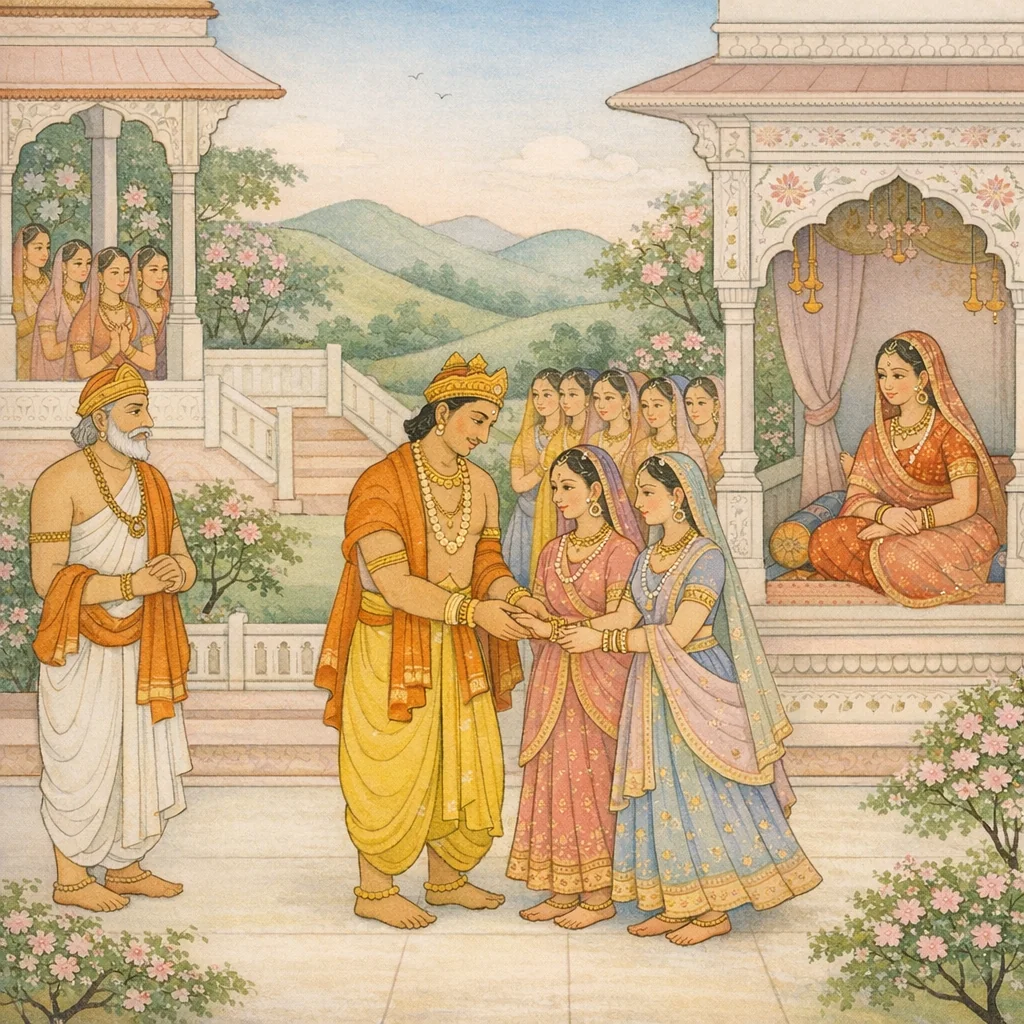
This sarga interweaves two linked ethical narratives. First, Kuśanābha’s hundred daughters report an assaultive attempt by the all-pervading Wind-god (Vāyu) and affirm their lack of autonomous choice in marriage, insisting that any proposal must be routed through paternal consent. Kuśanābha replies with a courtly-ethical discourse praising their unanimity and kṣamā (forbearance) as a dynastic safeguard and a cosmic support of dharma. Second, the text supplies a genealogical and providential solution: the celibate ascetic Cūlī, pleased by the devoted service of the gandharvī Somadā (daughter of Ūrmilā), grants her a mind-born son, Brahmadatta, who later rules at Kāṃpilya. Kuśanābha, after consulting ministers regarding proper time, place, and a suitable groom, decides to give all hundred daughters to Brahmadatta. Upon the orderly acceptance of their hands, the daughters are instantly cured of their deformity and distress, signaling restoration of social and bodily harmony through dharmic marriage. The sarga closes with the completed wedding rites and the pleased acknowledgment by Somadā of her son’s fitting conduct.
Shlokas
Verse 1
तस्य तद्वचनं श्रुत्वा कुशनाभस्य धीमत:।शिरोभिश्चरणौ स्पृष्ट्वा कन्याशतमभाषत।।1.33.1।।
Having heard the words of wise Kūśanābha, his hundred daughters touched his feet with their heads and then spoke.
Verse 2
वायुस्सर्वात्मको राजन् प्रधर्षयितुमिच्छति।अशुभं मार्गमास्थाय न धर्मं प्रत्यवेक्षते।।1.33.2।।
O King, the all-pervading Wind-god seeks to violate us; having taken to an inauspicious course, he gives no regard to dharma.
Verse 3
पितृमत्यस्स्म भद्रं ते स्वच्छन्दे न वयं स्थिता:।पितरं नो वृणीष्व त्वं यदि नो दास्यते तव।।1.33.3।।
‘We have a father—blessings to you—so we are not free to choose as we please. Ask our father; if he gives us to you, then (it may be so).’
Verse 4
तेन पापानुबन्धेन वचनं न प्रतीच्छता।एवं ब्रुवन्त्यस्सर्वास्स्म वायुना निहता भृशम्।।1.33.4।।
While we were all speaking in this way, that one, bound to a sinful course and refusing to accept our words, struck us harshly—by the force of Vāyu.
Verse 5
तासां तद्वचनं श्रुत्वा राजा परमधार्मिक:।प्रत्युवाच महातेजा: कन्याशतमनुत्तमम्।।1.33.5।।
Hearing those words of his daughters, the king—supremely righteous and of great splendor—replied to his hundred excellent maidens.
Verse 6
क्षान्तं क्षमावतां पुत्र्य: कर्तव्यं सुमहत्कृतम्।ऐकमत्यमुपागम्य कुलं चावेक्षितं मम।।1.33.6।।
‘O daughters, you have shown the forbearance that belongs to the truly patient—an exceedingly great deed. By standing together in unanimity, you have safeguarded the honor of my lineage.’
Verse 7
अलङ्कारो हि नारीणां क्षमा तु पुरुषस्य वा।दुष्करं तच्च यत् क्षान्तं त्रिदशेषु विशेषत:।।1.33.7।।यादृशी व: क्षमा पुत्र्यस्सर्वासामविशेषत:।
‘For women indeed, and for men as well, forbearance is an ornament. That act of forgiving is difficult—especially even among the gods. Yet such is your forbearance, O daughters, shown by all of you without any division among yourselves.’
Verse 8
क्षमा दानं क्षमा यज्ञः क्षमा सत्यं हि पुत्रिका:।।1.33.8।।क्षमा यश: क्षमा धर्म: क्षमया निष्ठितं जगत्।
‘Forbearance is charity; forbearance is sacrifice; forbearance indeed is truth, O daughters. Forbearance is glory; forbearance is dharma—by forbearance the world is upheld.’
Verse 9
विसृज्य कन्या: काकुत्स्थ राजा त्रिदशविक्रम:।।1.33.9।।मन्त्रज्ञो मन्त्रयामास प्रदानं सह मन्त्रिभि:। देशकालौ प्रदानस्य सदृशे प्रतिपादनम्।।1.33.10।।
O Kakutstha (Rāma), after dismissing his daughters, the king—whose prowess rivaled that of the gods, and who was skilled in counsel—consulted with his ministers about giving the maidens in marriage: the proper place and time for the gift, and a suitable match.
Verse 10
विसृज्य कन्या: काकुत्स्थ राजा त्रिदशविक्रम:।।1.33.9।।मन्त्रज्ञो मन्त्रयामास प्रदानं सह मन्त्रिभि:। देशकालौ प्रदानस्य सदृशे प्रतिपादनम्।।1.33.10।।
O descendant of Kakutstha, after dismissing his daughters, the king—mighty as the gods and skilled in counsel—consulted with his ministers about arranging their marriage: the proper place and time, and a fitting bridegroom.
Verse 11
एतस्मिन्नेव काले तु चूली नाम महातपा:।ऊर्ध्वरेताश्शुभाचारो ब्राह्मं तप उपागमत्।।1.33.11।।
Just at that time, a great ascetic named Cūlī—living in celibacy and of pure conduct—undertook brahmanical austerity in pursuit of Brahman.
Verse 12
तप्यन्तं तमृषिं तत्र गन्धर्वी पर्युपासते।सोमदा नाम भद्रं ते ऊर्मिला तनया तदा।।1.33.12।।
There, as that sage practiced austerities, a Gandharva-maiden served him—Somadā by name, daughter of Ūrmilā. Blessings upon you.
Verse 13
सा च तं प्रणता भूत्वा शुश्रूषणपरायणा।उवास काले धर्मिष्ठा तस्यास्तुष्टोऽभवद्गुरु:।।1.33.13।।
Bowing to him, she remained devoted to his service. Living there in due time with steadfast righteousness, she pleased her guru, and he became satisfied with her.
Verse 14
स च तां कालयोगेन प्रोवाच रघुनन्दन।परितुष्टोऽस्मि भद्रं ते किं करोमि तव प्रियम्।।1.33.14।।
And in due course, O delight of the Raghus, he said to her: “I am pleased. Blessings upon you—what favor may I do for you?”
Verse 15
परितुष्टं मुनिं ज्ञात्वा गन्धर्वी मधुरस्वरा।उवाच परमप्रीता वाक्यज्ञा वाक्यकोविदम्।।1.33.15।।
Knowing the sage to be satisfied, the Gandharva-maiden—sweet-voiced and greatly delighted—spoke, skilled in words, to that master of speech.
Verse 16
लक्ष्म्या समुदितो ब्राह्म्या ब्रह्मभूतो महातपा:।ब्राह्मेण तपसा युक्तं पुत्रमिच्छामि धार्मिक।।1.33.16।।
“Great ascetic, radiant with brahmanical splendor and like Brahmā himself—O righteous one, I desire a son, endowed with brahmanical austerity.”
Verse 17
अपतिश्चास्मि भद्रं ते भार्या चास्मि न कस्यचित्।ब्राह्मेणोपगतायाश्च दातुमर्हसि मे सुतम्।।1.33.17।।
I am without a husband—blessing be upon you—and I belong to no one as a wife. Since I have come to you for refuge, you ought to grant me a son by the power of your brahman (ascetic merit).
Verse 18
तस्या: प्रसन्नो ब्रह्मर्षिर्ददौ पुत्रमनुत्तमम्।ब्रह्मदत्त इति ख्यातं मानसं चूलिनस्सुतम्।।1.33.18।।
Pleased with her, the brahmarṣi granted her an excellent son—mind-born of Cūlin—who became renowned by the name Brahmadatta.
Verse 19
स राजा सौमदेयस्तु पुरीमध्यवसत्तदा।कांपिल्यां परया लक्ष्म्या देवराजो यथा दिवम्।।1.33.19।।
That king—Somadā’s son—then dwelt in the city of Kāṁpilya in great prosperity, like the lord of the gods in heaven.
Verse 20
स बुद्धिं कृतवान् राजा कुशनाभस्सुधार्मिक:।ब्रह्मदत्ताय काकुत्स्थ दातुं कन्याशतं तदा।।1.33.20।।
Then King Kūśanābha, deeply righteous—O Kakutstha—resolved to give his hundred daughters to Brahmadatta.
Verse 21
तमाहूय महातेजा ब्रह्मदत्तं महीपति:। ददौ कन्याशतं राजा सुप्रीतेनान्तरात्मना।।1.33.21।।
Summoning Brahmadatta, that mighty lord of the earth gladly gave him the hundred maidens, with a heart filled with joy.
Verse 22
यथाक्रमं तत: पाणीन् जग्राह रघुनन्दन।ब्रह्मदत्तो महीपालस्तासां देवपतिर्यथा।।1.33.22।।
Then, O delight of the Raghus, King Brahmadatta received their hands in due order, like Indra receiving the goddesses.
Verse 23
स्पृष्टमात्रे तत: पाणौ विकुब्जा विगतज्वरा:।युक्ता: परमया लक्ष्म्या बभु: कन्याशतं तदा।।1.33.23।।ृ32
Thereafter, by the mere touch of his hand, the hundred maidens became free of deformity and distress, and were endowed with splendid beauty.
Verse 24
स दृष्ट्वा वायुना मुक्ता: कुशनाभो महीपति:।बभूव परमप्रीतो हर्षं लेभे पुन:पुन:।।1.33.24।।
Seeing his daughters freed from the affliction caused by Vāyu, King Kūśanābha became exceedingly glad, again and again tasting delight.
Verse 25
कृतोद्वाहं तु राजानं ब्रह्मदत्तं महीपति:।सदारं प्रेषयामास सोपाध्यायगणं तदा।।1.33.25।।
When the wedding had been duly completed, the king then sent King Brahmadatta away with his wives, along with the company of priests and teachers.
Verse 26
सोमदाऽपि सुसंहृष्टा पुत्रस्य सदृशीं क्रियाम्।यथान्यायं च गन्धर्वी स्नुषास्ता: प्रत्यनन्दत।।1.33.26।।
Somadā, the Gandharva-woman, was greatly delighted. Seeing that her son had acted in a manner befitting him, she duly praised those daughters-in-law in accordance with propriety.
Frequently Asked Questions
The sarga presents an ethical crisis of coercion: Vāyu attempts to violate the daughters’ modesty through “foul means,” and they respond by refusing autonomous elopement logic, redirecting any marital claim to lawful paternal consent. The narrative then contrasts adharma (forced outrage) with dharma (restraint, counsel, and legitimate marriage rites).
Kuśanābha frames kṣamā (forbearance) as an ornament for all persons and as a stabilizing principle—equated with charity, sacrifice, truth, glory, and virtue—by which the world is “supported.” The episode teaches that moral strength can be expressed as controlled response and unified conduct, not merely retaliation.
Kāṃpilyā (Kampilya) is named as Brahmadatta’s prosperous royal seat, situating the marriage alliance within a recognizable political geography. Culturally, the sarga highlights court consultation with ministers (mantra), deśa-kāla suitability for marriage, pāṇigrahaṇa (hand-taking), and the presence of priests (upādhyāyagaṇa) as markers of orthodox matrimonial procedure.