Sarga 31
सिद्धाश्रमात् शोणातटं प्रस्थानम् — Departure from Siddhāśrama and the Invitation to Janaka’s Yajña (Bow of Mithilā)
बालकाण्ड
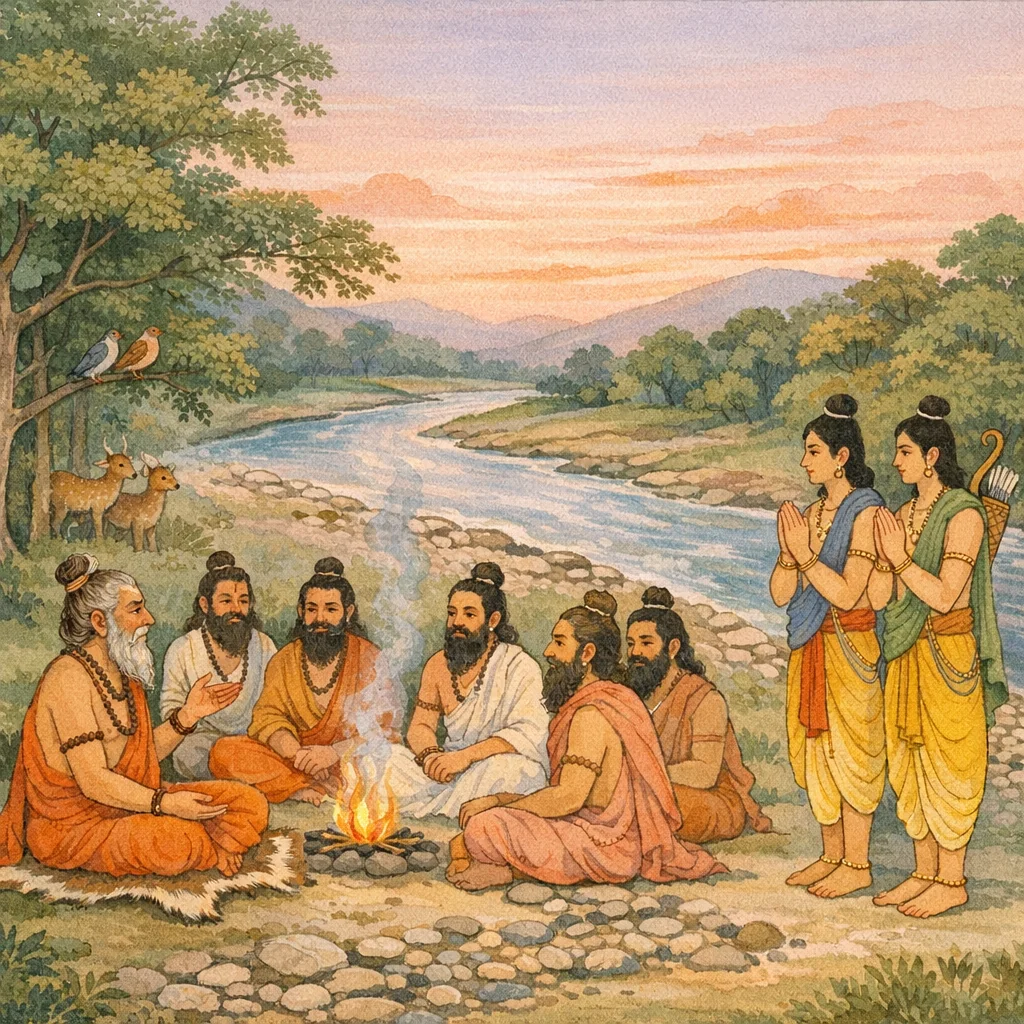
Sarga 31 transitions the narrative from the successful completion of Viśvāmitra’s purpose at Siddhāśrama to a northward journey toward Mithilā. Rāma and Lakṣmaṇa spend the night fulfilled and joyful, perform dawn rites, and formally present themselves as willing agents of the sage’s command, emphasizing disciplined service within an ascetic-ritual order. The assembled sages then announce Janaka’s forthcoming, highly righteous yajña in Mithilā and invite Rāma to witness an extraordinary “jewel of a bow,” described as dreadful, immeasurably potent, and once granted by the devas in a sacrificial assembly. The text stresses the bow’s inaccessibility: devas, gandharvas, asuras, rākṣasas, and even mighty kings and princes cannot string or even lift it. Further, the bow is presented as the consecrated fruit of sacrifice, worshipped in Janaka’s palace with perfumes, sandal paste, incense, and agaru—marking it as both political insignia and ritual object. Viśvāmitra departs with ṛṣis after taking leave of forest deities; even birds and beasts follow until dismissed. The party halts at sunset on the bank of the Śoṇā river, where the sages bathe, kindle fires, and sit with Viśvāmitra, prompting Rāma’s curious inquiry into the luxuriant region—setting up the next etiological narration.
Shlokas
Verse 1
अथ तां रजनीं तत्र कृतार्थौ रामलक्ष्मणौ।ऊषतुर्मुदितौ वीरौ प्रहृष्टेनान्तरात्मना।।1.31.1।।
Then, there, Rāma and Lakṣmaṇa—having achieved their purpose—spent the night, the two heroes rejoicing with hearts made glad.
Verse 2
प्रभातायां तु शर्वर्यां कृतपौर्वाह्णिकक्रियौ।विश्वामित्रमृषींश्चान्यान् सहितावभिजग्मतु:।।1.31.2।।
When the night had turned to dawn, the two brothers, having completed their morning observances, approached Viśvāmitra and the other sages together.
Verse 3
अभिवाद्य मुनिश्रेष्ठं ज्वलन्तमिव पावकम्।ऊचतुर्मधुरोदारं वाक्यं मधुरभाषिणौ।।1.31.3।।
Having saluted the foremost sage—blazing like fire—the two sweet-spoken brothers addressed him with words that were gentle and noble in tone.
Verse 4
इमौ स्म मुनिशार्दूल किङ्करौ समुपस्थितौ।आज्ञापय यथेष्टं वै शासनं करवाव किम्।।1.31.4।।
O best of ascetics, we two stand here in your presence as your attendants. Command us freely—what order shall we carry out?
Verse 5
एवमुक्ता स्ततस्ताभ्यां सर्व एव महर्षय:।विश्वामित्रं पुरस्कृत्य रामं वचनमब्रुवन्।।1.31.5।।
Thus addressed by the two, all the great sages—placing Viśvāmitra at their head—spoke these words to Rāma.
Verse 6
मैथिलस्य नरश्रेष्ठ जनकस्य भविष्यति।यज्ञ: परमधर्मिष्ठस्तस्य यास्यामहे वयम्।।1.31.6।।
O foremost of men, a supremely righteous sacrifice is to be performed by Janaka, the king of Mithilā. We shall go to that sacrifice.
Verse 7
त्वं चैव नरशार्दूल सहास्माभिर्गमिष्यसि।अद्भुतं धनुरत्नं च तत्र तद्रष्टुमर्हसि।।1.31.7।।
And you too, O best of men, shall go with us. There you are worthy to behold that wondrous jewel among bows.
Verse 8
तद्धि पूर्वं नरश्रेष्ठ दत्तं सदसि दैवतै:।अप्रमेयबलं घोरं मखे परमभास्वरम्।।1.31.8।।
For that bow, O best of men, was long ago bestowed by the gods in a sacrificial assembly—terrible, of immeasurable power, and supremely radiant amid the rite.
Verse 9
नास्य देवा न गन्धर्वा नासुरा न च राक्षसा:।कर्तुमारोपणं शक्ता न कथञ्चन मानुषा:।।1.31.9।।
Neither gods nor gandharvas, neither asuras nor rākṣasas—nor even human beings—are in any way able to string that bow.
Verse 10
धनुषस्तस्य वीर्यं तु जिज्ञासन्तो महीक्षित:।न शेकुरारोपयितुं राजपुत्रा महाबला:।।1.31.10।।
Wishing to test the might of that bow, kings and mighty princes could not even raise it to string it.
Verse 11
तद्धनुर्नरशार्दूल मैथिलस्य महात्मन:।तत्र द्रक्ष्यसि काकुत्स्थ यज्ञं चाद्भुतदर्शनम्।।1.31.11।।
O best of men, O scion of Kakutstha, there you will see that bow belonging to the great-souled king of Mithilā, and also a sacrifice wondrous to behold.
Verse 12
तद्धि यज्ञफलं तेन मैथिलेनोत्तमं धनु:।याचितं नरशार्दूल सुनाभं सर्वदैवतै:।।1.31.12।।
For that excellent bow—firm at its center—was obtained as the fruit of a sacrifice by the Maithila king, having been sought (and granted) by all the gods.
Verse 13
आयागभूतं नृपतेस्तस्य वेश्मनि राघव।अर्चितं विविधैर्गन्धैर्धूपैश्चागरुगन्धिभि:।।1.31.13।।
O Rāghava, in that king’s palace the bow is honored like a principal object of worship, being revered with many perfumes, incense, and fragrant agaru.
Verse 14
एवमुक्त्वा मुनिवर: प्रस्थानमकरोत्तदा।सर्षिसङ्घ स्सकाकुत्स्थ: आमन्त्र्य वनदेवता:।।1.31.14।।
Having spoken thus, the best of sages then set out, accompanied by the assemblage of seers and by the Kakutstha prince(s), after taking leave of the deities of the forest.
Verse 15
स्वस्ति वोऽस्तु गमिष्यामि सिद्वस्सिद्धाश्रमादहम्।उत्तरे जाह्नवीतीरे हिमवन्तं शिलोच्चयम्।।1.31.15।।
“May well-being be yours. My purpose is accomplished; from this Siddhāśrama I shall go to Himavān, the lofty mountain, on the northern bank of the Jāhnavī.”
Verse 16
प्रदक्षिणं तत: कृत्वा सिद्धाश्रममनुत्तमम्।उत्तरां दिशमुद्दिश्य प्रस्थातुमुपचक्रमे।।1.31.16।।
Thereafter, having circumambulated the unsurpassed Siddhāśrama in reverence, they began their journey, setting their course toward the northern direction.
Verse 17
तं प्रयान्तं मुनिवरमन्वयादनुसारिणम्।शकटीशतमात्रं तु प्रायेण ब्रह्मवादिनाम्।।1.31.17।।
As the foremost sage Viśvāmitra set out onward, the Veda-expounders followed after him—nearly a hundred carts’ worth of attendants accompanying the procession.
Verse 18
मृगपक्षिगणाश्चैव सिद्धाश्रमनिवासिन:।अनुजग्मुर्महात्मानं विश्वामित्रं महामुनिम्।।1.31.18।।निवर्तयामास तत: पक्षिसङ्घान् मृगानपि।
Even the herds of beasts and flocks of birds dwelling in Siddhāśrama followed the great-souled sage Viśvāmitra; then he sent the birds’ companies—and the animals as well—back again.
Verse 19
ते गत्वा दूरमध्वानं लम्बमाने दिवाकरे।वासं चक्रुर्मुनिगणाः शोणाकूले समाहिता:।।1.31.19।।
After travelling a long stretch, when the sun hung low, the gathered bands of sages, composed and attentive, made their halt on the bank of the Śoṇa.
Verse 20
तेऽस्तं गते दिनकरे स्नात्वा हुतहुताशना:।विश्वामित्रं पुरस्कृत्य निषेदुरमितौजस:।।1.31.20।।
When the sun had set, those men of great radiance bathed, offered oblations into the sacred fire, and then sat down, placing Viśvāmitra at the fore in honor.
Verse 21
रामोऽपि सहसौमित्रिर्मुनीं स्तानभिपूज्य च।अग्रतो निषसादाथ विश्वामित्रस्य धीमत:।।1.31.21।।
Rāma too, with Saumitri (Lakṣmaṇa), paid due honor to those sages; thereafter he sat down in front of the wise Viśvāmitra.
Verse 22
अथ रामो महातेजाः विश्वामित्रं महामुनिम्।पप्रच्छ नरशार्दूल: कौतूहलसमन्वित:।।1.31.22।।
Then Rāma—radiant, the tiger among men—full of earnest curiosity, questioned the great sage Viśvāmitra.
Verse 23
भगवन् कोऽन्वयं देशस्समृद्धवनशोभित:।श्रोतुमिच्छामि भद्रं ते वक्तुमर्हसि तत्त्वत:।।1.31.23।।
“O Blessed One, what is the origin and significance of this land, so beautiful with flourishing forests? I wish to hear it; may it be well with you—please tell me the truth of it in full.”
Verse 24
चोदितो रामवाक्येन कथयामास सुव्रत:।तस्य देशस्य निखिलमृषिमध्ये महातपा:।।1.31.24।।
Urged by Rāma’s words, that great ascetic—steadfast in vow—recounted, in the midst of the sages, the entire account of that region.
Frequently Asked Questions
The pivotal action is voluntary submission to dharmic command: Rāma and Lakṣmaṇa explicitly present themselves as ‘servants’ ready to execute Viśvāmitra’s orders, framing power as accountable service rather than autonomous prowess.
Sacred authority is validated through ritual and restraint: the bow’s greatness is not a spectacle of strength alone but a sign of yajña-born legitimacy, teaching that extraordinary capability must be approached through reverence, discipline, and rightful context.
Siddhāśrama (as an accomplished sacred mission-site), the northern bank of Jahnavī (Gaṅgā) and Himavanta (directional pilgrimage frame), and the Śoṇā riverbank (sunset rites and encampment) function as a mapped itinerary linking ascetic space to Mithilā’s royal-ritual culture.