Sarga 23
कामाश्रम-प्रवेशः / Entry into Kāma’s Hermitage at the Sarayū–Gaṅgā Confluence
बालकाण्ड
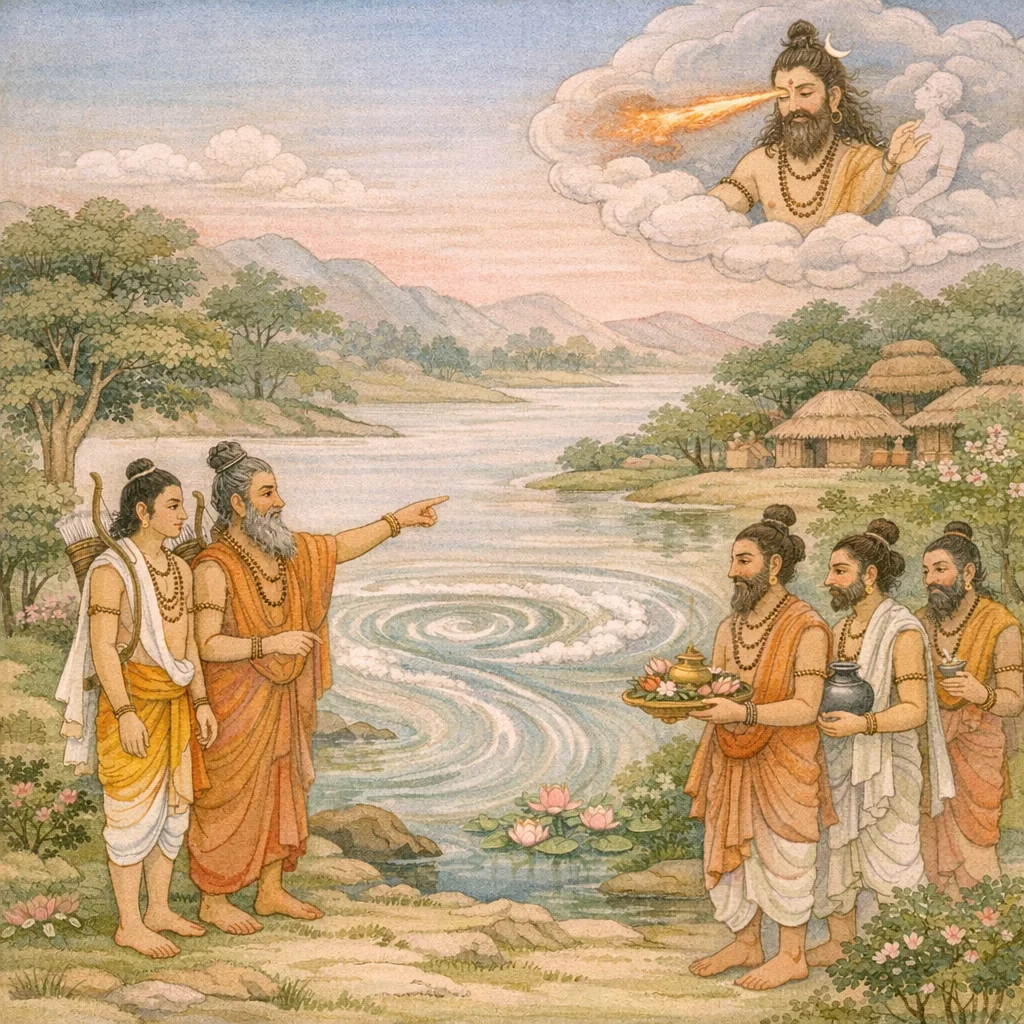
At daybreak Viśvāmitra awakens Rāma and Lakṣmaṇa and directs them to complete sandhyā and daily rites. After bathing, offering water-oblations, and performing japa, the princes respectfully stand ready for travel. Proceeding onward, they behold the auspicious saṅgama of the Sarayū with the divine, three-streamed Gaṅgā and notice a venerable āśrama where long-practicing ascetics have performed severe tapas for millennia. Curious, the brothers inquire whose hermitage it is. Viśvāmitra explains that this place is associated with Kandarpa/Kāma, who once offended Śiva during the latter’s austere meditation; Śiva’s fierce eye burns Kāma, rendering him aśarīra (disembodied), hence the epithet Anaṅga, and the locale becomes famed as Aṅgadeśa/Ananga-associated terrain. The narrative then returns to āśrama protocol: the party stays the night between the sacred rivers, the resident munis recognize them through tapas-born vision, offer arghya and pādya, and extend formal hospitality; the evening sandhyā is observed, and Viśvāmitra delights the princes with instructive tales, emphasizing disciplined ritual, sacred geography, and the moral consequences of transgressive desire.
Shlokas
Verse 1
प्रभातायां तु शर्वर्यां विश्वामित्रो महामुनि:।अभ्यभाषत काकुत्स्थौ शयानौ पर्णसंस्तरे।।।।
When the night had brightened into dawn, the great sage Viśvāmitra addressed the two Kakutsthas (Rāma and Lakṣmaṇa) as they lay upon a bed of leaves.
Verse 2
कौसल्या सुप्रजा राम पूर्वा सन्ध्या प्रवर्तते।उत्तिष्ठ नरशार्दूल कर्तव्यं दैवमाह्निकम्।।।।
O Rāma—fortunate son of Kauśalyā—the dawn is setting in. Rise, O tiger among men; the daily rites and offerings to the gods must be performed.
Verse 3
तस्यर्षे: परमोदारं वचश्श्रुत्वा नृपात्मजौ ।स्नात्वा कृतोदकौ वीरौ जेपतु: परमं जपम्।।।।
Hearing the most gracious words of that sage, the two princes bathed, offered the water-oblation, and then recited the highest sacred mantra-prayer.
Verse 4
कृताह्निकौ महावीर्यौ विश्वामित्रं तपोधनम्।अभिवाद्याभिसंहृष्टौ गमनायाभितस्थतु:।।।।
Having completed their daily rites, the two mighty princes saluted Viśvāmitra—whose wealth was austerity—and, filled with eager energy, stood ready to depart.
Verse 5
तौ प्रयातौ महावीर्यौ दिव्यां त्रिपथगां नदीम्।ददृशाते ततस्तत्र सरय्वास्सङ्गमे शुभे।।।।
Going on a little further, the two great heroes beheld the divine river Tripathagā (Gaṅgā), there at the auspicious confluence with the Sarayū.
Verse 6
तत्राश्रमपदं पुण्यमृषीणामग्य्रतेजसाम् ।बहुवर्षसहस्राणि तप्यतां परमं तप:।।।।
There they saw a sacred hermitage-ground of seers of foremost spiritual radiance, who for many thousands of years had been practicing the highest austerity.
Verse 7
तं दृष्ट्वा परमप्रीतौ राघवौ पुण्यमाश्रमम्।ऊचतुस्तं महात्मानं विश्वामित्रमिदं वच:।।।।
Seeing that holy hermitage, the two Rāghavas were greatly delighted and spoke these words to the noble-souled Viśvāmitra.
Verse 8
कस्यायमाश्रम: पुण्य: कोन्वस्मिन्वसते पुमान्।भगवन् श्रोतुमिच्छाव: परं कौतूहलं हि नौ।।।।
"Revered sir, whose sacred hermitage is this? And who indeed dwells here? We both truly wish to hear, for our curiosity is great."
Verse 9
तयोस्तद्वचनं श्रुत्वा प्रहस्य मुनिपुङ्गव:।अब्रवीच्छ्रूयतां राम यस्यायं पूर्व आश्रम:।। ।।
Hearing their words, the foremost of sages smiled gently and said, "Rāma, listen—this is the hermitage that once belonged to him in former times."
Verse 10
कन्दर्पो मूर्तिमानासीत्काम इत्युच्यते बुधै:।तपस्यन्तमिह स्थाणुं नियमेन समाहितम्।।।।कृतोद्वाहं तु देवेशं गच्छन्तं समरुद्गगणम्।धर्षयामास दुर्मेधा हुङ्कृतश्च महात्मना।।।।
“Here Kandarpa once lived embodied; the wise call him Kāma. In this place, when Lord Sthāṇu (Śiva), the lord of the gods, was absorbed in austere discipline—together with his newly wedded consort—Kāma, foolish in intent, harassed him while passing by with the hosts of the Maruts; and the great Lord uttered a terrible roar.”
Verse 11
कन्दर्पो मूर्तिमानासीत्काम इत्युच्यते बुधै:।तपस्यन्तमिह स्थाणुं नियमेन समाहितम्।।1.23.10।। कृतोद्वाहं तु देवेशं गच्छन्तं समरुद्गगणम्।धर्षयामास दुर्मेधा हुङ्कृतश्च महात्मना।।1.23.11।।
“Here Kandarpa once lived embodied; the wise call him Kāma. In this place, when Lord Sthāṇu (Śiva), the lord of the gods, was absorbed in austere discipline—together with his newly wedded consort—Kāma, foolish in intent, harassed him while passing by with the hosts of the Maruts; and the great Lord uttered a terrible roar.”
Verse 12
अवदग्धस्य रौद्रेण चक्षुषा रघुनन्दन।व्यशीर्यन्त शरीरात्स्वात्सर्वगात्राणि दुर्मते:।।।।
O scion of Raghu, scorched by that fierce eye, the evil-minded Kāma’s limbs fell away and were consumed from his own body.
Verse 13
तस्य गात्रं हतं तत्र निर्दग्थस्य महात्मना।अशरीर: कृत: काम: क्रोधाद्देवेश्वरेण हि।।।।
There, when the great one had utterly burned him, Kāma’s body was destroyed; indeed, through wrath the Lord of the gods made Kāma bodiless.
Verse 14
अनङ्ग इति विख्यातस्तदाप्रभृति राघव।स चाङ्गविषयश्श्रीमान्यत्राङ्गं प्रमुमोच ह।।।।
O Rāghava, from that time onward he became famed as ‘Anaṅga’ (the bodiless one); and the beautiful region where he cast off his body came to be known as Aṅgaviṣaya.
Verse 15
तस्यायमाश्रम: पुण्यस्तस्येमे मुनय: पुरा।शिष्या धर्मपरा नित्यं तेषां पापं न विद्यते।।।।
This is his holy hermitage, and these sages were formerly his disciples; ever devoted to Dharma, for them no sin is found to accrue.
Verse 16
इहाद्य रजनीं राम वसेम शुभदर्शन।पुण्ययोस्सरितोर्मध्ये श्वस्तरिष्यामहे वयम्।।।।
O Rāma of auspicious appearance, let us stay here tonight between the two sacred rivers; tomorrow we shall cross over.
Verse 17
अभिगच्छामहे सर्वे शुचय: पुण्यमाश्रमम्।स्नाताश्च कृतजप्याश्च हुतहव्या नरोत्तम।।।।
O best of men, once we have all become purified—having bathed, performed japa, and offered oblations into the fire—we shall enter this holy hermitage.
Verse 18
तेषां संवदतां तत्र तपोदीर्घेण चक्षुषा।विज्ञाय परमप्रीता मुनयो हर्षमागमन्।।।।
As they conversed there, the sages—seeing with the far-reaching vision born of austerity—recognized them and became exceedingly delighted.
Verse 19
अर्घ्यं पाद्यं तथाऽतिथ्यं निवेद्य कुशिकात्मजे।रामलक्ष्मणयो: पश्चादकुर्वन्नतिथिक्रियाम्।।।।
After offering arghya, pādya, and due hospitality to the son of Kuśika (Viśvāmitra), they then performed the rites of welcoming for Rāma and Lakṣmaṇa.
Verse 20
सत्कारं समनुप्राप्य कथाभिरभिरञ्जयन्।यथार्हमजपन् सन्ध्यामृषयस्ते समाहिता:।।।।
Having received due honor and being pleased by their conversation, those sages—composed in mind—recited the sandhyā prayers in the proper manner.
Verse 21
तत्र वासिभिरानीता मुनिभिस्सुव्रतै: सह।न्यवसन् सुसुखं तत्र कामाश्रमपदे तदा।।।।
There, brought in by the residents along with the vow-faithful sages, they then stayed very happily at that place—the hermitage-site of Kāma.
Verse 22
कथाभिरभिरामाभिरभिरामौ नृपात्मजौ।रमयामास धर्मात्मा कौशिको मुनिपुङ्गव:।।।।
Kauśika (Viśvāmitra)—righteous-souled and foremost among sages—delighted the charming princes with delightful tales.
Verse 23
Going on a little further, the two great heroes beheld the divine river Tripathagā (Gaṅgā), there at the auspicious confluence with the Sarayū.
Frequently Asked Questions
The chapter contrasts disciplined ritual conduct (sandhyā, japa, hospitality) with Kāma’s impulsive disrespect toward an ascetic vow; the pivotal action is Kāma’s affront to Śiva during tapas, resulting in immediate moral-ritual consequence.
Upadeśa centers on the governance of desire by dharma: tapas and self-restraint sustain cosmic and social order, while unregulated kāma—especially when it violates sacred boundaries—leads to diminution (the Anaṅga, ‘bodiless,’ condition) and lasting moral memory in place-names and tradition.
The Sarga highlights the Sarayū–Gaṅgā saṅgama, the sacred āśrama complex identified as Kāma’s hermitage, and the tradition that the locality is famed as Aṅgadeśa/Ananga-associated terrain, alongside āśrama customs such as arghya-pādya hospitality and sandhyā observance.