Sarga 16
पायसप्रादुर्भावः — The Manifestation of the Divine Payasa and the Avatara Resolution
बालकाण्ड
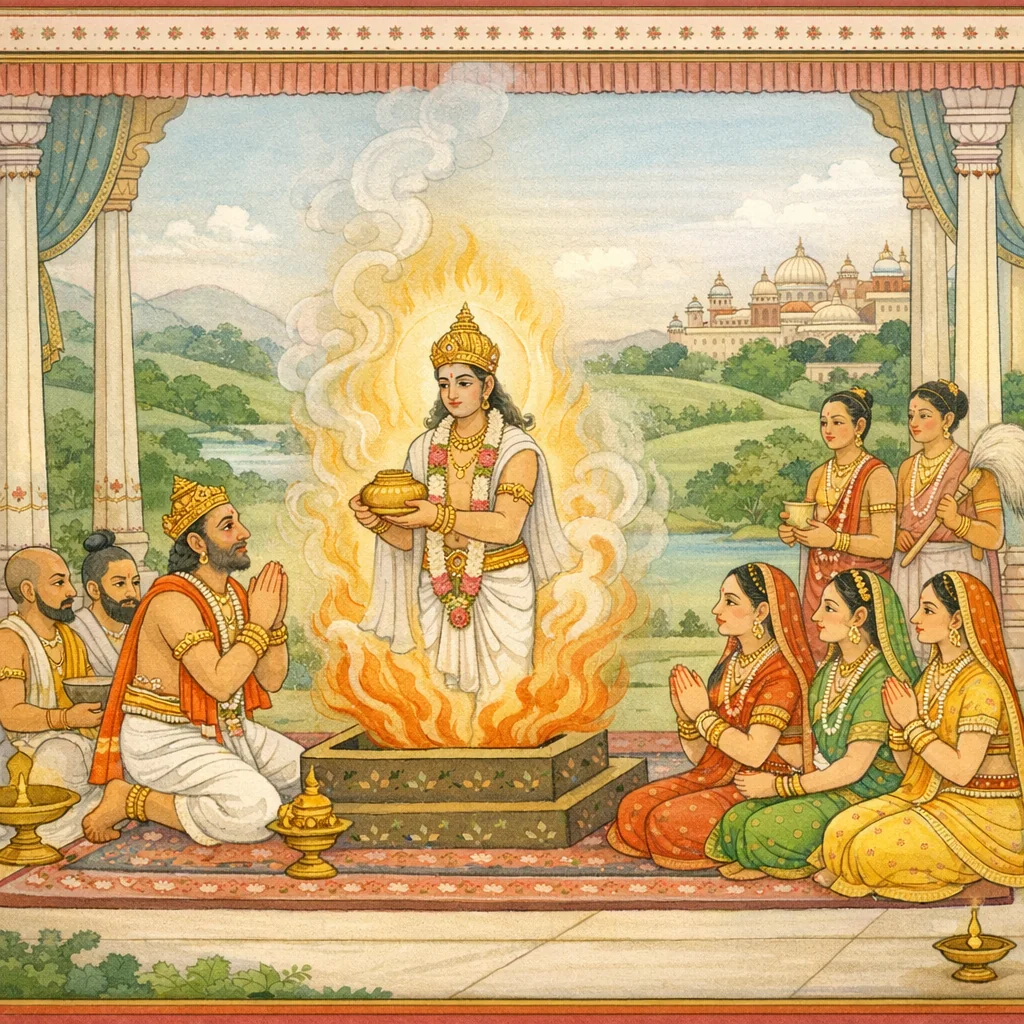
Sarga 16 links cosmic strategy to ritual enactment. Viṣṇu/Nārāyaṇa, though omniscient, addresses the devas with measured speech regarding the means to destroy Rāvaṇa, whose boon from Brahmā excludes non-human beings and inadvertently leaves a human vulnerability. The devas counsel Viṣṇu to assume a human body; Viṣṇu elects Daśaratha as father, synchronizing divine intention with the king’s putrīyā-iṣṭi (progeny-sacrifice). At the sacrifice, a radiant prājāpatya being emerges from the fire bearing a golden vessel with a silver lid filled with divinely prepared payasa, explicitly framed as progeny-conferring, prosperity-bestowing, and health-promoting. Daśaratha receives it with reverence, circumambulates the being, and distributes the portions among Kauśalyā, Sumitrā, and Kaikeyī according to a deliberate allotment. After consuming the payasa, the queens soon conceive, and the king’s restored composure and joy are poetically compared to Viṣṇu honored in heaven—closing the chapter with ritual efficacy as the immediate narrative engine for the avatāra’s human birthline.
Shlokas
Verse 1
ततो नारायणो देवो नियुक्तस्सुरसत्तमै:।जानन्नपि सुरानेवं श्लक्ष्णं वचनमब्रवीत्।।।।
Then Lord Nārāyaṇa—though already knowing what must be done—when requested by the foremost of the gods, spoke to them in gentle words.
Verse 2
उपाय: को वधे तस्य रावणस्य दुरात्मन:।यमहं तं समास्थाय निहन्यामृषिकण्टकम्।।।।
“Give it to your worthy queens to eat; through them you will obtain the sons for whose sake you are performing this sacrifice, O King.”
Verse 3
एवमुक्तास्सुरास्सर्वे प्रत्यूचुर्विष्णुमव्ययम्।मानुषीं तनुमास्थाय रावणं जहि संयुगे।।।।
Thus addressed, all the gods replied to the imperishable Viṣṇu: “Assume a human body, and in battle slay Rāvaṇa.”
Verse 4
स हि तेपे तपस्तीव्रं दीर्घकालमरिन्दम ।येन तुष्टोऽभवद्ब्रह्मा लोककृल्लोकपूर्वज:।।।।
For a long time he performed intense austerities, O subduer of foes; by that, Brahmā—the creator of the worlds, born before the worlds—became pleased.
Verse 5
सन्तुष्ट: प्रददौ तस्मै राक्षसाय वरं प्रभु:। 04नानाविधेभ्यो भूतेभ्यो भयं नान्यत्र मानुषात्।।।।अवज्ञाता: पुरा तेन वरदाने हि मानवा:। 105
Pleased, the Lord granted that rākṣasa a boon: he would have no fear from beings of many kinds—except from human beings. In seeking that boon, he had earlier treated humans with contempt.
Verse 6
एवं पितामहात्तस्माद्वरं प्राप्य स दर्पित:।।।।उत्सादयति लोकान्त्रीन् स्त्रियश्चाप्यपकर्षति ।तस्मात्तस्य वधो दृष्टो मानुषेभ्य: परन्तप।।।।
Thus, after obtaining that boon from Brahmā, he became arrogant: he ravaged the three worlds and even abducted women by force. Therefore, O scorcher of enemies, his death is foreseen to come at the hands of human beings.
Verse 7
एवं पितामहात्तस्माद्वरं प्राप्य स दर्पित:।।1.16.6।।उत्सादयति लोकान्त्रीन् स्त्रियश्चाप्यपकर्षति ।तस्मात्तस्य वधो दृष्टो मानुषेभ्य: परन्तप।।1.16.7।।
Thus, after obtaining that boon from Brahmā, he became arrogant: he ravaged the three worlds and even abducted women by force. Therefore, O scorcher of enemies, his death is foreseen to come at the hands of human beings.
Verse 8
इत्येतद्वचनं श्रुत्वा सुराणां विष्णुरात्मवान्।पितरं रोचयामास तदा दशरथं नृपम्।।।।
Hearing these words of the gods, self-possessed Viṣṇu then approved King Daśaratha as his father.
Verse 9
स चाप्यपुत्रो नृपतिस्तस्मिन्काले महाद्युति:।अयजत्पुत्रियामिष्टिं पुत्रेप्सुररिसूदन:।।।।
And at that time the radiant king—though without sons—performed the putrakāmeṣṭi (the rite for obtaining sons), desiring offspring, he who was a destroyer of enemies.
Verse 10
स कृत्वा निश्चयं विष्णुरामन्त्र्य च पितामहम्।अन्तर्धानं गतो देवै: पूज्यमानो महर्षिभि:।।।।
Having formed his resolve, Viṣṇu took leave of the Grandsire (Brahmā) and—worshipped by the gods and great seers—vanished from their sight.
Verse 11
तो वै यजमानस्य पावकादतुलप्रभम्।प्रादुर्भूतं महद्भूतं महावीर्यं महाबलम्।।।।कृष्णं रक्ताम्बरधरं रक्तास्यं दुन्दुभिस्वनम्।स्निग्धहर्यक्षतनुजश्मश्रुप्रवरमूर्धजम्।।।।शुभलक्षणसम्पन्नं दिव्याभरणभूषितम्।शैलशृङ्गसमुत्सेथं दृप्तशार्दूलविक्रमम्।।।।दिवाकरसमाकारं दीप्तानलशिखोपमम्।तप्तजाम्बूनदमयीं राजतान्तपरिच्छदाम्।।।।दिव्यपायससम्पूर्णां पात्रीं पत्नीमिव प्रियाम्।प्रगृह्य विपुलां दोर्भ्यां स्वयं मायामयीमिव।।।।
Then, from the sacrificial fire—while the patron of the rite was offering—there manifested a great divine being of incomparable splendor, immense valor, and mighty strength. Dark-hued and clad in crimson, red-faced, and resonant as a kettle-drum, he bore glossy tawny whiskers and splendid hair. Marked with auspicious signs and adorned with divine ornaments, he stood like a mountain peak and moved with the proud stride of a tiger—radiant like the sun, like the crest of blazing fire. In his broad arms he held a large vessel, dear as a beloved wife, fashioned of refined gold with a silver covering, filled with celestial pāyasa, appearing as though wrought by magic.
Verse 12
तो वै यजमानस्य पावकादतुलप्रभम्।प्रादुर्भूतं महद्भूतं महावीर्यं महाबलम्।।1.16.11।। कृष्णं रक्ताम्बरधरं रक्तास्यं दुन्दुभिस्वनम्।स्निग्धहर्यक्षतनुजश्मश्रुप्रवरमूर्धजम्।।1.16.12।।शुभलक्षणसम्पन्नं दिव्याभरणभूषितम्।शैलशृङ्गसमुत्सेथं दृप्तशार्दूलविक्रमम्।।1.16.13।।दिवाकरसमाकारं दीप्तानलशिखोपमम्।तप्तजाम्बूनदमयीं राजतान्तपरिच्छदाम्।।1.16.14।।दिव्यपायससम्पूर्णां पात्रीं पत्नीमिव प्रियाम्।प्रगृह्य विपुलां दोर्भ्यां स्वयं मायामयीमिव।।1.16.15।।
Then, from the sacrificial fire—while the patron of the rite was offering—there manifested a great divine being of incomparable splendor, immense valor, and mighty strength. Dark-hued and clad in crimson, red-faced, and resonant as a kettle-drum, he bore glossy tawny whiskers and splendid hair. Marked with auspicious signs and adorned with divine ornaments, he stood like a mountain peak and moved with the proud stride of a tiger—radiant like the sun, like the crest of blazing fire. In his broad arms he held a large vessel, dear as a beloved wife, fashioned of refined gold with a silver covering, filled with celestial pāyasa, appearing as though wrought by magic.
Verse 13
तो वै यजमानस्य पावकादतुलप्रभम्।प्रादुर्भूतं महद्भूतं महावीर्यं महाबलम्।।1.16.11।। कृष्णं रक्ताम्बरधरं रक्तास्यं दुन्दुभिस्वनम्।स्निग्धहर्यक्षतनुजश्मश्रुप्रवरमूर्धजम्।।1.16.12।।शुभलक्षणसम्पन्नं दिव्याभरणभूषितम्।शैलशृङ्गसमुत्सेथं दृप्तशार्दूलविक्रमम्।।1.16.13।।दिवाकरसमाकारं दीप्तानलशिखोपमम्।तप्तजाम्बूनदमयीं राजतान्तपरिच्छदाम्।।1.16.14।।दिव्यपायससम्पूर्णां पात्रीं पत्नीमिव प्रियाम्।प्रगृह्य विपुलां दोर्भ्यां स्वयं मायामयीमिव।।1.16.15।।
Then, from the sacrificial fire—while the patron of the rite was offering—there manifested a great divine being of incomparable splendor, immense valor, and mighty strength. Dark-hued and clad in crimson, red-faced, and resonant as a kettle-drum, he bore glossy tawny whiskers and splendid hair. Marked with auspicious signs and adorned with divine ornaments, he stood like a mountain peak and moved with the proud stride of a tiger—radiant like the sun, like the crest of blazing fire. In his broad arms he held a large vessel, dear as a beloved wife, fashioned of refined gold with a silver covering, filled with celestial pāyasa, appearing as though wrought by magic.
Verse 14
तो वै यजमानस्य पावकादतुलप्रभम्।प्रादुर्भूतं महद्भूतं महावीर्यं महाबलम्।।1.16.11।। कृष्णं रक्ताम्बरधरं रक्तास्यं दुन्दुभिस्वनम्।स्निग्धहर्यक्षतनुजश्मश्रुप्रवरमूर्धजम्।।1.16.12।।शुभलक्षणसम्पन्नं दिव्याभरणभूषितम्।शैलशृङ्गसमुत्सेथं दृप्तशार्दूलविक्रमम्।।1.16.13।।दिवाकरसमाकारं दीप्तानलशिखोपमम्।तप्तजाम्बूनदमयीं राजतान्तपरिच्छदाम्।।1.16.14।।दिव्यपायससम्पूर्णां पात्रीं पत्नीमिव प्रियाम्।प्रगृह्य विपुलां दोर्भ्यां स्वयं मायामयीमिव।।1.16.15।।
Then, from the sacrificial fire—while the patron of the rite was offering—there manifested a great divine being of incomparable splendor, immense valor, and mighty strength. Dark-hued and clad in crimson, red-faced, and resonant as a kettle-drum, he bore glossy tawny whiskers and splendid hair. Marked with auspicious signs and adorned with divine ornaments, he stood like a mountain peak and moved with the proud stride of a tiger—radiant like the sun, like the crest of blazing fire. In his broad arms he held a large vessel, dear as a beloved wife, fashioned of refined gold with a silver covering, filled with celestial pāyasa, appearing as though wrought by magic.
Verse 15
तो वै यजमानस्य पावकादतुलप्रभम्।प्रादुर्भूतं महद्भूतं महावीर्यं महाबलम्।।1.16.11।। कृष्णं रक्ताम्बरधरं रक्तास्यं दुन्दुभिस्वनम्।स्निग्धहर्यक्षतनुजश्मश्रुप्रवरमूर्धजम्।।1.16.12।।शुभलक्षणसम्पन्नं दिव्याभरणभूषितम्।शैलशृङ्गसमुत्सेथं दृप्तशार्दूलविक्रमम्।।1.16.13।।दिवाकरसमाकारं दीप्तानलशिखोपमम्।तप्तजाम्बूनदमयीं राजतान्तपरिच्छदाम्।।1.16.14।।दिव्यपायससम्पूर्णां पात्रीं पत्नीमिव प्रियाम्।प्रगृह्य विपुलां दोर्भ्यां स्वयं मायामयीमिव।।1.16.15।।
Then, from the sacrificial fire—while the patron of the rite was offering—there manifested a great divine being of incomparable splendor, immense valor, and mighty strength. Dark-hued and clad in crimson, red-faced, and resonant as a kettle-drum, he bore glossy tawny whiskers and splendid hair. Marked with auspicious signs and adorned with divine ornaments, he stood like a mountain peak and moved with the proud stride of a tiger—radiant like the sun, like the crest of blazing fire. In his broad arms he held a large vessel, dear as a beloved wife, fashioned of refined gold with a silver covering, filled with celestial pāyasa, appearing as though wrought by magic.
Verse 16
समवेक्ष्याब्रवीद्वाक्यमिदं दशरथं नृपम्।प्राजापत्यं नरं विद्धि मामिहाभ्यागतं नृप।।।।
Seeing King Daśaratha, he spoke: “O King, know me to be a person sent by Prajāpati, who has come here.”
Verse 17
तत: परं तदा राजा प्रत्युवाच कृताञ्जलि:।भगवन् स्वागतं तेऽस्तु किमहं करवाणि ते।।।।
Then the king, with palms folded, replied: “O Blessed Lord, welcome to you. What may I do for you?”
Verse 18
अथो पुनरिदं वाक्यं प्राजापत्यो नरोऽब्रवीत्।राजन्नर्चयता देवानद्य प्राप्तमिदं त्वया।।।।
Then the emissary from Prajāpati spoke again: “O King, because you have worshipped the gods, you have obtained this today.”
Verse 19
इदं तु नृपशार्दूल पायसं देवनिर्मितम्।प्रजाकरं गृहाण त्वं धन्यमारोग्यवर्धनम्।।।।
“O tiger among kings, accept this pāyasa made by the gods—bestowing progeny, bringing prosperity, and increasing health.”
Verse 20
भार्याणामनुरूपाणामश्नीतेति प्रयच्छ वै।तासु त्वं प्राप्स्यसे पुत्रान्यदर्थं यजसे नृप।।।।
“Give it to your worthy queens to eat; through them you will obtain the sons for whose sake you are performing this sacrifice, O King.”
Verse 21
तथेति नृपति: प्रीतश्शिरसा प्रतिगृह्यताम्।पात्रीं देवान्नसम्पूर्णां देवदत्तां हिरण्मयीम्।।।।
Saying, “So be it,” the king—delighted—bowed his head in reverence and accepted the golden vessel, filled with divine food and bestowed by the gods.
Verse 22
अभिवाद्य च तद्भूतमद्भुतं प्रियदर्शनम्।मुदा परमया युक्तश्चकाराभिप्रदक्षिणम्।।।।
Having saluted that wondrous being of pleasing appearance, he—filled with the utmost joy—circumambulated him in reverence.
Verse 23
ततो दशरथ: प्राप्य पायसं देवनिर्मितम्।बभूव परमप्रीत: प्राप्य वित्तमिवाधन:।।।।
Then Daśaratha, having obtained the gods-made pāyasa, became exceedingly glad—like a destitute man who suddenly gains wealth.
Verse 24
ततस्तदद्भुतप्रख्यं भूतं परमभास्वरम्।संवर्तयित्वा तत्कर्म तत्रैवान्तरधीयत।।।।
Then that radiant being—marvelous in form—having completed that task, vanished from that very place.
Verse 25
हर्षरश्मिभिरुद्योतं तस्यान्त:पुरमाबभौ।शारदस्याभिरामस्य चन्द्रस्येव नभोंऽशुभि:।।।।
His inner palace shone, lit by rays of happiness—like the autumn sky illumined by the beams of the lovely moon.
Verse 26
सोऽन्त:पुरं प्रविश्यैव कौसल्यामिदमब्रवीत्।पायसं प्रतिगृह्णीष्व पुत्रीयं त्विदमात्मन:।।।।
Entering the inner palace, he said to Kausalyā: “Receive this pāyasa—this is for you, and it is a giver of sons.”
Verse 27
कौसल्यायै नरपति: पायसार्धं ददौ तदा।अर्धादर्धं ददौ चापि सुमित्रायै नराधिप:।।।।कैकेय्यै चावशिष्टार्धं ददौ पुत्रार्थकारणात्।प्रददौ चावशिष्टार्धं पायसस्यामृतोपमम्।।।।अनुचिन्त्य सुमित्रायै पुनरेव महीपति:।एवं तासां ददौ राजा भार्याणां पायसं पृथक् ।।।।
Then the king gave half of the pāyasa to Kausalyā; from the remaining half he gave one half to Sumitrā. For the sake of obtaining sons, he gave half of what remained to Kaikeyī; and, after reflecting again, the lord of the earth gave the last remaining portion—pāyasa like nectar—to Sumitrā. Thus the king distributed the pāyasa separately among his wives.
Verse 28
कौसल्यायै नरपति: पायसार्धं ददौ तदा।अर्धादर्धं ददौ चापि सुमित्रायै नराधिप:।।1.16.27।।कैकेय्यै चावशिष्टार्धं ददौ पुत्रार्थकारणात्। प्रददौ चावशिष्टार्धं पायसस्यामृतोपमम्।।1.16.28।। अनुचिन्त्य सुमित्रायै पुनरेव महीपति:।एवं तासां ददौ राजा भार्याणां पायसं पृथक् ।।1.16.29।।
Then the king gave half of the pāyasa to Kausalyā; from the remaining half he gave one half to Sumitrā. For the sake of obtaining sons, he gave half of what remained to Kaikeyī; and, after reflecting again, the lord of the earth gave the last remaining portion—pāyasa like nectar—to Sumitrā. Thus the king distributed the pāyasa separately among his wives.
Verse 29
कौसल्यायै नरपति: पायसार्धं ददौ तदा।अर्धादर्धं ददौ चापि सुमित्रायै नराधिप:।।1.16.27।।कैकेय्यै चावशिष्टार्धं ददौ पुत्रार्थकारणात्। प्रददौ चावशिष्टार्धं पायसस्यामृतोपमम्।।1.16.28।। अनुचिन्त्य सुमित्रायै पुनरेव महीपति:।एवं तासां ददौ राजा भार्याणां पायसं पृथक् ।।1.16.29।।
Then the king gave half of the pāyasa to Kausalyā; from the remaining half he gave one half to Sumitrā. For the sake of obtaining sons, he gave half of what remained to Kaikeyī; and, after reflecting again, the lord of the earth gave the last remaining portion—pāyasa like nectar—to Sumitrā. Thus the king distributed the pāyasa separately among his wives.
Verse 30
तास्त्वेतत्पायसं प्राप्य नरेन्द्रस्योत्तमास्स्त्रय:।सम्मानं मेनिरे सर्वां: प्रहर्षोदितचेतस:।।।।
Those three noble queens, having received that payasa from the king, all felt honored, their hearts uplifted with joy.
Verse 31
ततस्तु ता: प्राश्य तदुत्तमास्त्रियोमहीपतेरुत्तमपायसं पृथक्।हुताशनादित्यसमानतेजसोऽचिरेण गर्भान्प्रतिपेदिरे तदा।।।।
Then those noble consorts, each consuming her portion of the king’s finest payasa, soon conceived—radiant in splendor like fire and the sun.
Verse 32
ततस्तु राजा प्रसमीक्ष्य ता: स्त्रिय:प्ररूढगर्भा: प्रतिलब्धमानस:।बभूव हृष्टस्त्रिदिवे यथा हरि:सुरेन्द्रसिद्धर्षिगणाभिपूजित:।।।।
Then the king, seeing his wives now with established pregnancies, regained calmness of mind and became joyful—like Hari (Viṣṇu) in heaven, worshipped by Indra and by hosts of siddhas and seers.
Verse 33
Hearing these words of the gods, self-possessed Viṣṇu then approved King Daśaratha as his father.
Frequently Asked Questions
The pivotal action is the selection of a dharmically viable means to end Rāvaṇa’s oppression without violating the boon-structure granted by Brahmā; the resolution is to adopt a human embodiment, aligning divine intervention with lawful cosmic conditions.
The chapter teaches that cosmic justice operates through constraints and proper means (upāya): even omnipotent power is narrated as working through dharma, boon-logic, and ritual order, making ethical process integral to legitimate victory.
The primary cultural landmark is the Vedic yajña setting—especially the sacrificial fire (pāvaka/hutāśana) and the royal antaḥpura—presented as institutional spaces where polity, ritual culture, and divine purpose converge.