Sarga 15
पञ्चदशः सर्गः — देवकृत-प्रार्थना, रावणवधोपायः, विष्णोः मानुषावतारनियोजनम् (Sarga 15: The Devas’ Petition, the Means to Slay Ravana, and Vishnu’s Commission to Incarnate as Man)
बालकाण्ड
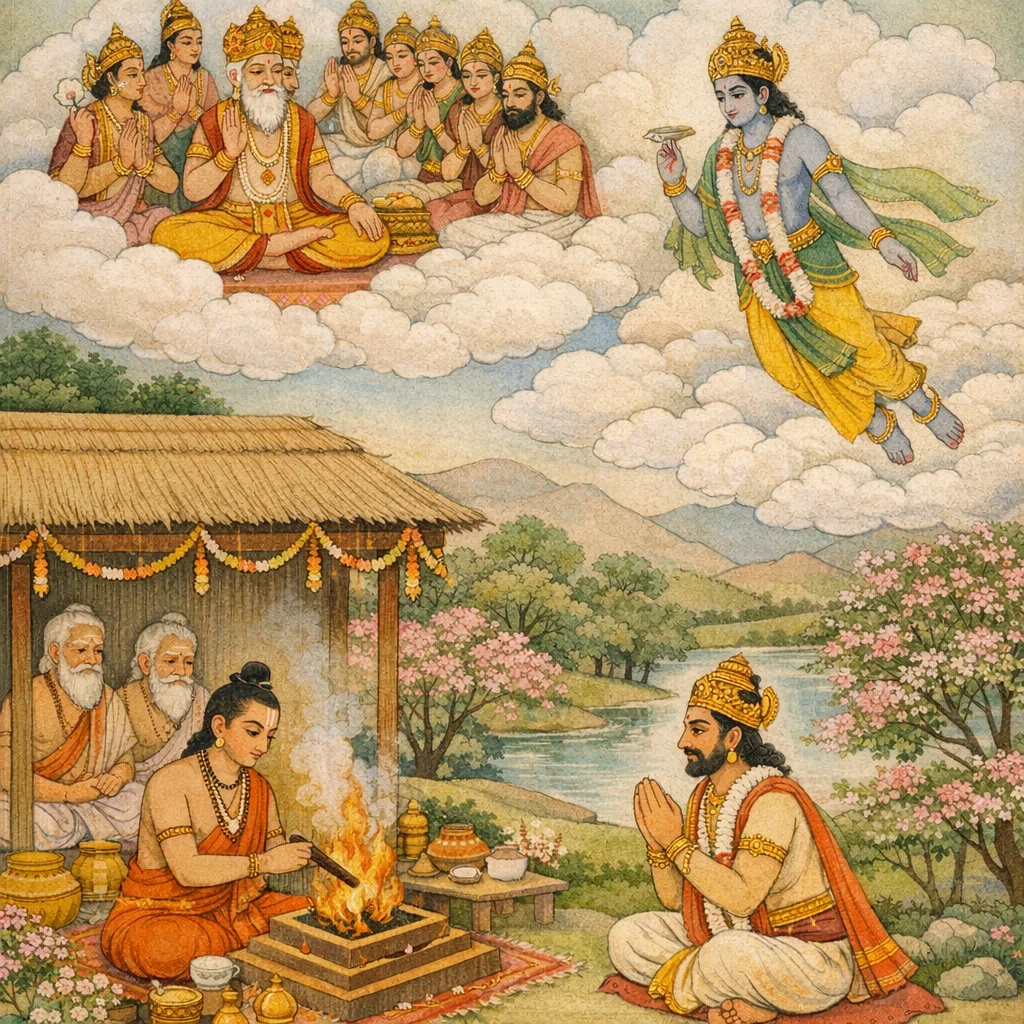
This sarga interleaves ritual narrative with cosmic deliberation. Ṛśyaśṛṅga, after reflection, assures Daśaratha of performing the putrīyeṣṭi according to Atharvaśiras mantras, and commences the rite by offering oblations into fire; devas and allied beings assemble to receive their sacrificial portions. In the divine council, the devas address Brahmā: Rāvaṇa, empowered by Brahmā’s boon, oppresses the three worlds and seeks to assault Indra; his pride makes him transgress against ṛṣis, yakṣas, gandharvas, asuras, and brāhmaṇas. Brahmā recalls the boon’s loophole—Rāvaṇa disdained humans (and, in the received translation, also monkeys and bears) and did not request invulnerability from them—therefore his death is possible only through a human agent. Viṣṇu arrives, receives hymnic homage, and is petitioned to divide himself fourfold and be born as Daśaratha’s sons through the king’s three queens. The devas further request that, in human form, Viṣṇu slay the increasingly arrogant world-tormentor Rāvaṇa. Viṣṇu grants assurance: fear should be abandoned; he will destroy Rāvaṇa along with his allies and then dwell in the human world as a righteous ruler, thereafter contemplating the appropriate human birthplace and accepting Daśaratha as father.
Shlokas
Verse 1
मेथावी तु ततो ध्यात्वा स किञ्चिदिदमुत्तरम्।लब्धसंज्ञस्ततस्तं तु वेदज्ञो नृपमब्रवीत्।।1.15.1।।
Then the wise Veda-knower, after pondering for a while and regaining clarity, spoke this reply to the king.
Verse 2
इष्टिं तेऽहं करिष्यामि पुत्रीयां पुत्रकारणात्।अथर्वशिरसि प्रोक्तैर्मन्त्रैस्सिद्धां विधानत:।।1.15.2।।
I shall perform for you the Putrīyeṣṭi sacrifice, meant for obtaining sons—accomplished according to proper procedure and empowered by mantras taught in the Atharvaśiras tradition.
Verse 3
तत: प्राक्रमदिष्टिं तां पुत्रीयां पुत्रकारणात्।जुहाव चाग्नौ तेजस्वी मन्त्रदृष्टेन कर्मणा।।1.15.3।।
Then, for the sake of begetting sons, the radiant Ṛśyaśṛṅga began that Putrīyeṣṭi sacrifice and poured oblations into the fire, performing the rite as enjoined by the revealed mantras.
Verse 4
ततो देवास्सगन्धर्वास्सिद्धाश्च परमर्षय: ।भागप्रतिग्रहार्थं वै समवेता यथाविधि।।1.15.4।।
Then the gods—together with the Gandharvas, the Siddhas, and the great seers—assembled in due form, in order to receive their rightful shares of the sacrificial offerings.
Verse 5
तास्समेत्य यथान्यायं तस्मिन्सदसि देवता:।अब्रुवन् लोककर्तारं ब्रह्माणं वचनं महत्।।1.15.5।।
Having assembled there in that council according to proper custom, the gods addressed a weighty appeal to Brahmā, the creator of the worlds.
Verse 6
भगवन्त्वत्प्रसादेन रावणो नाम राक्षस:।सर्वान्नो बाधते वीर्याच्छासितुं तं न शक्नुम:।।1.15.6।।
"Revered Lord, a rākṣasa named Rāvaṇa—empowered by your favor—harasses all of us by his might; we are not able to restrain or punish him."
Verse 7
त्वया तस्मै वरो दत्त: प्रीतेन भगवन्पुरा।मानयन्तश्च तं नित्यं सर्वं तस्य क्षमामहे।।1.15.7।।
"For you, O Lord, once pleased, granted him that boon; honoring it continually, we endure all his outrages."
Verse 8
उद्वेजयति लोकान्स्तीनुच्छ्रितान्द्वेष्टि दुर्मति:।शक्रं त्रिदशराजानं प्रधर्षयितुमिच्छति।।1.15.8।।
"That evil-minded one torments the three worlds; he hates those who stand eminent, and he even desires to assault Śakra—Indra, king of the thirty-three gods."
Verse 9
ऋषीन्यक्षान्सगन्धर्वानसुरान्ब्राह्मणांस्तथा।अतिक्रामति दुर्धर्षो वरदानेन मोहित:।।1.15.9।।
"Made arrogant by the gift of boons, the hard-to-assail one oversteps all bounds—against sages, Yakṣas, Gandharvas, Asuras, and even Brāhmaṇas."
Verse 10
नैनं सूर्य: प्रतपति पार्श्वे वाति न मारुत:।चलोर्मिमाली तं दृष्ट्वा समुद्रोऽपि न कम्पते।।1.15.10।।
The sun does not scorch him, nor does the wind blow near him; even the ocean, though wreathed in restless waves, grows still at the sight of him.
Verse 11
तन्महन्नो भयं तस्माद्राक्षसाद्घोरदर्शनात्।वधार्थं तस्य भगवन्नुपायं कर्तुमर्हसि।।1.15.11।।
Therefore, great fear has come upon us because of that dreadful-looking rākṣasa; O Lord, you should devise a means for his destruction.
Verse 12
एवमुक्तस्सुरैस्सर्वैश्चिन्तयित्वा ततोऽब्रवीत्।हन्तायं विदितस्तस्य वधोपायो दुरात्मन:।।1.15.12।।
Thus addressed by all the gods, Brahmā reflected and then said: “Indeed—now the means to destroy that wicked one is known.”
Verse 13
तेन गन्धर्वयक्षाणां देवदानवरक्षसाम्।अवध्योऽस्मीति वागुक्ता तथेत्युक्तं च तन्मया।।1.15.13।।
By him it was requested—“Let me be invulnerable to Gandharvas and Yakṣas, to gods, Dānavas, and Rākṣasas”; and to that, I too replied, “So be it.”
Verse 14
नाकीर्तयदवज्ञानात्तद्रक्षो मानुषान् प्रति।तस्मात्स मानुषाद्वध्यो मृत्युर्नान्योऽस्य विद्यते।।1.15.14।।
But that rākṣasa, out of contempt, did not mention humans in his request; therefore he is killable by a human—there is no other death for him.
Verse 15
एतच्छ्रुत्वा प्रियं वाक्यं ब्रह्मणा समुदाहृतम्।सर्वे महर्षयो देवाः प्रहृष्टास्तेऽभवंस्तदा।।1.15.15।।
Hearing these welcome words spoken by Brahmā, all the gods and great seers were filled with joy at that time.
Verse 16
एतस्मिन्नन्तरे विष्णुरुपयातो महाद्युति:।शङ्खचक्रगदापाणि: पीतवासा जगत्पति:।।1.15.16।।
At that very moment, Viṣṇu—the radiant Lord of the world—arrived, bearing conch, discus, and mace in his hands, and clad in yellow garments.
Verse 17
ब्रह्मणा च समागम्य तत्र तस्थौ समाहित:। 1तमब्रुवन्सुरास्सर्वे समभिष्टूय सन्नता:।।1.15.17।।
Having met with Brahmā, he stood there composed; then all the gods, bowing low and praising him with hymns, addressed him.
Verse 18
त्वान्नियोक्ष्यामहे विष्णो लोकानां हितकाम्यया। 1 राज्ञो दशरथस्य त्वमयोध्याधिपते: प्रभो:।।1.15.18। धर्मज्ञस्य वदान्यस्य महर्षिसमतेजस: । 18तस्य भार्यासु तिसृषु ह्रीश्रीकीर्त्युपमासु च।।1.15.19।।विष्णो पुत्रत्वमागच्छ कृत्वाऽऽत्मानं चतुर्विधम्। 1
O Viṣṇu, for the welfare of the worlds we appoint you (to a mission): become the son of King Daśaratha, the sovereign lord of Ayodhyā.
Verse 19
त्वान्नियोक्ष्यामहे विष्णो लोकानां हितकाम्यया। 1 राज्ञो दशरथस्य त्वमयोध्याधिपते: प्रभो:।।1.15.18। धर्मज्ञस्य वदान्यस्य महर्षिसमतेजस: । 18तस्य भार्यासु तिसृषु ह्रीश्रीकीर्त्युपमासु च।।1.15.19।।विष्णो पुत्रत्वमागच्छ कृत्वाऽऽत्मानं चतुर्विधम्। 1
He is righteous, generous, and radiant like a great seer. Among his three wives—comparable to Modesty (Hrī), Auspicious Fortune (Śrī), and Fame (Kīrti)—O Viṣṇu, come as their son, dividing yourself into four forms.
Verse 20
तत्र त्वं मानुषो भूत्वा प्रवृद्धं लोककण्टकम्।अवध्यं दैवतैर्विष्णो समरे जहि रावणम्।।1.15.20।।
There, taking human form, O Viṣṇu, slay in battle Rāvaṇa—grown arrogant, a thorn to the worlds, and invincible to the gods.
Verse 21
स हि देवांश्च गन्धर्वान्सिद्धांश्च मुनिसत्तमान्।राक्षसो रावणो मूर्खो वीर्योत्सेकेन बाधते।।1.15.21।।
For that foolish rākṣasa Rāvaṇa, swollen with pride in his own prowess, torments the gods, the gandharvas, the siddhas, and the foremost sages.
Verse 22
ऋषयश्च ततस्तेन गन्धर्वाप्सरसस्तथा।क्रीडन्तो नन्दनवने क्रूरेण किल हिंसिता:।।1.15.22।।
Thus, even sages—and likewise gandharvas and apsarases—while sporting in the Nandana grove, are said to have been harmed by that cruel one.
Verse 23
वधार्थं वयमायातास्तस्य वै मुनिभिस्सह।सिद्धगन्धर्वयक्षाश्च ततस्त्वां शरणं गता:।।1.15.23।।
We have come, together with sages, seeking his destruction; therefore siddhas, gandharvas, and yakṣas have taken refuge in you.
Verse 24
त्वं गति: परमा देव सर्वेषां न: परन्तप:।वधाय देवशत्रूणां नृणां लोके मन: कुरु।।1.15.24।।
O god, tormentor of foes, you are the highest refuge for us all; set your resolve to be in the world of men, for the destruction of the enemies of the gods.
Verse 25
एवमुक्तस्तु देवेशो विष्णुस्त्रिदशपुङ्गव:।पितामहपुरोगांस्तान्सर्वलोकनमस्कृत:।।1.15.25।।अब्रवीत्त्रिदशान्सर्वान्समेतान्धर्मसंहितान् ।।1.15.26।।
Thus addressed, Viṣṇu—the Lord of the gods, foremost among the celestials, revered by all the worlds—turned toward those deities assembled under Brahmā’s leadership.
Verse 26
एवमुक्तस्तु देवेशो विष्णुस्त्रिदशपुङ्गव:।पितामहपुरोगांस्तान्सर्वलोकनमस्कृत:।।1.15.25।।अब्रवीत्त्रिदशान्सर्वान्समेतान्धर्मसंहितान् ।।1.15.26।।
He spoke to all the assembled gods, who were aligned with dharma and gathered in due order.
Verse 27
भयं त्यजत भद्रं वो हितार्थं युधि रावणम्।सपुत्रपौत्रं सामात्यं समित्रज्ञातिबान्धवम्।।1.15.27।।हत्वा क्रूरं दुरात्मानं देवर्षीणां भयावहम्।दशवर्षसहस्राणि दशवर्षशतानि च।वत्स्यामि मानुषे लोके पालयन्पृथिवीमिमाम्।।1.15.28।।
Cast off your fear—may welfare be yours. For your good, I shall slay Rāvaṇa in battle, together with his sons and grandsons, his ministers, and his friends, kin, and allies.
Verse 28
भयं त्यजत भद्रं वो हितार्थं युधि रावणम्।सपुत्रपौत्रं सामात्यं समित्रज्ञातिबान्धवम्।।1.15.27।।हत्वा क्रूरं दुरात्मानं देवर्षीणां भयावहम्।दशवर्षसहस्राणि दशवर्षशतानि च।वत्स्यामि मानुषे लोके पालयन्पृथिवीमिमाम्।।1.15.28।।
Having slain that cruel, wicked one—who is a terror to gods and sages—I shall dwell in the human world for ten thousand years and ten hundreds more, protecting this earth.
Verse 29
एवं दत्वा वरं देवो देवानां विष्णुरात्मवान्।मानुषे चिन्तयामास जन्मभूमिमथात्मन:।।1.15.29।।
Thus, having granted this boon to the gods, Viṣṇu—the self-possessed Lord—then reflected, in the human world, upon the very place where he would take birth.
Verse 30
तत: पद्मपलाशाक्ष: कृत्वाऽऽत्मानं चतुर्विधम्।पितरं रोचयामास तथा दशरथन्नृपम्।।1.15.30।।
Thereafter, the lotus-petaled-eyed Lord, dividing himself into four forms, chose King Daśaratha as his father.
Verse 31
तदा देवर्षि गन्धर्वास्सरुद्रास्साप्सरोगणा:।स्तुतिभिर्दिव्यरूपाभिस्तुष्टुवुर्मधुसूदनम्।।1.15.31।।
Then the gods, sages, Gandharvas—together with the Rudras and hosts of Apsarases—praised Madhusūdana with hymns of divine beauty.
Verse 32
तमुद्धतं रावणमुग्रतेजसंप्रवृद्धदर्पं त्रिदशेश्वरद्विषम्।विरावणं साधुतपस्विकण्टकंतपस्विनामुद्धर तं भयावहम्।।1.15.32।।
Uproot that dreadful Rāvaṇa—arrogant, of terrible might, swollen with pride, an enemy of Indra, a torment that makes the worlds cry out, and a thorn in the path of the righteous ascetics.
Verse 33
तमेव हत्वा सबलं सबान्धवंविरावणं रावणमग्य्रपौरुषम्।स्वर्लोकमागच्छ गतज्वरश्चिरंसुरेन्द्रगुप्तं गतदोषकल्मषम्।।1.15.33।।
Slay that very Rāvaṇa—who makes the worlds wail—along with his forces and his kin; then return to heaven, long freed from distress, guarded by Indra, and cleansed of all fault and taint.
Verse 34
Then, the Lord of Men [Dasharatha] gave half of the divine payasam to Kausalya. The King then gave half of the remaining portion to Sumitra.
Frequently Asked Questions
The dilemma is the binding force of a divine boon versus the need to restrain adharma: Brahmā cannot revoke his granted protection, so the resolution must honor the boon’s terms by acting through the unrequested category—human embodiment—making the slaying of Rāvaṇa a lawful, not arbitrary, act.
Power acquired through tapas and boons remains accountable to moral order: when arrogance weaponizes gifts against the world, restoration occurs through dharma-aligned means. The sarga frames avatāra not as spectacle but as principled intervention—divinity entering human limitation to re-establish normative righteousness.
Ayodhyā is foregrounded as the dharmic political center where Viṣṇu will be born through Daśaratha’s household; Nandana-vana appears as a celestial pleasure-grove violated by Rāvaṇa, underscoring the reach of his tyranny; the yajña-sabha (ritual assembly) and agni (sacrificial fire) function as key cultural-ritual loci driving the narrative.