Sarga 89
गङ्गातरणम् — Bharata’s Ferrying of the Army across the Ganga
अयोध्याकाण्ड
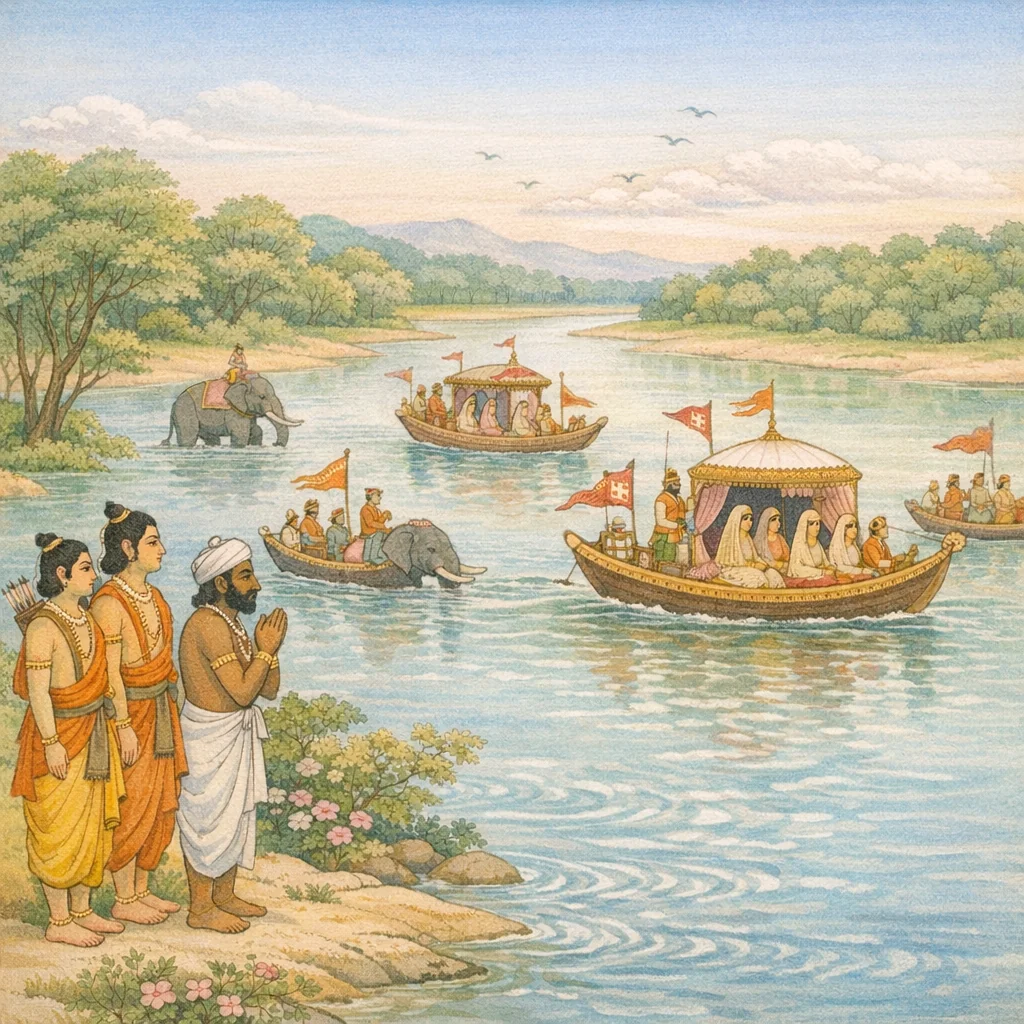
After spending the night on the Gaṅgā’s bank at the very campsite earlier used by Rāma, Bharata rises at daybreak and urges Śatrughna to summon Guha, the Niṣāda chief, to arrange passage for the marching host. Śatrughna replies that he is awake, absorbed in thought of Rāma, as Guha arrives with folded hands and inquires about the army’s comfort. Bharata, described as obedient to Rāma’s will, requests that Guha’s fisherfolk ferry them across. Guha issues rapid orders to his kin: boats are hauled down and, by royal command, five hundred vessels are assembled from all directions, including ornate “Svāstika” boats with bells, sails, flags, and solid build; Guha personally brings an auspicious, white-canopied boat. Boarding proceeds with ritual-social order: priests and brahmins first, then Bharata and Śatrughna, the queens (Kauśalyā, Sumitrā, and other royal women), followed by wagons and supplies. Amid the clamour of breaking camp and loading goods, the fleet moves swiftly; some boats carry women, others horses, draught animals, and treasures. Those unable to board cross by rafts, pots, or swimming. Elephants, bannered and goaded by mahouts, ford the waters like flag-topped mountains. Having been ferried at the auspicious Maitra muhūrta, the army reaches the Prayāga forest; Bharata encamps the force and then proceeds, accompanied by priests, to visit the eminent sage Bharadvāja, where he beholds the hermitage’s charming huts and groves.
Shlokas
Verse 1
उष्य रात्रिं तु तत्रैव गङ्गाकूले स राघवः।भरतः काल्यमुत्थाय शत्रुघ्नमिदमब्रवीत्।।।।
Having spent the night right there on the bank of the Ganga—at the very spot where Raghava had stayed—Bharata rose at daybreak and spoke these words to Satrughna.
Verse 2
शत्रुघ्नोत्तिष्ठ किं शेषे निषादाधिपतिं गुहम्।शीघ्रमानय भद्रं ते तारयिष्यति वाहिनीम्।।।।
“Śatrughna, rise—why are you still asleep? Quickly bring Guha, the lord of the Niṣādas. Blessings upon you; he will help ferry the army across.”
Verse 3
जागर्मि नाहं स्वपिमि तमेवाऽर्यं विचिन्तयन्।इत्येवमब्रवीद्भ्रात्ता शत्रुघ्नोऽपि प्रचोदितः।।।।
Urged by Bharata, Śatrughna replied: “I am not asleep; I am awake, absorbed in thoughts of that noble elder—Rāma.”
Verse 4
इति संवदतोरेवमन्योन्यं नरसिंहयोः।आगम्य प्राञ्जलिः काले गुहो भरतमब्रवीत्।।।।
As those two lion-like men conversed with each other, Guha arrived at the proper moment and, with folded hands, addressed Bharata.
Verse 5
कच्चित्सुखं नदीतीरेऽवात्सीः काकुत्स्थ शर्वरीम्।कच्चित्ते सह सैन्यस्य तावत्सर्वमनामयम्।।।।
Guha asked: “O scion of the Kakutsthas, did you spend the night comfortably on the riverbank? And has everything been free from trouble for you and your army?”
Verse 6
गुहस्य वचनं श्रुत्वा तत्तु स्नेहादुदीरितम्।रामस्यानुवशो वाक्यं भरतोऽपीदमब्रवीत्।।।।
Hearing Guha’s words spoken out of affection, Bharata—ever obedient to Rāma—replied in these terms.
Verse 7
सुखा न श्शर्वरी राजन् पूजिताश्चापि ते वयम्।गङ्गां तु नौभिर्बह्वीभिर्दाशास्सन्तारयन्तु नः।।।।
Bharata said: “O king, the night was comfortable for us, and we have indeed been honored by you. Now let the fishermen ferry us across the Gaṅgā with many boats.”
Verse 8
ततो गुह स्सन्त्वरितं श्रुत्वा भरतशासनम्।प्रति प्रविश्य नगरं तं ज्ञातिजनमब्रवीत्।।।।
Then Guha, quickly heeding Bharata’s instruction, entered his settlement and spoke to his kinsmen.
Verse 9
उत्तिष्ठत प्रबुध्यध्वं भद्रमस्तु च वस्सदा।नाव स्समनुकर्षध्वं तारयिष्याम वाहिनीम्।।।।
Arise; wake up. May you always be blessed. Draw the boats down (to the water); we shall ferry the army across.
Verse 10
ते तथोक्ता स्समुत्थाय त्वरिता राजशासनात्।पञ्चनावां शतान्याशु समानिन्युस्समन्ततः।।।।
Thus instructed, they rose at once; and, acting swiftly under the king’s command, they immediately brought five hundred boats from all directions.
Verse 11
अन्या स्स्वस्तिकविज्ञेया महाघंटाधरा वराः।शोभमानाः पताकाभिर्युक्तवातास्सुसंहताः।।।।
“Other excellent boats too were brought—known as ‘Svastika’—solidly built, splendid with flags, fitted with sails, and hung with large bells.”
Verse 12
तत स्स्वस्तिकविज्ञेयां पाण्डुकम्बलसंवृताम्।सनन्दिघोषां कल्याणीं गुहो नावमुपाहरत्।।।।
Then Guha brought forward an auspicious boat known as ‘Svastika’, covered with white canvas and resounding with pleasing sounds.
Verse 13
तामारुरोह भरतश्शत्रुघ्नश्च महाबलः।कौसल्या च सुमित्रा च याश्चान्या राजयोषितः।।।।पुरोहितश्च तत्पूर्वं गुरवो ब्राह्मणाश्च ये।अनन्तरं राजदारास्तदैव शकटापणाः।।।।
The family priest and the elders—preceptors and Brahmins—boarded first. After them Bharata and the mighty Śatrughna embarked, along with Kauśalyā, Sumitrā, and the other royal women; then followed the king’s wives and the wagons with provisions.
Verse 14
तामारुरोह भरतश्शत्रुघ्नश्च महाबलः।कौसल्या च सुमित्रा च याश्चान्या राजयोषितः।।2.89.13।।पुरोहितश्च तत्पूर्वं गुरवो ब्राह्मणाश्च ये।अनन्तरं राजदारास्तदैव शकटापणाः।।2.89.14।।
The family priest and the elders—preceptors and Brahmins—boarded first. After them Bharata and the mighty Śatrughna embarked, along with Kauśalyā, Sumitrā, and the other royal women; then followed the king’s wives and the wagons with provisions.
Verse 15
आवासमादीपयतां तीर्थं चाप्यवगाहताम्।भाण्डानि चाददानानां घोषस्त्रिदिवमस्पृशत्।।।।
As some set fire to the temporary shelters, others descended at the ford, and others carried the goods; the clamour of this activity rose as though it touched heaven itself.
Verse 16
पताकिन्यस्तु ता नावस्स्वयं दाशैरधिष्ठिताः।वहन्त्यो जनमारूढं तदा सम्पेतुराशुगाः।।।।
Those boats, adorned with flags and manned by fishermen themselves, then swiftly moved off, carrying the people who had boarded.
Verse 17
नारीणामभिपूर्णा स्तु काश्चित् काश्चिच्च वाजिनाम्।काश्चिदत्र वहन्ति स्म यानयुग्यं महाधनम्।।।।
Some boats were filled with women; some with horses; and some here carried the draught animals for vehicles, along with great treasure.
Verse 18
ता स्स्म गत्वा परं तीरमवरोप्य च तं जनम्।निवृत्ताः काण्डचित्राणि क्रियन्ते दाशबन्धुभिः।।।।
Having reached the far bank and set the people down, the boats returned; and the fisherfolk displayed skillful manoeuvres and patterns with their craft.
Verse 19
सवैजयन्तास्तु गजा गजारोहप्रचोदिताः।तरन्त स्स्म प्रकाशन्ते सध्वजा इव पर्वताः।।।।
The elephants, adorned with banners and urged on by their riders, crossed the water shining like mountains crowned with flags.
Verse 20
नावस्त्वारुरुहुश्चान्ये प्लवैस्तेरु स्तथापरे।अन्ये कुम्भघटैस्तेरुरन्येतेरुश्च बाहुभिः।।।।
Some managed to board boats; others crossed on rafts, and others still by clinging to large pots—while yet others made the crossing by swimming with their own arms.
Verse 21
सा पुण्या ध्वजिनी गङ्गां दाशैस्सन्तारिता स्वयम्।मैत्रे मुहूर्ते प्रययौ प्रयागवनमुत्तमम्।।।।
That auspicious host, ferried across the Gaṅgā by the fishermen, proceeded and reached the excellent forest region of Prayāga at the Maitra muhūrta.
Verse 22
आश्वासयित्वा च चमूं महात्मा निवेशयित्वा च यथोपजोषम्।द्रष्टुं भरद्वाजमृषिप्रवर्य मृत्विग्वृतस्सन्भरतः प्रतस्थे।।।।
After giving rest to the army and settling it as they wished, the noble Bharata—accompanied by his priests—set out to meet the foremost sage, Bharadvāja.
Verse 23
स ब्राह्मणस्याऽश्रममभ्युपेत्य महात्मनो देवपुरोहितस्य।ददर्श रम्योटजवृक्षषण्डं महद्वनं विप्रवरस्य रम्यम्।।।।
Having approached the hermitage of that great-souled brahmin—Bharadvāja, the divine priest—Bharata beheld a charming great woodland, adorned with delightful huts and clusters of trees.
Frequently Asked Questions
The chapter presents an action-centered dharma of governance: Bharata must move a large, multi-class retinue across the Gaṅgā without disorder. He relies on legitimate local authority (Guha) and implements structured boarding (priests first, then royals, then supplies), balancing urgency with ritual-social propriety.
The dialogue models responsible leadership as service and coordination rather than display: Bharata’s obedience to Rāma’s moral axis, Guha’s affectionate hospitality, and the fisherfolk’s skilled cooperation together illustrate that collective dharma is enacted through disciplined roles, timely action, and mutual trust.
Key landmarks include the Gaṅgā riverbank campsite associated with Rāma, the crossing of the Gaṅgā by boats and fords, arrival in the Prayāga forest at Maitra muhūrta, and the culturally significant āśrama of Bharadvāja—an institutional center of Vedic hospitality, counsel, and pilgrimage geography.