Sarga 85
भरत-गुहसंवादः (Bharata and Guha: Trust, Hospitality, and the Burden of Grief)
अयोध्याकाण्ड
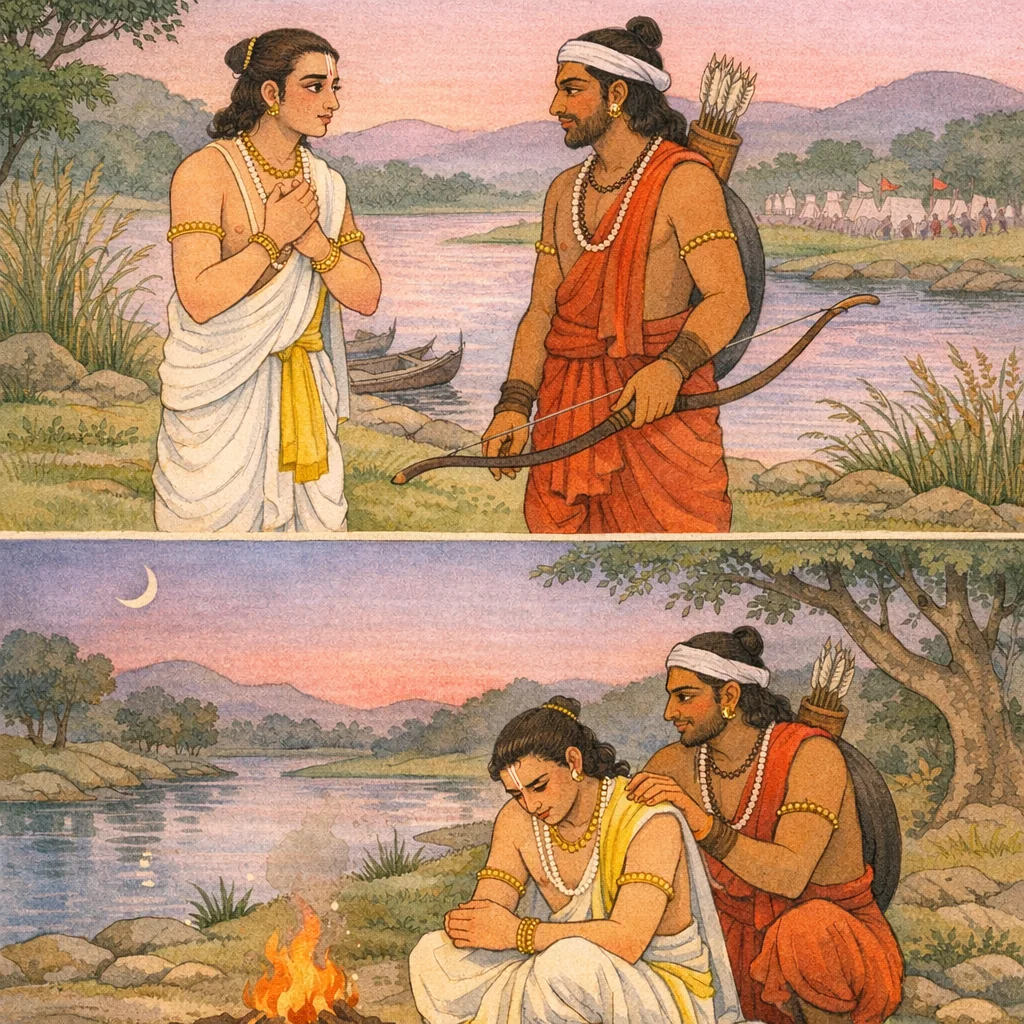
Sarga 85 stages a carefully calibrated dialogue between Bharata and Guha, the Niṣāda leader, to resolve suspicion and secure safe passage through the difficult Gāṅgā terrain toward Bharadvāja’s āśrama. Guha, attentive to security, questions whether Bharata’s large army conceals hostile intent toward Rāma; Bharata replies with measured gentleness, affirming Rāma as his revered elder—“equal to a father”—and explicitly states his purpose: to bring Rāma back, urging Guha to abandon doubt. The exchange then shifts to ethics of hospitality and alliance: Bharata praises Guha’s noble willingness to host an entire force, while Guha, delighted, extols Bharata’s renunciatory intent and predicts enduring fame. The setting transitions as daylight fades and night arrives; Bharata encamps and retires with Śatrughna. The chapter closes with an interior portrait of Bharata’s grief—rendered through extended mountain-and-forest-fire imagery—depicting sorrow as an inward conflagration that produces physical effects (sweat, fever of the heart) and mental disorientation, while Guha attempts consolation focused on Rāma.
Shlokas
Verse 1
एवमुक्तस्तु भरतो निषादाधिपतिं गुहम्।प्रत्युवाच महाप्राज्ञो वाक्यं हेत्वर्थसंहितम्।।2.85.1।।
Thus addressed, Bharata—the wise—replied to Guha, lord of the Niṣādas, with words rich in reason and meaning.
Verse 2
ऊर्जितः खलु ते कामः कृतो मम गुरोस्सखे।यो मे त्वमीदृशीं सेनामेकोऽभ्यर्चितुमिच्छसि।।2.85.2।।
O friend of my elder brother, truly noble is your intention—since you wish, all by yourself, to offer hospitality to so great an army of mine.
Verse 3
इत्युक्त्वा तु महातेजा गुहं वचनमुत्तमम्।अब्रवीद्भरत श्श्रीमाननिषादाधिपतिं पुनः।।2.85.3।।
Having thus spoken courteous words to Guha, the radiant Bharata again addressed the lord of the Niṣādas.
Verse 4
कतरेण गमिष्यामि भरद्वाजाश्रमं गुह।गहनोऽयं भृशं देशो गङ्गाऽनूपो दुरत्ययः।।2.85.4।।
O Guha, by which route may I reach Bharadvāja’s hermitage? This tract along the marshy banks of the Gaṅgā is thick and exceedingly hard to cross.
Verse 5
तस्य तद्वचनं श्रुत्वा राजपुत्रस्य धीमतः।अब्रवीत्प्राञ्जलिर्वाक्यं गुहो गहनगोचरः।।2.85.5।।
Hearing those words of the wise prince, Guha—who knew the ways of dense forests—replied with folded hands in reverence.
Verse 6
दाशास्त्वाऽनुऽगमिष्यन्ति धन्विनस्सुसमाहिताः।अहं त्वानुगमिष्यामि राजपुत्र महायशः।।2.85.6।।
O prince of great renown, these fishermen, well-prepared and armed with bows, will accompany you—and I too will follow with you.
Verse 7
कच्छिन्नदुष्टो व्रजसि रामस्याक्लिष्टकर्मणः।इयं ते महती सेना शङ्कां जनयतीव मे।।2.85.7।।
Surely you are not going to Rama—whose deeds are tireless—with ill intent? This great army of yours seems to raise suspicion in me.
Verse 8
तमेवमभिभाषन्तमाकाश इव निर्मलः।भरतश्श्लक्ष्णया वाचा गुहं वचनमब्रवीत्।।2.85.8।।
As Guha spoke thus, Bharata—clear and tranquil like the sky—answered him with gentle words.
Verse 9
माभूत्स कालो यत्कष्टं न मां शङ्कितुमर्हसि।राघव स्सहि मे भ्राता ज्येष्ठः पितुसमो मतः।।2.85.9।।
May that dreadful time never come; you ought not to suspect me. For Rama—my eldest brother—has always been regarded by me as equal to my father.
Verse 10
तं निवर्तयितुं यामि काकुत्स्थं वनवासिनम्।बुद्धिरन्या न ते कार्या गुह सत्यं ब्रवीमि ते।।2.85.10।।
I am going to bring back that Kakutstha prince who dwells in the forest. Entertain no other thought, O Guha—I speak the truth to you.
Verse 11
स तु संहृष्टवदन श्श्रुत्वा भरतभाषितम्।पुनरेवाब्रवीद्वाक्यं भरतं प्रति हर्षितः।।2.85.11।।
Hearing Bharata’s words, Guha—his face bright with joy—delightedly spoke again, addressing Bharata.
Verse 12
धन्यस्त्वं न त्वया तुल्यं पश्यामि जगतीतले।अयत्नादागतं राज्यं यस्त्वं त्यक्तुमिहेच्छसि।।2.85.12।।
Blessed are you; on this earth I see none equal to you—since you wish to renounce the kingdom that has come to you without effort.
Verse 13
शाश्वती खलु ते कीर्तिर्लोकाननुचरिष्यति।यस्त्वं कृच्छ्रगतं रामं प्रत्यानयितुमिच्छसि।।2.85.13।।
Indeed, your fame will endure and spread through the world—since you wish to bring back Rama who has fallen into hardship.
Verse 14
एवं सम्भाषमाणस्य गुहस्य भरतं तदा।बभौ नष्टप्रभस्सूर्यो रजनी चाभ्यवर्तत।।2.85.14।।
While Guha was thus speaking with Bharata, the sun’s light waned, and night came on.
Verse 15
सन्निवेश्य स तां सेनां गुहेन परितोषितः।शत्रुघ्नेन सह श्रीमाञ्छयनं समुपागमत्।।2.85.15।।
Having encamped that army, Bharata—gratified by Guha—went to rest together with Śatrughna.
Verse 16
रामचिन्तामय श्शोको भरतस्य महात्मनः।उपस्थितो ह्यनर्हस्य धर्मप्रेक्षस्य तादृशः।।2.85.16।।
Yet grief—filled with thoughts of Rama—came upon the great-souled Bharata, though such sorrow did not befit him, a man who looks to dharma.
Verse 17
अन्तर्दाहेन दहनस्सन्तापयति राघवम्।वनदाहाभिसन्तप्तं गूढोऽग्निरिव पादपम्।।2.85.17।।
The fire of grief scorched Bharata from within—like a hidden flame burning a tree already seared by a forest-fire.
Verse 18
प्रसृतस्सर्वगात्रेभ्यस्स्वेदं शोकाग्निसम्भवम्।यथा सूर्यांशुसन्तप्तो हिमवान् प्रसृतोहिमम्।।2.85.18।।
Sweat, born of the fire of grief, flowed from all his limbs—just as, when heated by the sun’s rays, the Himālaya lets its ice melt and stream down.
Verse 19
ध्याननिर्धरशैलेन विनिश्श्वसितधातुना।दैन्यपादपसंघेन शोकायासाधिशृङ्गिणा।।2.85.19।।प्रमोहानन्तसत्त्वेन सन्तापौषधिवेणुना।आक्रान्तो दुःखशैलेन महता कैकयीसुतः।।2.85.20।।
Kaikeyī’s son was overwhelmed by a vast mountain of sorrow: its unbroken rocks were his brooding thoughts, its ores were his heavy sighs, its thickets of trees were his dejection, its lofty peaks were grief and weariness, its countless creatures were stupor, and its bamboo and healing plants were burning anguish.
Verse 20
ध्याननिर्धरशैलेन विनिश्श्वसितधातुना।दैन्यपादपसंघेन शोकायासाधिशृङ्गिणा।।2.85.19।।प्रमोहानन्तसत्त्वेन सन्तापौषधिवेणुना।आक्रान्तो दुःखशैलेन महता कैकयीसुतः।।2.85.20।।
Kaikeyī’s son was overwhelmed by a vast mountain of sorrow: its unbroken rocks were his brooding thoughts, its ores were his heavy sighs, its thickets of trees were his dejection, its lofty peaks were grief and weariness, its countless creatures were stupor, and its bamboo and healing plants were burning anguish.
Verse 21
विनिश्श्वसन्वै भृशदुर्मनास्ततः प्रमूढसंज्ञः परमापदं गतः।शमं न लेभे हृदयज्वरार्दितो नरर्षभो यूथहतो यथर्षभः।।2.85.21।।
Then Bharata, best among men, heaving deep sighs and sorely distressed—his senses bewildered, fallen into extreme calamity, and scorched by the fever in his heart—found no peace, like a bull cut off from its herd.
Verse 22
गुहेन सार्धं भरतस्समागतो महानुभावस्सजनस्समाहितः।सुदुर्मनास्तं भरतं तदा पुनर्गुह स्समाश्वासयदग्रजं प्रति।।2.85.22।।
Bharata—noble in spirit—came together with Guha, accompanied by his people, steadying his mind; and then Guha, though deeply troubled, once again consoled Bharata concerning his elder brother, Rama.
Frequently Asked Questions
The dilemma is political suspicion versus dharmic intent: Guha must judge whether Bharata’s army signals aggression toward the exiled Rāma. Bharata resolves the tension by transparent declaration of purpose (to bring Rāma back) and by affirming filial reverence for his elder brother, converting a security challenge into a trust-based alliance.
The chapter teaches that righteous aims should be communicated with restraint and clarity: gentle, reasoned speech can dissolve mistrust, while genuine renunciation (refusal to exploit effortless power) becomes a marker of moral authority. It also frames grief as an inward fire that must be acknowledged without allowing it to corrupt duty.
The marshy, forested banks of the Gaṅgā are emphasized as difficult terrain, and Bharadvāja’s āśrama is the immediate destination—functioning as a cultural waypoint where royal travelers seek guidance from ascetic authority. The Niṣāda domain and Guha’s fishermen/boatmen indicate riverine mobility and local guardianship of crossings.