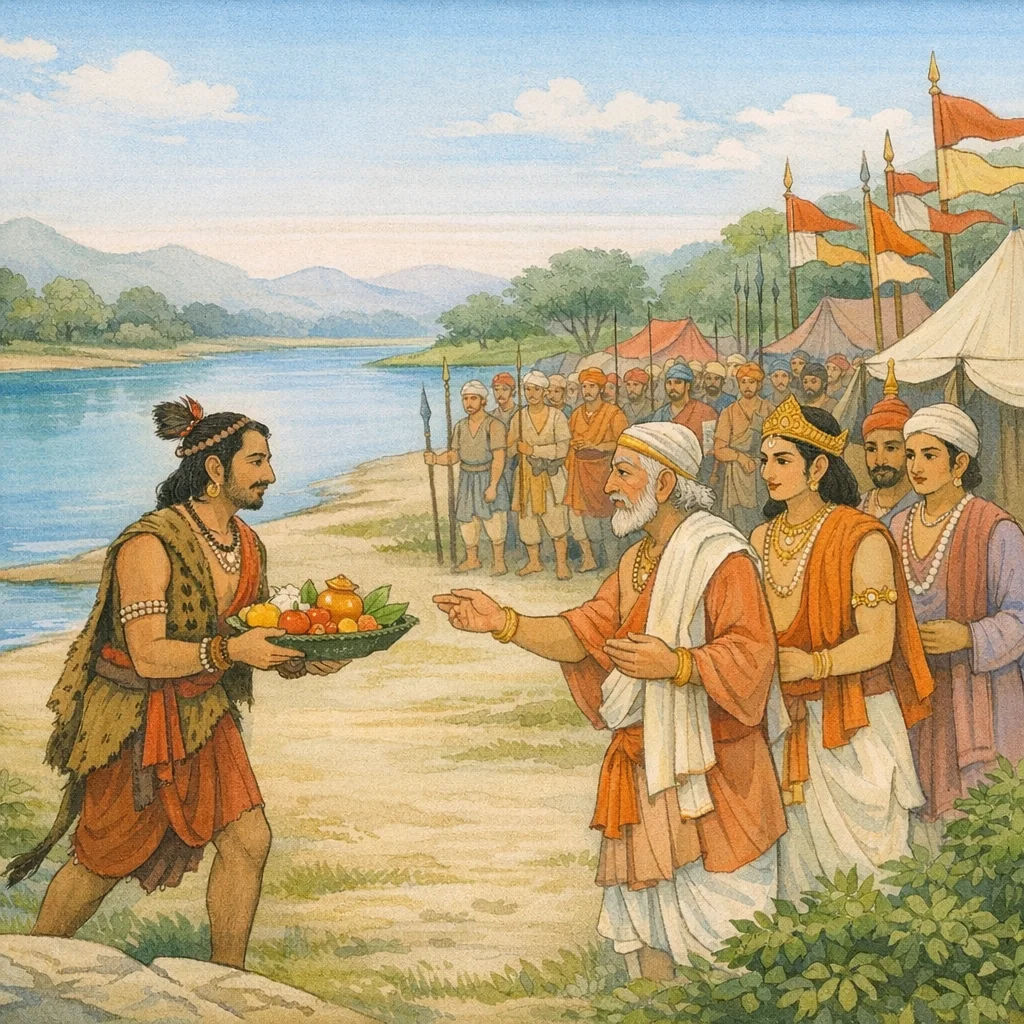
Sarga 84
गुहस्य सन्देहः, गङ्गातीर-रक्षा, भरतस्य सत्कारः (Guha’s Suspicion, Securing the Ganga Bank, and Hospitality to Bharata)
अयोध्याकाण्ड
Sarga 84 stages a tense encounter at the Gaṅgā’s bank where Guha, chief of the Niṣādas, sees Bharata’s bannered army encamped along the river and initially interprets the force as a possible threat to the exiled Rāma. He voices strategic anxieties—whether Bharata comes to bind or kill the river-folk—and orders a defensive river posture: fishermen and river-guards to hold positions, and five hundred boats to be readied with fully equipped crews. The conditional logic is explicit: if Bharata is proved not ill-disposed toward Rāma, the army may safely cross that very day. As the situation clarifies, Guha approaches Bharata with offerings (fish, meat, wine) and requests him to lodge in his servant-household, presenting his territory as subordinate and welcoming. Sumantra functions as a diplomatic mediator, identifying Guha as an aged friend of Rāma, knowledgeable of the Dandaka region, and advising Bharata to grant audience—thus converting suspicion into alliance and establishing the Gaṅgā corridor as a controlled, ethically negotiated passage.
Shlokas
Verse 1
ततो निविष्टां ध्वजिनीं गङ्गामन्वाश्रितां नदीम्।निषादराजो दृष्ट्वैव ज्ञातीन्सन्त्वरितोऽऽब्रवीत्।।।।
Then Guha, king of the Niṣādas, saw the bannered army encamped along the river Gaṅgā’s bank; at once he hurried to his kinsmen and spoke.
Verse 2
महतीयमितस्सेना सागराभा प्रदृश्यते।नास्यान्तमधिगच्छामि मनसापि विचिन्तयन्।।।।
This army on this side appears vast like an ocean; even when I reflect upon it in my mind, I cannot grasp its limit.
Verse 3
यथा तु खलु दुर्बुद्धिर्भरत स्स्वयमागतः।स एष हि महाकायः कोविदारध्वजो रथे।।।।
It seems that Bharata himself has come—ill-advised as he is; for there, on the chariot, is seen the great standard bearing the emblem of the kovidāra tree.
Verse 4
बन्धयिष्यति वा दाशानथवाऽस्मान्वधिष्यति।अथ दाशरथिं रामं पित्रा राज्याद्विवासितम्।।।।सम्पन्नां श्रियमन्विच्छन्स्तस्य राज्ञ स्सुदुर्लभाम्।भरतः कैकयीपुत्रो हन्तुं समधिगच्छति।।।।
Will he bind the fishermen with cords—or will he even slay us? Or has he come to strike at Rāma, the son of Daśaratha, whom his father has banished from the kingdom?
Verse 5
बन्धयिष्यति वा दाशानथवाऽस्मान्वधिष्यति।अथ दाशरथिं रामं पित्रा राज्याद्विवासितम्।।2.84.4।।सम्पन्नां श्रियमन्विच्छन्स्तस्य राज्ञ स्सुदुर्लभाम्।भरतः कैकयीपुत्रो हन्तुं समधिगच्छति।।2.84.5।।
Seeking that kingly prosperity—full and hard to obtain—does Bharata, Kaikeyī’s son, advance with the purpose of killing (Rāma)?
Verse 6
भर्ताचैव सखाचैव रामो दाशरथिर्मम।तस्यार्थकामास्सन्नद्धा गङ्गाऽनूपे प्रतिष्ठत।।।।
Rāma, Daśaratha’s son, is both my lord and my friend. Therefore, armed for the sake of his interests, take your stand upon the Gaṅgā’s riverbank.
Verse 7
तिष्ठन्तु सर्वे दाशाश्च गङ्गामन्वाश्रिता नदीम्।बलयुक्ता नदीरक्षा मांसमूलफलाशनाः।।।।
Let all the fishermen—river-guards who live on meat, roots, and fruits—take up positions along the river Gaṅgā, together with their forces, and remain stationed.
Verse 8
नावां शतानां पञ्चानां कैवर्तानां शतं शतम्।सन्नद्धानां तथा यूनां तिष्ठन्त्वित्यभ्यचोदयत्।।।।
He urged them: “Let five hundred boats be kept ready, and in each boat a hundred young fishermen, fully equipped, stand prepared.”
Verse 9
यदाऽऽदुष्टस्तु भरतो रामस्येह भविष्यति।सेयं स्वस्तिमती सेना गङ्गामद्य तरिष्यति।।।।
If it turns out that Bharata is not ill-disposed toward Rāma here, then this army may cross the Gaṅgā today itself in safety.
Verse 10
इत्युक्त्वोपायनं गृह्य मत्स्यमांसमधूनि च।अभिचक्राम भरतं निषादाधिपतिर्गुहः।।।।
Having spoken thus, Guha, lord of the Niṣādas, took gifts—fish, meat, and wine—and went forth to meet Bharata.
Verse 11
तमायान्तं तु सम्प्रेक्ष्य सूतपुत्रः प्रतापवान्।भरतायाऽचचक्षेऽथ विनयज्ञो विनीतवत्।।।।
Seeing him approaching, the valiant Sumantra—skilled in propriety—humbly informed Bharata.
Verse 12
एष ज्ञातिसहस्रेण स्थपतिः परिवारितः।कुशलो दण्डकारण्ये वृद्धो भ्रातुश्च ते सखा।।।।
“Here is that chief, surrounded by thousands of his kinsmen—skilled in the ways of the Daṇḍaka forest, an elder, and also your brother’s friend.”
Verse 13
तस्मात्पश्यतु काकुत्स्थ त्वां निषादाधिपो गुहः।असंशयं विजानीते यत्र तौ रामलक्ष्मणौ।।।।
“Therefore, O scion of the Kakutsthas, let Guha, lord of the Niṣādas, meet you; without doubt he will know where Rama and Lakṣmaṇa are.”
Verse 14
एतत्तु वचनं श्रुत्वा सुमन्त्राद्भरत श्शुभम्।उवाच वचनं शीघ्रं गुहः पश्यतु मामिति।।।।
Hearing these auspicious words from Sumantra, Bharata promptly replied, “Let Guha meet me at once.”
Verse 15
लब्ध्वाऽभ्यनुज्ञां संहृष्टो ज्ञातिभिः परिवारितः।आगम्य भरतं प्रह्वो गुहो वचनमब्रवीत्।।।।
Having received permission, Guha—delighted and accompanied by his kinsmen—approached Bharata; bowing low, he spoke.
Verse 16
निष्कुटश्चैव देशोऽयं वञ्चिताश्चापि ते वयम्।निवेदयामस्ते सर्वे स्वके दासकुले वस।।।।
“This land is as though it were your own private garden, and we too are your dependents. We all entreat you: stay in the home of your servant.”
Verse 17
अस्ति मूलं फलञ्चैव निषादैस्समुपाहृतम्।आर्द्रं च मांसं शुष्कं च वन्यं चोच्चावचं महत्।।।।
“There are roots and fruits gathered and brought by the Niṣādas, and meat as well—fresh and dried—along with abundant forest provisions of many kinds.”
Verse 18
आशंसे स्वाशिता सेना वत्स्यतीमां विभावरीम्।अर्चितो विविधैः कामै श्श्व स्ससैन्यो गमिष्यसि।।।।
“I trust your army, well-fed and refreshed, will spend this night here; honored with various comforts, you will depart tomorrow with your forces.”
Frequently Asked Questions
Guha faces a dharma-laden security dilemma: protect Rāma’s interests and his own river community while avoiding unjust hostility toward Bharata; he responds with conditional defense—prepare boats and guards—until Bharata’s intent is verified.
The episode models prudent ethics: vigilance is compatible with goodwill when guided by evidence, mediation, and respect for legitimate bonds; hospitality becomes a civic instrument that transforms potential conflict into ordered passage.
The Gaṅgā bank (anūpa) is treated as a strategic corridor controlled by boatmen (dāśa/kaivarta) and local polities (Niṣādas), while Dandaka is referenced as the forest-region Guha knows—mapping routes relevant to Rāma and Lakṣmaṇa’s whereabouts.