Sarga 80
मर्गनिर्माणम् (Roadworks and the Royal Route Prepared for Bharata)
अयोध्याकाण्ड
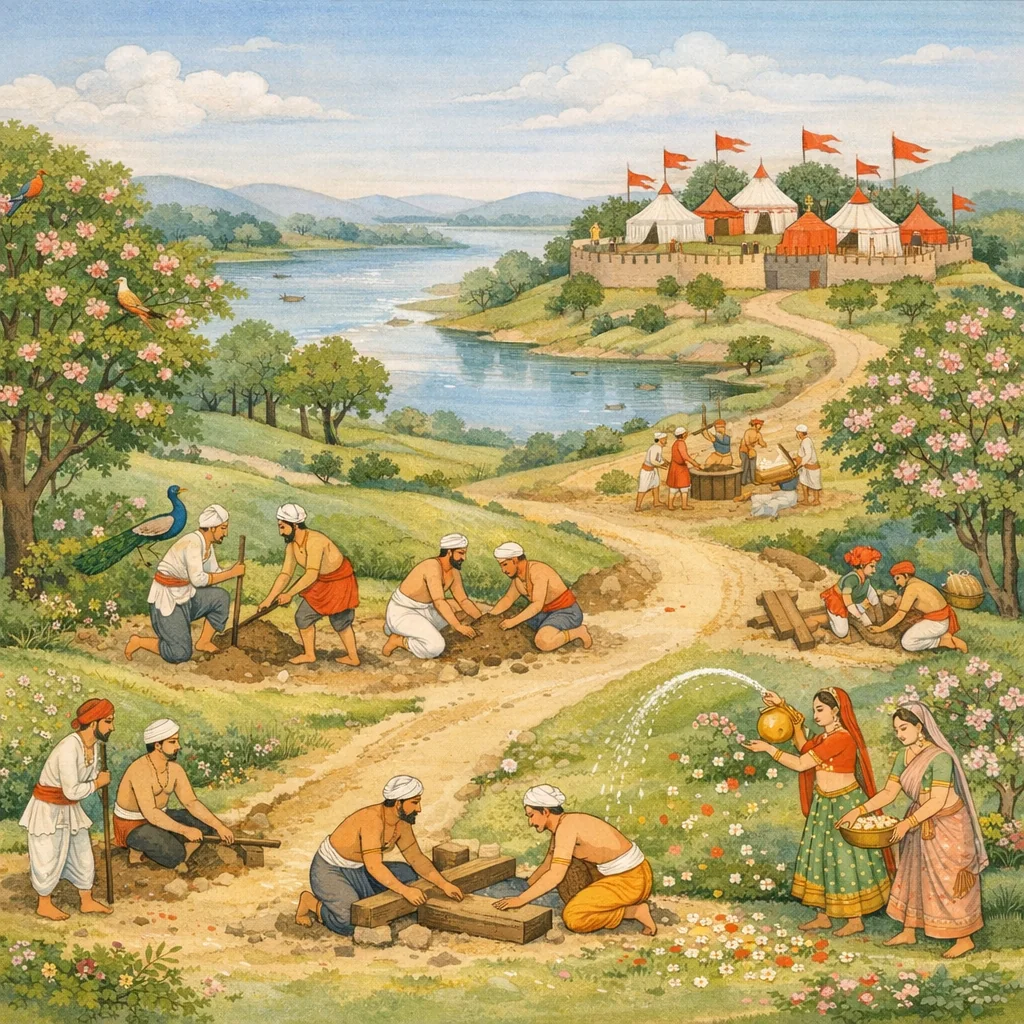
Sarga 80 presents a logistical and architectural interlude: authorized officials dispatch specialized guilds—surveyors, measurers, excavators, engineers, architects, carpenters, road-workers, woodcutters, well-diggers, plasterers/whitewashers, bamboo-workers, and supervisors—to prepare Bharata’s route and encampments in advance. The workforce clears vegetation and boulders, levels impassable ground, fills wells and chasms, bridges necessary crossings, crushes and splits obstructive stones to manage drainage, and rapidly constructs water-courses/reservoirs. In arid stretches they dig ornamented drinking wells with circular embankments. The road is then aestheticized as a royal processional way: mosaic paving, blossoming avenues, birdsong, banners, sandal-water sprinkling, and floral strewing—likened to a divine path and to a night sky adorned with moon and stars. Resting-places (nivēśa) are selected in fertile, pleasant tracts and established at astrologically auspicious constellations and muhūrtas; fortified camp-features appear—sand-heaps, moats, walls, mansions, and flag-topped peaks—making the encampments resemble Indra’s city. The sequence culminates as the party reaches the river Jāhnavī (Gaṅgā), described with cool clear waters, abundant fish, and wooded banks, anchoring the narrative in a concrete sacred geography.
Shlokas
Verse 1
अथ भूमिप्रदेशज्ञास्सूत्रकर्मविशारदाः।स्वकर्माभिरताश्शूराः खनका यन्त्रकास्तथा।।।।कर्मान्तिकाः स्थपतयः पुरुष यन्त्रकोविदाः।तथा वार्धकयश्चैव मार्गिणो वृक्षतक्षकाः।।।।कूपकारास्सुधाकारार्वंशकर्मकृतस्तथा।समर्था ये च द्रष्टारः पुरतस्ते प्रतस्थिरे।।।।
Thereafter, land-surveyors and expert measurers, zealous and capable workers—excavators and engineers—skilled craftsmen, architects, and mechanics, carpenters, road-makers, and tree-cutters, well-diggers, plasterers/whitewashers, bamboo-workers, and competent overseers set out ahead in advance.
Verse 2
अथ भूमिप्रदेशज्ञास्सूत्रकर्मविशारदाः।स्वकर्माभिरताश्शूराः खनका यन्त्रकास्तथा।।2.80.1।।कर्मान्तिकाः स्थपतयः पुरुष यन्त्रकोविदाः।तथा वार्धकयश्चैव मार्गिणो वृक्षतक्षकाः।।2.80.2।।कूपकारास्सुधाकारार्वंशकर्मकृतस्तथा।समर्था ये च द्रष्टारः पुरतस्ते प्रतस्थिरे।।2.80.3।।
Then skilled workmen—architects and mechanics, along with carpenters, road-builders, and wood-cutters—were dispatched to proceed and prepare the way.
Verse 3
अथ भूमिप्रदेशज्ञास्सूत्रकर्मविशारदाः।स्वकर्माभिरताश्शूराः खनका यन्त्रकास्तथा।।2.80.1।।कर्मान्तिकाः स्थपतयः पुरुष यन्त्रकोविदाः।तथा वार्धकयश्चैव मार्गिणो वृक्षतक्षकाः।।2.80.2।।कूपकारास्सुधाकारार्वंशकर्मकृतस्तथा।समर्था ये च द्रष्टारः पुरतस्ते प्रतस्थिरे।।2.80.3।।
Well-diggers, plasterers, and bamboo-workers too—together with capable overseers—set out in advance to supervise and complete the preparations.
Verse 4
स तु हर्षात्तमुद्देशं जनौघो विपुलः प्रयान्।अशोभत महावेगस्समुद्र इव पर्वणि।।।।
That immense throng of people, moving joyfully toward the appointed place, surged with great speed—splendid like the ocean swelling on a festival full-moon tide.
Verse 5
ते स्ववारं समास्थाय वर्त्मकर्मणि कोविदाः।करणैर्विविधोपेतैः पुरस्तात्सम्प्रतस्थिरे।।।।
Those skilled in road-work took their assigned positions in their respective teams and, equipped with diverse tools, set out ahead.
Verse 6
लतावल्ली श्च गुल्मांश्च स्थाणूनश्मन एव च।जनायांचक्रिरे मार्गं छिन्दन्तो विविधान्द्रुमान्।।।।
Cutting down creepers and shrubs, removing stumps and even boulders, and felling various trees, the king’s men made a clear road for the people.
Verse 7
अवृक्षेषु च देशेषु केचिद्वृक्षानरोपयन्।केचित्कुठारैष्टङ्कैश्च दात्रैश्चिन्दन्क्वचित्क्वचित्।।।।
Some planted saplings in places that had no trees, while others, here and there, cut (obstructing) growth with axes, hatchets, and sickles.
Verse 8
अपरे वीरणस्तम्भान्बलिनो बलवत्तराः।विधमन्ति स्म दुर्गाणि स्थलानि च ततस्ततः।।।।
Others—strong men, stronger still—uprooted the tough clumps of vīraṇa grass and, here and there, leveled difficult patches of ground.
Verse 9
अपरेऽपूरयन्कूपान्पांसुभि श्श्वभ्रमायतम्।निम्नभागान्स्ततः केचित्समान्श्चक्रु स्समन्ततः।।।।
Some filled in wells and broad chasms with loose earth; thereafter others made the low-lying ground level and even on all sides.
Verse 10
बबन्धुर्बन्धनीयांश्च क्षोद्यान्सञ्चुक्षुदुस्तदा।बिभिदुर्भेदनीयांश्च तांस्तान्देशान्नरा स्तदा।।।।
Then the men bridged what needed bridging, crushed what had to be crushed, and split open what required splitting—clearing and opening up those stretches of the route.
Verse 11
अचिरेणैव कालेन परिवाहान्बहूदकान्।चक्रुर्बहुविधाकारान् सागरप्रतिमान्बहून्।।।।
In a short time they made many water-courses and reservoirs—of varied designs—holding abundant water, vast as the sea in their capacity.
Verse 12
निर्जलेषु च देशेषु खानयामासुरुत्तमान्।उदपानान्बहुविधान्वेदिकापरिमण्डितान्।।।।
And in waterless regions they had excellent wells dug—many kinds of drinking-water wells—encircled and finished with raised platforms and protective embankments.
Verse 13
ससुधाकुट्टिमतलः प्रपुष्पितमहीरुहः।मत्तोद्घुष्ट द्विजगणः पताकाभिरलङ्कृतः।।।।चन्दनोदकसंसिक्तो नानाकुसुमभूषितः।बह्वशोभत सेनायाः पन्था स्सुरपथोपमः।।।।
The army’s highway shone splendidly—its surface finished with plastered paving, lined with trees in bloom, resonant with flocks of birds in exuberant song; adorned with banners, sprinkled with sandal-scented water, and decorated with flowers of many kinds—like a pathway of the gods.
Verse 14
ससुधाकुट्टिमतलः प्रपुष्पितमहीरुहः।मत्तोद्घुष्ट द्विजगणः पताकाभिरलङ्कृतः।।2.80.13।।चन्दनोदकसंसिक्तो नानाकुसुमभूषितः।बह्वशोभत सेनायाः पन्था स्सुरपथोपमः।।2.80.14।।
The army’s highway shone splendidly—paved and plaster-finished, lined with flowering trees, vibrant with singing birds, adorned with banners; sprinkled with sandal-water and strewn with many kinds of flowers—like a road of the gods.
Verse 15
आज्ञाप्याथ यथाऽज्ञप्ति युक्तास्तेऽधिकृता नराः।रमणीयेषु देशेषु बहुस्वादुफलेषु च।।।।यो निवेशस्त्वभिप्रेतो भरतस्य महात्मनः।भूयस्तं शोभयामासुर्भूषाभिर्भूषणोपमम्।।।।
Then the appointed officials, acting exactly as instructed, chose delightful places rich with sweet fruits as the great-souled Bharata’s resting-stations, and adorned them again and again with decorations, so that the camps themselves looked like ornaments.
Verse 16
आज्ञाप्याथ यथाऽज्ञप्ति युक्तास्तेऽधिकृता नराः।रमणीयेषु देशेषु बहुस्वादुफलेषु च।।2.80.15।।यो निवेशस्त्वभिप्रेतो भरतस्य महात्मनः।भूयस्तं शोभयामासुर्भूषाभिर्भूषणोपमम्।।2.80.16।।
Then the authorized officers, working precisely as directed, selected charming regions abundant in sweet fruits for the great Bharata’s resting-place, and adorned it so well with decorations that it appeared like an ornament itself.
Verse 17
नक्षत्रेषु प्रशस्तेषु मुहूर्तेषु च तद्विदः।निवेशान् स्थापयामासुर्भरतस्य महात्मनः।।।।
Experts in auspicious timing established Bharata’s resting-camps at favorable constellations and proper muhūrtas, aligning the journey’s stages with auspicious celestial conditions.
Verse 18
बहुपांसुचयाश्चापि परिखापरिवारिताः।तत्रेन्द्रकीलप्रतिमाः प्रतोलीवरशोभिताः।।।।प्रासादमालावितता स्सौधप्राकारसंवृताः।पताकाशोभिता स्सर्वे सुनिर्मितमहापथाः।।।।विसर्पद्भिरिवाऽकाशे विटङ्काग्रविमानकैः।समुच्छ्रितैर्निवेशास्ते बभुश्शक्रपुरोपमाः।।।।
There, heaps of sand were raised and the area was encircled by moats; splendid gateways adorned it, and the ramparts rose like Mount Indrakīla.
Verse 19
बहुपांसुचयाश्चापि परिखापरिवारिताः।तत्रेन्द्रकीलप्रतिमाः प्रतोलीवरशोभिताः।।2.80.18।।प्रासादमालावितता स्सौधप्राकारसंवृताः।पताकाशोभिता स्सर्वे सुनिर्मितमहापथाः।।2.80.19।।विसर्पद्भिरिवाऽकाशे विटङ्काग्रविमानकैः।समुच्छ्रितैर्निवेशास्ते बभुश्शक्रपुरोपमाः।।2.80.20।।
It was lined with rows of mansions and enclosed by lofty walls; everywhere flags added splendor, and the great roads were broad and well constructed.
Verse 20
बहुपांसुचयाश्चापि परिखापरिवारिताः।तत्रेन्द्रकीलप्रतिमाः प्रतोलीवरशोभिताः।।2.80.18।।प्रासादमालावितता स्सौधप्राकारसंवृताः।पताकाशोभिता स्सर्वे सुनिर्मितमहापथाः।।2.80.19।।विसर्पद्भिरिवाऽकाशे विटङ्काग्रविमानकैः।समुच्छ्रितैर्निवेशास्ते बभुश्शक्रपुरोपमाः।।2.80.20।।
With their lofty mansions and peaked rooftops seeming to spread into the sky, those residences stood exalted—like Śakra’s own celestial city.
Verse 21
जाह्नवीं तु समासाद्य विविधद्रुमकाननाम्।शीतलामलपानीयां महामीनसमाकुलाम्।।।।
Reaching the Jāhnavī (Gaṅgā), whose banks held groves of many kinds of trees, whose waters were cool and clear, and which teemed with great fish, they arrived at the river’s side.
Verse 22
सचन्द्रतारागणमण्डितं यथा नभः क्षपायाममलं विराजते।नरेन्द्रमार्गस्स तथा व्यराजत क्रमेण रम्यः शुभशिल्पिनिर्मितः।।।।
As the pure night-sky shines adorned with the moon and clusters of stars, so too the king’s road—lovely, orderly, and fashioned by skilled artisans—shone in splendor.
Frequently Asked Questions
The chapter emphasizes a collective civic action rather than a debate: the state mobilizes skilled labor to ensure safe passage and dignified reception for Bharata, presenting governance as dharma expressed through public works, safety, and ordered planning.
Dharma is operational: legitimacy and virtue are supported by disciplined institutions—measurement, supervision, timely execution, and care for water and roads—showing that ethical kingship includes infrastructure, aesthetics, and ritual auspiciousness.
Key landmarks include the royal road (नरेन्द्रमार्ग) engineered and beautified for procession, the fortified encampments likened to Śakra’s city, and the river Jāhnavī (Gaṅgā), described as cool, clear, fish-rich, and bordered by diverse tree-groves.