Sarga 78
अष्टसप्ततितमः सर्गः — Śatrughna’s Fury and Bharata’s Restraint (Mantharā Episode)
अयोध्याकाण्ड
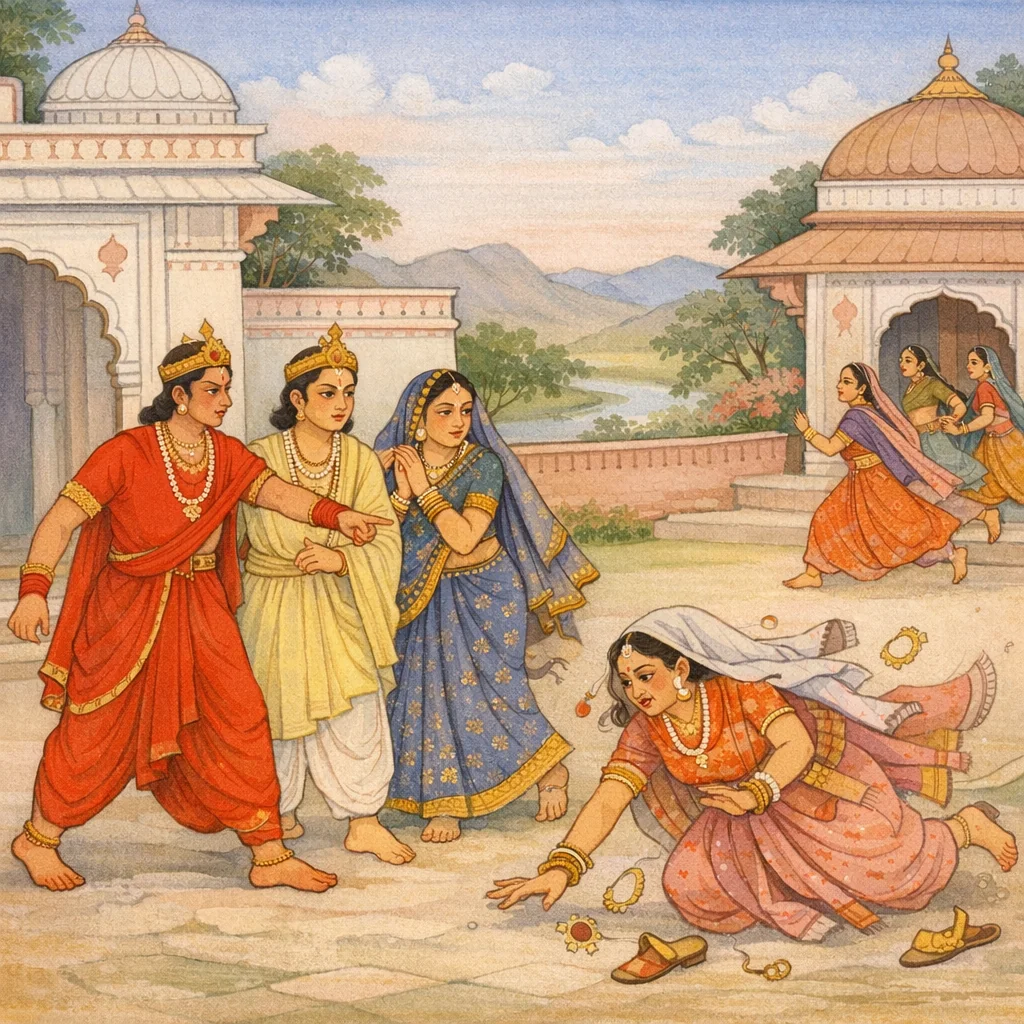
Sarga 78 stages an ethics-of-anger episode within the Ayodhyā court aftermath. As Bharata, grief-stricken, prepares to depart toward Rāma, Śatrughna speaks with indignation: he questions how Rāma—refuge of beings—could be exiled by a woman, why Lakṣmaṇa did not countermand the exile, and why the king did not restrain himself after weighing right and wrong. Mantharā appears at the palace entrance adorned in royal garments and ornaments; gatekeepers seize and present her as culpable for Rāma’s forest exile and Daśaratha’s death. Hearing this, Śatrughna—steadfast in vows yet overcome by grief—threatens retribution and violently drags Mantharā; her ornaments scatter, and the palace is depicted as glittering like an autumn sky. Companions flee and seek refuge with compassionate Kausalyā. Śatrughna’s fury extends to harsh censure of Kaikeyī, who then seeks Bharata’s protection. Bharata intervenes with a normative injunction: women are not to be slain; he urges pardon. Śatrughna admits he would kill Kaikeyī but for fear of Rāma’s reproach as ‘mother-slayer,’ and he desists, releasing Mantharā. Mantharā collapses at Kaikeyī’s feet, lamenting; Kaikeyī consoles her gently—closing the sarga with a contrast between vengeance, restraint, and courtly compassion.
Shlokas
Verse 1
अथ यात्रां समीहन्तं शत्रुघ्नो लक्ष्मणानुजः।भरतं शोकसन्तप्तमिदं वचनमब्रवीत्।।।।
Then, as grief-tormented Bharata sought to set out on the journey (to Rāma), Śatrughna—Lakṣmaṇa’s younger brother—spoke these words to him.
Verse 2
गतिर्य स्सर्वभूतानां दुःखे किं पुनरात्मनः।स राम स्सत्त्वसम्पन्नः स्त्रिया प्रव्राजितो वनम्।।।।
How could Rāma—who is the final refuge of all beings—not be able to safeguard himself in his own hour of sorrow? Yet that very Rāma, steadfast and strong, has been driven into the forest by a woman.
Verse 3
बलवान्वीर्यसम्पन्नो लक्ष्मणो नाम योऽप्यसौ।किं न मोचयते रामं कृत्वा स्म पितृनिग्रहम्।।।।
And why did Lakṣmaṇa—strong and full of valor—not free Rāma by restraining our father?
Verse 4
पूर्वमेव तु निग्राह्य स्समवेक्ष्य नयानयौ।उत्पथं यस्समारूढो राजा नार्या वशं गतः।।।।
Indeed, the king ought to have checked himself at the very outset, discerning right from wrong—he who, having strayed onto a wrongful path, came under a woman’s sway.
Verse 5
इति सम्भाषमाणे तु शत्रुघ्ने लक्ष्मणानुजे।प्राग्द्वारेऽभूत्तदा कुब्जा सर्वाभरणभूषिता।।।।
As Śatrughna, the younger brother of Lakṣmaṇa, was conversing in this way, the hunchback Mantharā—adorned with every kind of ornament—appeared at the eastern entrance.
Verse 6
लिप्ता चन्दनसारेण राजवस्त्राणि बिभ्रती।विविधं विविधै स्तैस्तैर्भूषणैश्च विभूषिता।।।।
She was anointed with sandal essence, dressed in royal garments, and ornamented in manifold ways with a variety of jewelry.
Verse 7
मेखलादामभिश्चित्रैरन्यैश्च शुभभूषणैः।बभासे बहुभिर्बद्धा रज्जुबद्धेव वानरी।।।।
Bound about with many colorful girdle-strings and other auspicious ornaments, she glittered—like a female monkey tied up with ropes.
Verse 8
तां समीक्ष्य तदा द्वास्स्थास्सुभृशं पापकारिणीम्।गृहीत्वाऽकरुणां कुब्जां शत्रुघ्नाय न्यवेदयन्।।।।
Seeing her then, the gatekeepers—regarding the hunchback as a grievous wrongdoer, pitiless in nature—seized her and reported the matter to Śatrughna.
Verse 9
यस्याः कृते वने रामो न्यस्तदेहश्च वः पिता।सेयं पापा नृशंसा च तस्याः कुरु यथामति।।।।
“Because of her, Rāma is in the forest, and your father has laid down his body. This is that sinful, cruel woman—do with her as you think fit.”
Verse 10
शत्रुघ्नश्च तदाज्ञाय वचनं भृशदुःखितः।अन्तःपुरचरान्सर्वानित्युवाच धृत व्रतः।।।।
Deeply grieved on hearing those words, Śatrughna—steadfast in his resolve—addressed all the attendants of the inner palace quarters:
Verse 11
तीव्रमुत्पादितं दुःखं भ्रात्रूणां मे तथा पितुः।यया सेयं नृशंसस्य कर्मणः फलमश्नुताम्।।।।
“She by whom intense sorrow has been brought upon my brothers and my father—let that very woman reap the fruit of her cruel deed.”
Verse 12
एवमुक्त्वा तु तेनाशु सखीजनसमावृता।गृहीता बलवत्कुब्जा सा तद्गृहमनादयत्।।।।
Having spoken thus, he swiftly seized the hunchback—though she was surrounded by her companions—and she then filled that house with her loud cries.
Verse 13
तत स्सुभृशसन्तप्तस्तस्या स्सर्व स्सखीजनः।क्रुद्धमाज्ञाय शत्रुघ्नं विपलायत सर्वशः।।।।
Then all her companions, greatly distressed, realizing that Śatrughna was enraged, fled away in every direction.
Verse 14
आमन्त्रयत कृत्स्न श्च तस्या स्सर्व स्सखीजनः।यथाऽयं समुपक्रान्तो निश्शेषां नः करिष्यति।।।।
All her companions conferred together: “From how he has begun, this man will make an end of us completely—leaving none.”
Verse 15
सानुक्रोशां वदान्यां च धर्मज्ञां च यशस्विनीम्।कौसल्यां शरणं याम सा हि नोऽस्तु ध्रुवा गतिः।।।।
“Let us seek refuge in Kausalyā—compassionate, generous, wise in dharma, and illustrious—for she alone will be our sure protection.”
Verse 16
स च रोषेण ताम्राक्ष श्शत्रुघ्न श्शत्रुतापनः।विचकर्ष तदा कुब्जां क्रोशन्तीं धरणीतले।।।।
And Śatrughna—the enemy-scorcher—his eyes reddened with rage, then dragged the shrieking hunchback along the ground.
Verse 17
तस्या ह्याकृष्यमाणाया मन्थराया स्ततस्ततः।चित्रं बहुविधं भाण्डं पृथिव्यां तद्व्यशीर्यत।।।।
As Mantharā was being dragged, her many-colored and various ornaments scattered and broke, strewn here and there upon the ground.
Verse 18
तेन भाण्डेन संस्तीर्णं श्रीमद्राजनिवेशनम्।अशोभत तदा भूयः शारदं गगनं यथा।।।।
The splendid royal residence, strewn with those ornaments, shone all the more—like the clear autumn sky (glittering with stars).
Verse 19
स बली बलवत्क्रोधाद्गृहीत्वा पुरुषर्षभः।कैकेयीमभिनिर्भर्त्स्य बभाषे परुषं वचः।।।।
Mighty and foremost among men, he—seized by fierce anger—took hold (of the hunchback) and, threatening Kaikeyī, spoke harsh words.
Verse 20
तैर्वाक्यैः परुषैर्दुःखैः कैकेयी भृशदुःखिता।शत्रुघ्नभयसन्त्रस्ता पुत्रं शरणमागता।।।।
Wounded by those harsh and painful words, Kaikeyī became deeply distressed; frightened of Śatrughna, she went to her son as a refuge.
Verse 21
तं प्रेक्ष्य भरतः क्रुद्धं शत्रुघ्नमिदमब्रवीत्।अवध्या स्सर्वभूतानां प्रमदाः क्षम्यतामिति।।।।
Seeing Śatrughna enraged, Bharata said to him: “Women are not to be slain—among all beings. Let her be forgiven.”
Verse 22
हन्यामहमिमां पापां कैकेयीं दुष्टचारिणीम्।यदि मां धार्मिको रामो नासूयेन्मातृघातकम्।।।।
I would have slain this sinful Kaikeyī, a woman of wicked conduct—if righteous Rāma would not then condemn me as a ‘slayer of a mother.’
Verse 23
इमामपि हतां कुब्जां यदि जानाति राघवः।त्वां च मां च हि धर्मात्मा नाभिभाषिष्यते ध्रुवम्।।।।
If Rāghava learns that even this hunchback has been killed, that righteous man will surely not speak to you or to me.
Verse 24
भरतस्य वचश्श्रुत्वा शत्रुघ्नो लक्ष्मणानुजः।न्यवर्तत ततो रोषात्तां मुमोच च मन्थराम्।।।।
Hearing Bharata’s words, Śatrughna—the younger brother of Lakṣmaṇa—checked his rage and released Mantharā.
Verse 25
सा पादमूले कैकेय्या मन्थरा निपपात ह।निश्श्वसन्ती सुदुःखार्ता कृपणं विललाप च।।।।
Mantharā fell down at Kaikeyī’s feet; heaving deep sighs, tormented by grief, she lamented pitiably.
Verse 26
शत्रुघ्नविक्षेपविमूढसंज्ञां समीक्ष्य कुब्जां भरतस्य माता।शनैस्समाश्वासयदार्तरूपां क्रौञ्चीं विलग्नामिव वीक्षमाणाम्।।।।
Seeing the hunchback, her senses dazed from being flung about by Śatrughna—anguished and looking about like a female krauñca-bird trapped—Bharata’s mother (Kaikeyī) gently consoled her.
Frequently Asked Questions
The chapter presents the dilemma of retaliatory justice versus dharmic restraint: Śatrughna attempts violent punishment of Mantharā (and condemns Kaikeyī), while Bharata restrains him by invoking a normative rule that women are not to be slain.
Anger may arise from grief and perceived injustice, but dharma is measured by self-control and proportionality; Bharata’s intervention reframes vengeance as a moral hazard that could alienate Rāma and violate ethical boundaries.
The action is anchored in Ayodhyā’s palace space: the eastern gate (प्राग्द्वार), the inner apartments (अन्तःपुर), and the royal residence (श्रीमद्राजनिवेशनम्), with cultural markers such as royal garments, sandal paste, and ornamentation used to visualize status and disorder.