Sarga 71
भरतस्य अयोध्याप्रत्यागमनम् — Bharata’s Return Journey and the Distant Sight of Ayodhya
अयोध्याकाण्ड
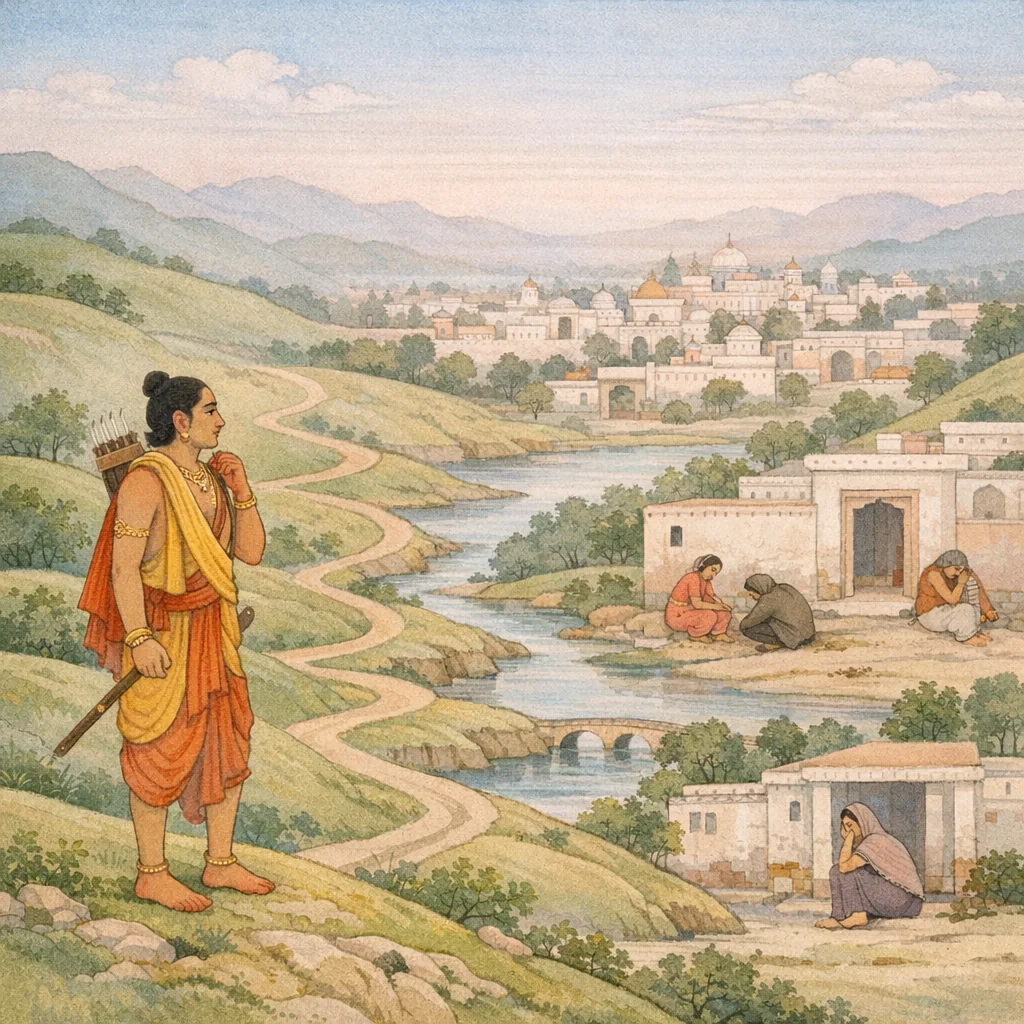
Sarga 71 tracks Bharata’s approach toward Ayodhyā through a geographically dense itinerary and then pivots to a civic-psychological portrait of the capital in distress. Departing from Rājagṛha and moving eastward, Bharata observes and crosses multiple rivers—Sudāmā, Hlādinī, and the broad, wave-crested Śatadrū flowing westward—followed by additional crossings at named locales (Elādhāna; Sarvatīrtha; Lauhitya). The text emphasizes practical conveyances (hill-born horses; an elephant mount) while cataloging rivers such as Uttānikā, Kuṭikā, and Kapīvatī, presenting a travel log that functions as a narrative map. As Ayodhyā becomes visible from afar—renowned, white-soiled, gardened, and populated by Veda-versed ritual specialists—the mood shifts: Bharata perceives inauspicious signs in domestic and sacred spaces. Houses appear unswept and neglected; doors stand unfastened; offerings and incense are absent; families are hungry; people are tearful, emaciated, and absorbed in grief. The chapter thus juxtaposes a remembered ideal of a ritually vibrant capital with the present suspension of normal religious and household rhythms, using civic decay as an index of royal and moral rupture.
Shlokas
Verse 2
स प्राङ्मुखो राजगृहादभिनिर्याय राघवः। ततस्सुदामां द्युतिमान् सन्तीर्यावेक्ष्य तां नदीम्।।2.71.1।। ह्लादिनीं दूरपारां च प्रत्यक्स्रोतस्तरङ्गिणीम्। शतद्रूमतरच्छ्रीमान्नदीमिक्ष्वाकुनन्दनः।।2.71.2।।
Setting out eastward from Rājagṛha, that Rāghava prince—radiant and illustrious—saw the river Sudāmā and crossed it. Thereafter the delight of the Ikṣvāku line crossed the Hlādinī, and then the Śatadrū as well—broad, wave-crested, and flowing westward.
Verse 4
ऐलाधाने नदीं तीर्त्वा प्राप्य चापरपर्पटान्। शिलामकुर्वतीं तीर्त्वा आग्नेयं शल्यकर्षणम्।।2.71.3।। सत्यसन्धश्शुचिश्श्रीमान्प्रेक्षमाण श्शिलावहाम्। अत्ययात्स महाशैलान्वनं चैत्ररथं प्रति।।2.71.4।।
Having crossed the river at Ailādhāna and reached the region of Apara-parpaṭa, he crossed the river that issues from the mountain, proceeding toward the northeastern Śalya-karṣaṇa. True to his word, pure-hearted and illustrious, he watched the course of the Śilāvahā and passed beyond the great mountains, heading toward the forest called Caitraratha.
Verse 15
वासं कृत्वा सर्वतीर्थे तीर्त्वा चोत्तानिकां नदीम्। अन्या नदीश्च विविधाः पार्वतीयैस्तुरङ्गमैः।।2.71.14।। हस्तिपृष्ठकमासाद्य कुटिकामत्यवर्तत। ततार च नरव्याघ्रो लौहित्ये स कपीवतीम्।।2.71.15।।
After making camp at Sarvatīrtha, he crossed the river Uttānikā, and many other rivers besides, using mountain-bred horses. Mounting an elephant, he forded the Kuṭikā; and that tiger among men crossed the Kapīvatī at Lauhitya.
Verse 20
एषा नातिप्रतीता मे पुण्योद्याना यशस्विनी।।2.71.19।। अयोध्या दृश्यते दूरात्सारथे पाण्डुमृत्तिका। यज्वभिर्गुणसम्पन्नैर्ब्राह्मणैर्वेदपारगैः।।2.71.20।। भूयिष्ठमृद्धैराकीर्णा राजर्षिपरिपालिता।
“Charioteer, there is Ayodhyā—renowned and graced with sacred gardens—though from this distance it does not appear to me very clearly. That city of pale-white earth is filled with many wealthy people, and with virtuous brāhmaṇas and sacrificial priests, accomplished in the Vedas, and protected by royal sages.”
Verse 38
सम्मार्जनविहीनानि परुषाण्युपलक्षये।।2.71.37।। असंयत कवाटानि श्रीविहीनानि सर्वशः। बलिकर्मविहीनानि धूपसम्मोदनेन च।।2.71.38।। अनाशितकुटुम्बानि प्रभाहीनजनानि च। अलक्ष्मीकानि पश्यामि कुटुम्बिभवनान्यहम्।।2.71.39।।
“I notice householders’ homes left unswept and grimy; their doors stand unfastened, and everywhere they seem bereft of prosperity. No offerings are being made, nor is there the pleasing fragrance of incense. I see families unfed, people without brightness, and houses marked by inauspiciousness.”
Verse 39
सम्मार्जनविहीनानि परुषाण्युपलक्षये।।2.71.37।। असंयत कवाटानि श्रीविहीनानि सर्वशः। बलिकर्मविहीनानि धूपसम्मोदनेन च।।2.71.38।। अनाशितकुटुम्बानि प्रभाहीनजनानि च। अलक्ष्मीकानि पश्यामि कुटुम्बिभवनान्यहम्।।2.71.39।।
“I notice householders’ homes left unswept and grimy; their doors stand unfastened, and everywhere they seem bereft of prosperity. No offerings are being made, nor is there the pleasing fragrance of incense. I see families unfed, people without brightness, and houses marked by inauspiciousness.”
Verse 44
देवायतनचैत्येषु दीनाः पक्षिगणास्तथा।।2.71.43।। मलिनं चाश्रुपूर्णाक्षं दीनं ध्यानपरं कृशम्। सस्त्रीपुंसं च पश्यामि जनमुत्कण्ठितं पुरे।।2.71.44।।
I see the people in the city—women and men alike—downcast and emaciated, their eyes brimming with tears, wretched in spirit, and absorbed in anxious, sorrowful thought.
Frequently Asked Questions
Rather than a courtroom-like dilemma, the chapter presents an ethical diagnostic action: Bharata reads the city’s disrupted household and ritual routines as evidence of moral-political rupture, implying that governance and dharma are measurable through civic well-being and maintained rites.
The sarga teaches that social auspiciousness (śrī) is not merely aesthetic but ethical: when leadership falters and communal grief dominates, ordinary dharmic practices—cleanliness, offerings, incense, hospitality, and emotional steadiness—collapse, revealing the interdependence of polity, ritual, and inner resilience.
Geographically, the sarga highlights a chain of rivers and regions—Sudāmā, Hlādinī, Śatadrū, Uttānikā, Kuṭikā, Kapīvatī; locales such as Rājagṛha, Elādhāna, Sarvatīrtha, and Lauhitya—while culturally it foregrounds Ayodhyā’s temples/caityas, Veda-versed brāhmaṇas and sacrificers, and the visible absence of domestic-ritual markers (oblations and incense).