Sarga 55
चित्रकूटमार्गोपदेशः — Instructions for the Chitrakuta Route and the Yamuna Crossing
अयोध्याकाण्ड
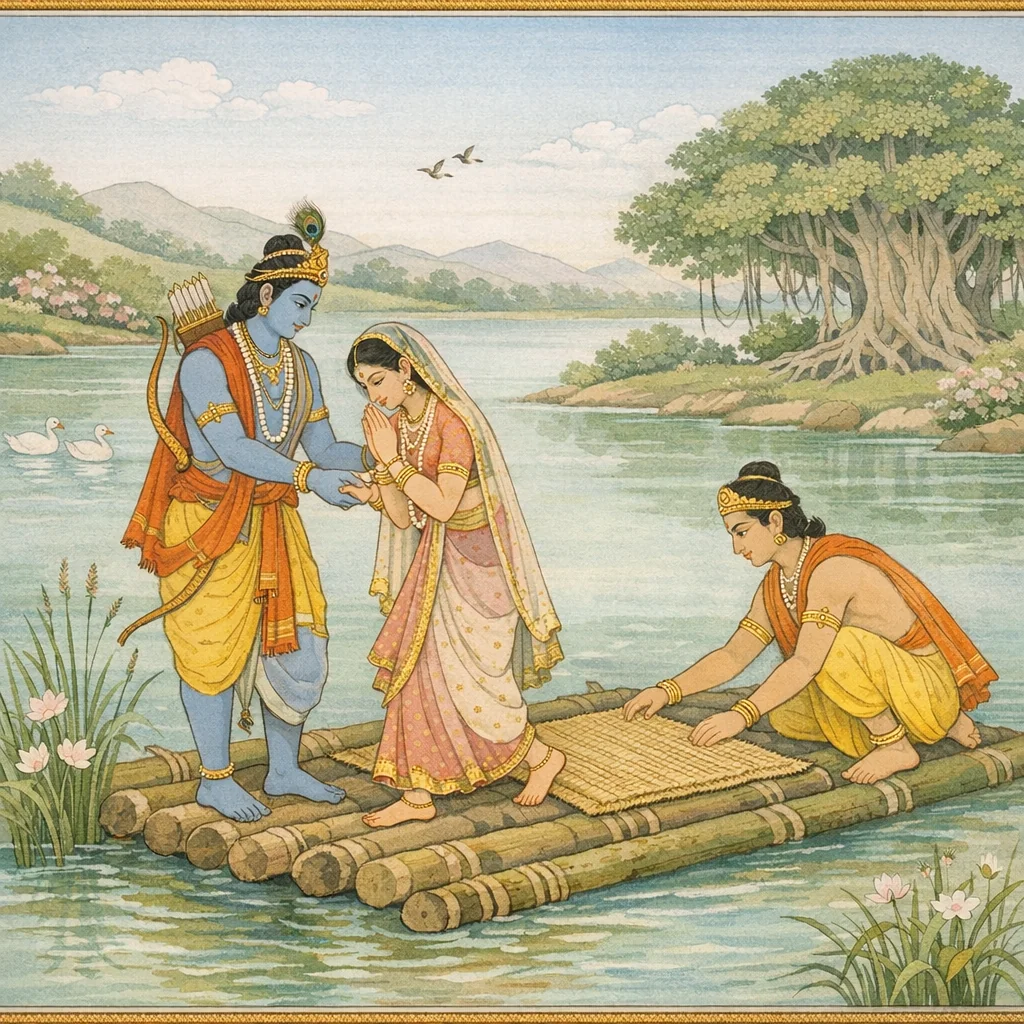
Sarga 55 maps a transitional itinerary from Bharadvāja’s hermitage toward Citrakūṭa. After spending the night, Rāma and Lakṣmaṇa offer obeisance; Bharadvāja provides precise route-instructions: reach the Gaṅgā–Yamunā confluence, proceed along the westward-flowing Kālindī (Yamunā), locate an ancient ford-site, construct a raft, and cross. He further identifies a prominent nyagrodha (banyan) associated with siddha-presence, prescribing Sītā’s auspicious invocations there. The narrative shifts from guidance to enactment: the brothers build a large wooden float (logs bound together, bamboo spread, uśīra covering), Lakṣmaṇa prepares a comfortable seat, and Rāma assists the bashful Sītā onto the raft while placing garments, ornaments, tools, and weapons. Midstream, Sītā performs a river-salutation, vows future worship upon safe return, and the party reaches the southern bank. After crossing, Sītā circumambulates the banyan, prays for Rāma’s vow to be fulfilled and for reunion with Kauśalyā and Sumitrā. Rāma then instructs Lakṣmaṇa to walk ahead with Sītā while he follows armed, and to satisfy her botanical curiosities. The sarga closes with Sītā’s delight in Yamunā’s beauty, the brothers’ forest foraging, and selection of a suitable riverside dwelling—integrating dharma, ritual gesture, and topographical precision into a navigable “digital map” segment.
Shlokas
Verse 1
उषित्वा रजनीं तत्र राजपुत्रावरिन्दमौ।महर्षिमभिवाद्याथ जग्मतुस्तं गिरिं प्रति।।।।
After spending the night there, the two princely foeslayers paid reverence to the great sage and then set out toward that mountain (Citrakūṭa).
Verse 2
तेषां चैव स्वस्त्ययनं महर्षि स्स चकार ह।प्रस्थितांश्चैव तान्प्रेक्ष्य पिता पुत्रानिवान्वगात्।।।।
Seeing them set out, the great sage pronounced blessings for their safe journey; and, watching them depart, he followed them too—like a father following his own sons.
Verse 3
ततः प्रचक्रमे वक्तुं वचनं स महामुनिः।भरद्वाजो महातेजा रामं सत्यपराक्रमम्।।।।
Then the great sage Bharadvāja, radiant with spiritual power, began to address Rāma—whose valor is grounded in truth.
Verse 4
गङ्गायमुनयो स्सन्धिमासाद्य मनुजर्षभौ।कालिन्दीमनुगच्छेतां नदीं पश्चान्मुखाश्रिताम्।।।।
Having reached the confluence of the Gaṅgā and the Yamunā, O best of men, proceed along the Kālindī (Yamunā), which here flows westward.
Verse 5
अथाऽसाद्य तु कालिन्दी शीघ्रस्रोतसमापगाम्।तस्यास्तीर्थं प्रचलितं पुराणं प्रेक्ष्य राघवौ।।।।तत्र यूयं प्लवं कृत्वा तरतांशुमतीं नदीम्।
When you reach the swift-flowing river Kāлиндī (Yamunā), you will notice an ancient and well-frequented ford on its bank. There, make a raft and cross that river Aṃśumatī—the daughter of the Sun.
Verse 6
ततो न्यग्रोधमासाद्य महान्तं हरितच्छदम्।।।।विवृद्धं बहुभिर्वृक्षै श्श्यामं सिद्धोपसेवितम्।तस्मै सीताञ्जलिं कृत्वा प्रयुञ्जीताशिषश्शिवाः।।।।
Then, on reaching a great banyan tree thick with green leaves—dark with dense growth and attended by siddhas—Sītā should fold her hands to it and offer auspicious prayers.
Verse 7
ततो न्यग्रोधमासाद्य महान्तं हरितच्छदम्।।2.55.6।।विवृद्धं बहुभिर्वृक्षै श्श्यामं सिद्धोपसेवितम्।तस्मै सीताञ्जलिं कृत्वा प्रयुञ्जीताशिषश्शिवाः।।2.55.7।।
Then, on reaching that great banyan tree with verdant foliage—dark with dense growth and attended by siddhas—Sītā should fold her hands and offer auspicious prayers.
Verse 8
समासाद्य तु तं वृक्षं वसेद्वातिक्रमेत वा।क्रोशमात्रं ततो गत्वा नीलं द्रक्ष्यथ काननम्।।।।पलाशबदरीमिश्रं रम्यं वंशैश्च यामुनैः।
After reaching that tree, you may rest there or pass on. Going a single krośa beyond it, you will see a lovely, dark forest, mixed with palāśa and badarī trees, and also with Yamunā-side bamboos.
Verse 9
स पन्थाश्चित्रकूटस्य गत स्सुबहुशो मया।।।।रम्यो मार्दवयुक्तश्च वनदावैर्विवर्जितः।
That is the road to Citrakūṭa—I have gone along it many times. It is pleasant, easy underfoot, and free from the danger of forest fires.
Verse 10
इति पन्थानमावेद्य महर्षिस्सन्यवर्तत।।।।अभिवाद्य तथेत्युक्त्वा रामेण विनिवर्तितः।
Having thus explained the route, the great sage turned back; and Rāma, saying “So be it” and offering obeisance, requested him to return.
Verse 11
उपावृत्ते मुनौ तस्मिन्रामो लक्ष्मणमब्रवीत्।।।।कृतपुण्याः स्म सौमित्रे मुनिर्यन्नोऽनुकम्पते।
When that sage had turned back, Rāma said to Lakṣmaṇa, “O Saumitri, we are truly blessed, since the sage has shown us compassion.”
Verse 12
इति तौ पुरुषव्याघ्रौ मन्त्रयित्वा मनस्विनौ।सीतामेवाग्रतः कृत्वा कालिन्दीं जग्मतुर्नदीम्।।।।
So the two high-minded ‘tigers among men’ conferred together, and with Sītā placed in front, they went on toward the river Kālindī (Yamunā).
Verse 13
अथाऽसाद्य तु कालिन्दीं शीघ्रस्रोतोवहां नदीम्।चिन्तामापेदिरे सर्वे नदीजलतितीर्षवः।।।।
Then, upon reaching the swiftly flowing river Kālindī, all of them—wishing to cross its waters—fell into deliberation.
Verse 14
तौ काष्ठसङ्घातमथो चक्रतु स्सुमहाप्लवम्।शुष्कैर्वंशै स्समास्तीर्णमुशीरैश्च समावृतम्।।।।
Then the two made a very large float by binding logs together, spreading dry bamboo over it, and covering it with fragrant uśīra grass-roots.
Verse 15
ततो वेतसशाखाश्च जम्बूशाखाश्च वीर्यवान्।चकार लक्ष्मणश्छित्वा सीताया स्सुखमासनम्।।।।
Then the valiant Lakṣmaṇa, cutting reed-stems and jambu branches, made a comfortable seat for Sītā.
Verse 16
तत्र श्रियमिवाचिन्त्यां रामो दाशरथिः प्रियाम्।ईषत्संलज्जमानां तामध्यारोपयतप्लवम्।।।।
There, Rāma Dāśarathi helped his beloved Sītā—radiant like Śrī (Lakṣmī) in her indescribable splendor—onto the float, as she stepped forward with gentle bashfulness.
Verse 17
पार्श्वे च तत्र वैदेह्या वसने भूषणानि च।प्लवे कठिनकाजं च रामश्चक्रे सहायुधैः।।।।
And there on the float, beside Vaidehī, Rāma placed clothing and ornaments, as well as a crowbar and a basket, together with their weapons.
Verse 18
आरोप्य प्रथमं सीतां सङ्घाटं परिगृह्य तौ।तत प्रतेरतुर्यत्तौ वीरौ दशरथात्मजौ।।।।
First they helped Sītā board the raft, holding it firmly; then the two heroic sons of Daśaratha crossed over with careful attention.
Verse 19
कालिन्दीमध्यमायाता सीता त्वेनामवन्दत।स्वस्ति देवि तरामि त्वां पारये न्मे पतिर्व्रतम्।।।।यक्ष्ये त्वां गोसहस्रेण सुराघटशतेन च।स्वस्ति प्रत्यागते रामे पुरी मिक्ष्वाकुपालिताम्।।।।
When she reached midstream in the Kāliṇdī (Yamunā), Sītā bowed to the river-goddess: “May there be welfare, O देवी; I am crossing you—may my husband’s vow be fulfilled. When Rāma returns safely to Ayodhyā, the city guarded by the Ikṣvāku line, I shall worship you with a thousand cows and a hundred jars of surā.”
Verse 20
कालिन्दीमध्यमायाता सीता त्वेनामवन्दत।स्वस्ति देवि तरामि त्वां पारये न्मे पतिर्व्रतम्।।2.55.19।।यक्ष्ये त्वां गोसहस्रेण सुराघटशतेन च।स्वस्ति प्रत्यागते रामे पुरी मिक्ष्वाकुपालिताम्।।2.56.20।।
Thus Sītā—fair in complexion—still praying with folded hands to the Kāliṇdī, reached the southern bank.
Verse 21
कालिन्दी मथ सीता तु याचमाना कृताञ्जलिः।तीरमेवाभिसम्प्राप्ता दक्षिणं वरवर्णिनी।।।।
Thus Sītā—fair in complexion—still praying with folded hands to the Kāliṇdī, reached the southern bank.
Verse 22
तत प्लवेनांशुमतीं शीघ्रगामूर्मिमालिनीम्।तीरजै र्बहुभिर्वृक्षै स्सन्तेरुर्यमुनां नदीम्।।।।
Then, by the raft, they crossed the river Yamunā—daughter of the Sun—swift-flowing, garlanded with waves, with many trees rising along her banks.
Verse 23
ते तीर्णाः प्लवमुत्सृज्य प्रस्थाय यमुनावनात्।श्यामं न्यग्रोध मासेदु श्शीतलं हरितच्छदम्।।।।
After crossing, they left the raft behind and, setting out from the woodland by the Yamunā, came to a dark banyan—cool, and thick with green foliage.
Verse 24
न्यग्रोधं तमुपागम्य वैदेही वाक्यमब्रवीत्।नमस्तेऽस्तु महावृक्ष पारयेन्मे पतिर्व्रतम्।।।।कौशल्यां चैव पश्येयं सुमित्रां च यशश्विनीम्।इति सीताऽञ्जलिं कृत्वा पर्यगच्छद्वनस्पतिम्।।।।
Reaching that banyan, Vaidehī spoke: “Salutations to you, O great tree. May my husband’s vow be fulfilled; may I again behold Kauśalyā and the illustrious Sumitrā.” So Sītā, joining her palms, circumambulated the lordly tree in reverence.
Verse 25
न्यग्रोधं तमुपागम्य वैदेही वाक्यमब्रवीत्।नमस्तेऽस्तु महावृक्ष पारयेन्मे पतिर्व्रतम्।।2.55.24।।कौशल्यां चैव पश्येयं सुमित्रां च यशश्विनीम्।इति सीताऽञ्जलिं कृत्वा पर्यगच्छद्वनस्पतिम्।।2.55.25।।
Approaching that banyan tree, Vaidehī (Sita) spoke: “Salutations to you, O great tree. May my husband fulfil his vow; may I see Kausalyā and the illustrious Sumitrā again.” Having spoken thus, Sita folded her hands in reverence and circumambulated the lordly tree.
Verse 26
अवलोक्य तत स्सीतामायाचन्तीमनिन्दिताम्।दयितां च विधेयां च रामो लक्ष्मणमब्रवीत्।।।।
Then, seeing Sītā—blameless, beloved, and obedient—seeking blessings, Rāma spoke to Lakṣmaṇa.
Verse 27
सीतामादाय गच्छत्वमग्रतो भरतानुज।पृष्ठतोऽहं गमिष्यामि सायुधो द्विपदां वर।।।।
O Lakṣmaṇa—Bharata’s younger brother, best among men—go in front, taking Sītā with you; I shall follow from behind, armed.
Verse 28
यद्यत्फलं प्रार्थयते पुष्पं वा जनकात्मजा।तत्तत्प्रदद्या वैदेह्या यत्राऽस्या रमते मनः।।।।
Whatever fruit or flower Janaka’s daughter may ask for—give her that; give Vaidehī whatever brings delight to her heart.
Verse 29
गच्छतोऽस्तु तयोर्मध्ये बभूव जनकात्मजा।मातङ्गयोर्मध्यगता शुभा नागवधूरिव।।।।
As they went on, Janaka’s daughter walked between the two—auspicious, like a noble cow-elephant moving between two bull elephants.
Verse 30
एकैकं पादपं गुल्मं लतां वा पुष्पशालिनीम्।अदृष्टपूर्वां पश्यन्ती रामं पप्रच्छ साऽबला।।।।
That gentle lady, seeing one tree after another—shrubs and flowering creepers she had never seen before—kept asking Rāma about them.
Verse 31
रमणीयान्बहुविधान्पादपान्कुसुमोत्कटान्।सीतावचनसंरब्ध आनयामास लक्ष्मणः।।।।
Prompted by Sītā’s words, Lakṣmaṇa brought her many kinds of lovely trees, heavy with blossoms.
Verse 32
विचित्रवालुकजलां हंससारसनादिताम्।रेमे जनकराजस्य सुता प्रेक्ष्य तदा नदीम्।।।।
Then Janaka’s daughter, gazing upon the river—its waters and sands delightful, and resonant with swans and cranes—rejoiced greatly.
Verse 33
क्रोशमात्रं ततो गत्वा भ्रातरौ रामलक्ष्मणौ।बहून्मेध्यान्मृगान्हत्वा चेरतुर्यमुनावने।।।।
Having gone about a krośa from there, the brothers Rāma and Lakṣmaṇa, after killing many deer fit for sacred use, ate in the forest by the Yamunā.
Verse 34
विहृत्य ते बर्हिणपूगनादिते शुभे वने वानरवारणायुते।समं नदीवप्रमुपेत्य सम्मतं निवास माजग्मु रदीनदर्शनाः।।।।
After roaming in that lovely forest, resonant with flocks of peacocks and filled with monkeys and elephants, they reached an even riverbank and chose a suitable place to dwell—appearing undaunted in spirit.
Frequently Asked Questions
The pivotal action is the disciplined execution of exile-wayfinding: accepting the sage’s counsel, ensuring Sītā’s safety in a hazardous river crossing, and organizing movement order (Lakṣmaṇa leading with Sītā, Rāma following armed) as a practical expression of protective dharma.
Guidance (upadeśa) from a realized sage is to be received with humility and enacted with care; gratitude is expressed through obeisance, and nature is approached as sacred—river and tree become moral witnesses to vows, safety, and righteous return.
Key landmarks include the Gaṅgā–Yamunā confluence, the westward course of Kālindī (Yamunā), an ancient tīrtha/ford used for crossing, and a siddha-associated nyagrodha (banyan) where Sītā performs circumambulation and prayer before the party continues toward Citrakūṭa.