Sarga 5
अभिषेकोपवास-आदेशः (Coronation Preparations and the Fast Enjoined)
अयोध्याकाण्ड
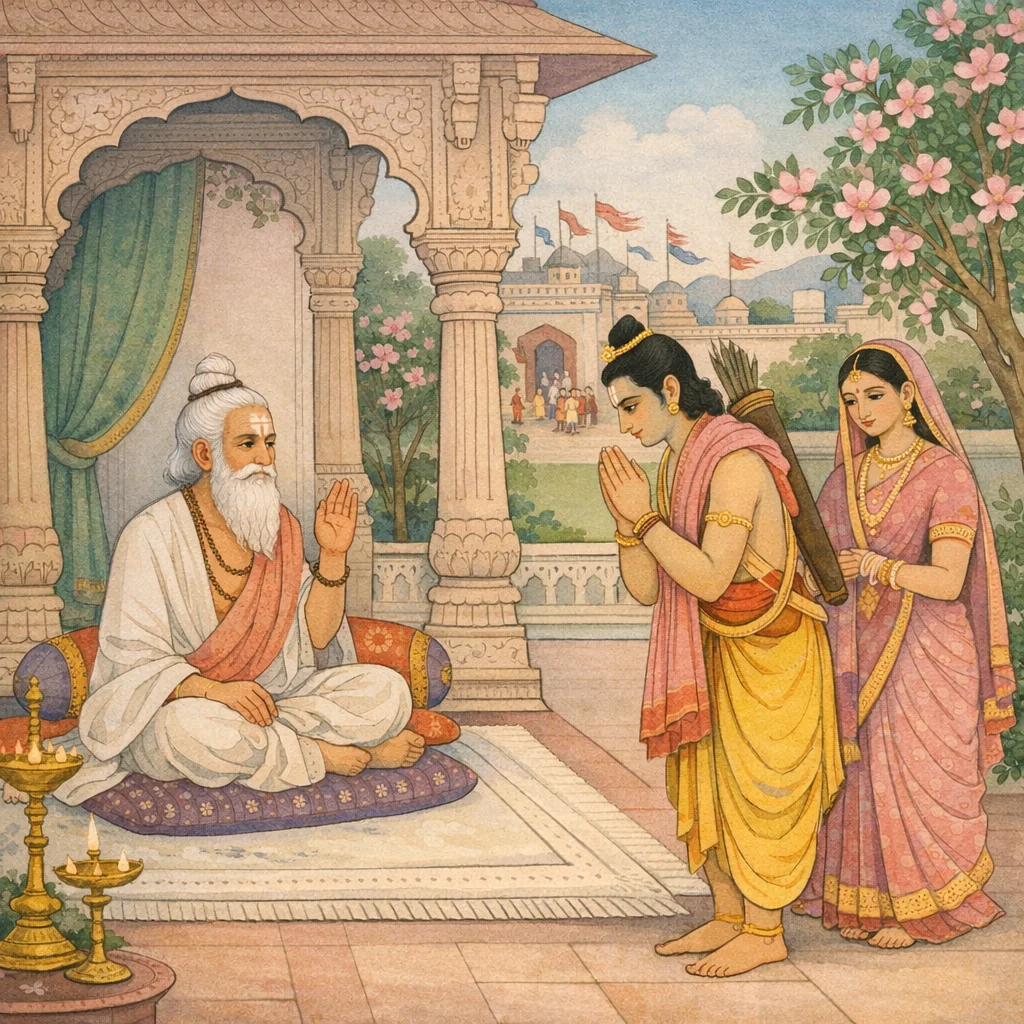
Sarga 5 documents the procedural and ritual mechanics preceding Rama’s intended yauvarājya-abhiṣeka. King Daśaratha, after instructing Rama regarding the imminent coronation, summons the purohita Vasiṣṭha and commissions him to direct Rama and Sita to undertake an upavāsa (fast) with mantra-accompaniment as a prosperity- and legitimacy-securing observance. Vasiṣṭha proceeds in a brahmin-appropriate chariot to Rama’s residence, is received with formal honor, and communicates the king’s affectionate intention to coronate Rama at dawn, analogizing the act to Nahuṣa’s coronation of Yayāti. Rama accepts the instruction with humility; Vasiṣṭha ritually initiates the fast and departs. The narrative then widens to civic phenomenology: Ayodhyā’s streets are washed, banners raised, and the royal highways become densely crowded with curious citizens whose collective sound is compared to the sea. Vasiṣṭha returns through the throngs to the palace, meets the king, confirms completion of the mission, and the court rises in reverence. Daśaratha, permitted by his preceptor, dismisses the assembly and enters the inner apartments, described through luminous similes (moon among stars), underscoring the night-before-ceremony intensity.
Shlokas
Verse 1
सन्दिश्य रामं नृपति श्श्वोभाविन्यभिषेचने।पुरोहितं समाहूय वशिष्ठमिदमब्रवीत्।।।।
After instructing Rāma about the consecration to take place the next day, the king summoned his family priest Vasiṣṭha and spoke as follows.
Verse 2
गच्छोपवासं काकुत्स्थं कारयाद्य तपोधन।श्रीयशोराज्यलाभाय वध्वा सह यतव्रतम्।।।।
Go today, O sage whose wealth is austerity, and have Kakutstha (Rāma)—steadfast in his vows—undertake a fast together with my daughter-in-law (Sītā), so that prosperity, fame, and the kingdom may be rightly secured.
Verse 3
तथेति च स राजानमुक्त्वा वेदविदां वरः।स्वयं वसिष्ठो भगवान्ययौ रामनिवेशनम्।।।।उपवासयितुं रामं मन्त्रवन्मन्त्रकोविदः।ब्राह्मं रथवरं युक्तमास्थाय सुदृढव्रतः।।।।
Having said to the king, “So be it,” the venerable Vasiṣṭha—foremost among the knowers of the Vedas—set out in person for Rāma’s residence.
Verse 4
तथेति च स राजानमुक्त्वा वेदविदां वरः।स्वयं वसिष्ठो भगवान्ययौ रामनिवेशनम्।।2.5.3।।उपवासयितुं रामं मन्त्रवन्मन्त्रकोविदः।ब्राह्मं रथवरं युक्तमास्थाय सुदृढव्रतः।।2.5.4।।
Skilled in mantras and steadfast in vow, he mounted a well-harnessed, brahmin-suited excellent chariot, intending—accompanied by sacred formulae—to have Rāma undertake the prescribed fast.
Verse 5
स रामभवनं प्राप्य पाण्डुराभ्रघनप्रभम्।तिस्रः कक्ष्या रथेनैव विवेशमुनिसत्तमः।।।।
Reaching Rāma’s residence—radiant like a dense mass of pale-white clouds—the foremost of sages entered, passing through three courtyards while still in the chariot.
Verse 6
तमागतमृषिं रामस्त्वरन्निव ससम्भ्रमः।मानयिष्यन्समानार्हं निश्चक्राम निवेशनात्।।।।
Seeing the sage arrive, Rāma—eager and full of respectful haste—came out from his residence to honour him, as was fitting for one deserving equal reverence.
Verse 7
अभ्येत्य त्वरमाणश्च रथाभ्याशं मनीषिणः।ततोऽवतारयामास परिगृह्य रथात्स्वयम्।।।।
Hurrying up to the wise one’s chariot, Rāma then personally assisted him down from the chariot, taking hold of him with due care.
Verse 8
स चैनं प्रश्रितं दृष्ट्वा सम्भाष्याभिप्रसाद्य च।प्रियार्हं हर्षयन्राममित्युवाच पुरोहितः।।।।
Seeing Rāma humble, the family priest addressed him, gladdened him with fitting, affectionate words, and then spoke as follows.
Verse 9
प्रसन्नस्ते पिता राम यौवराज्यमवाप्स्यसि।उपवासं भवानद्य करोतु सह सीतया।।।।
O Rāma, your father is pleased with you—you will obtain the rank of heir-apparent. Therefore, today you should undertake a fast, together with Sītā.
Verse 10
प्रातस्त्वामभिषेक्ता हि यौवराज्ये नराधिपः।पिता दशरथः प्रीत्या ययातिं नहुषो यथा।।।।
“Indeed, early tomorrow morning your father, King Daśaratha, will consecrate you as heir-apparent with affection—just as Nahuṣa consecrated Yayāti.”
Verse 11
इत्युक्त्वा स तदा राममुपवासं यतव्रतम्।मन्त्रवत्कारयामास वैदेह्या सहितं मुनिः।।।।
Having spoken thus, the sage then had Rāma—observant of vows—undertake a fast, together with Vaidehī (Sītā), accompanied by sacred mantras.
Verse 12
ततो यथावद्रामेण स राज्ञो गुरुरर्चितः।अभ्यनुज्ञाप्य काकुत्स्थं ययौ रामनिवेशनात्।।।।
Thereafter, duly honored by Rāma, the king’s preceptor took leave of Kakutstha (Rāma) and departed from Rāma’s residence.
Verse 13
सुहृद्भिस्तत्र रामोऽपि सहासीनः प्रियंवदैः।सभाजितो विवेशाऽथ ताननुज्ञाप्य सर्वशः।।।।
There, Rāma too sat for a time with his sweet-speaking friends; and, having been honored in every way, he then took leave of them and entered his own apartments.
Verse 14
हृष्टनारीनरयुतं रामवेश्म तदा बभौ।यथा मत्तद्विजगणं प्रफुल्लनलिनं सरः।।।।
Then Rāma’s residence, filled with delighted men and women, shone splendidly—like a lake where lotuses are fully in bloom and flocks of exhilarated birds gather.
Verse 15
स राजभवनप्रख्यात्तस्माद्रामनिवेशानात्।निर्गत्य ददृशे मार्गं वसिष्ठो जनसंवृतम्।।।।
Vasiṣṭha then came out from Rāma’s abode—renowned as being like a royal palace—and saw the roadway crowded all around with people.
Verse 16
बृन्दबृन्दैरयोध्यायां राजमार्गास्समन्ततः।बभूवुरभिसम्बाधाः कुतूहलजनैर्वृताः।।।।
In Ayodhyā, the royal highways on every side became tightly congested, surrounded by groups upon groups of curious townspeople.
Verse 17
जनबृन्दोर्मिसंघर्षहर्षस्वनवतस्तदा।बभूव राजमार्गस्य सागरस्येव निस्वनः।।।।
Then the sound along the royal highway arose like the roar of the sea—like waves colliding—so did the joyful clamor of the multitude surge and resound.
Verse 18
सिक्तसम्मृष्टरथ्या हि तदहर्वनमालिनी।आसीदयोध्यानगरी समुच्छ्रितगृहध्वजा।।।।
On that day, the city of Ayodhyā had its streets sprinkled with water and thoroughly swept; garlanded as it were with gardens, it stood with house-banners raised high.
Verse 19
तदा ह्ययोध्यानिलयः सस्त्रीबालाबलो जनः।रामाभिषेकमाकाङ्क्षन्नाकाङ्क्षदुदयं रवेः।।।।
Then the people dwelling in Ayodhyā—women, children, and the aged alike—longing for Rāma’s consecration, eagerly longed for the sun to rise.
Verse 20
प्रजालङ्कारभूतं च जनस्यानन्दवर्धनम्।उत्सुकोऽभूज्जनो द्रष्टुं तमयोध्यामहोत्सवम्।।।।
People became eager to witness that great festival of Ayodhyā—an ornament to the citizens and an occasion that increased everyone’s joy.
Verse 21
एवं तज्जनसम्बाधं राजमार्गं पुरोहितः।व्यूहन्निव जनौघं तं शनै राजकुलं ययौ।।।।
Thus, seeing that royal road thronged with people, the royal priest advanced slowly toward the palace, as though parting the human flood into two streams.
Verse 22
सिताभ्रशिखरप्रख्यं प्रासादमधिरुह्य सः।समीयाय नरेन्द्रेण शक्रेणेव बृहस्पतिः।।।।
Ascending the palace that looked like a mountain-peak crowned with white clouds, he approached the king—like Bṛhaspati drawing near to Śakra (Indra).
Verse 23
तमागतमभिप्रेक्ष्य हित्वा राजासनं नृपः।पप्रच्छ स च तस्मै तत्कृतमित्यभ्यवेदयत्।।।।
Seeing him arrive, the king left his throne and enquired; and the sage informed him that the task had been done.
Verse 24
चैव तदा तुल्यं सहासीनास्सभासदः।आसनेभ्यस्समुत्तस्थुः पूजयन्तः पुरोहितम्।।।।
Then the courtiers seated there likewise rose from their seats, paying honour to the royal priest.
Verse 25
गुरुणा त्वभ्यनुज्ञातो मनुजौघं विसृज्य तम्।विवेशान्तः पुरं राजा सिंहो गिरिगुहामिव।।।।
Permitted by the preceptor, the king dismissed that gathering of people and entered the inner apartments—like a lion entering a mountain cave.
Verse 26
तदग्य्रवेषप्रमदाजनाकुलंमहेन्द्रवेश्मप्रतिमं निवेशनम्।विदीपयंश्चारु विवेश पार्थिवश्शशीव तारागणसङ्कुलं नभः।।।।
The king entered that residence—like Mahendra’s palace—thronged with women splendidly dressed; and as he went in, he shone beautifully, like the moon illuminating a sky crowded with stars.
Frequently Asked Questions
The pivotal action is the formal commissioning of Vasiṣṭha to impose a ritual fast on Rama and Sita ahead of the coronation, showing how private actors submit to institutional dharma: kingship is treated as a sacralized responsibility requiring disciplined observance, not merely political appointment.
The chapter emphasizes that authority is legitimized through alignment of intention, ritual procedure, and humility: Daśaratha acts through the preceptor, Rama responds with respectful compliance, and the rite (upavāsa with mantras) frames governance as self-regulation under dharma.
Ayodhyā’s राजमार्ग (royal highways) and the palace complex (प्रासाद, राजकुल, अन्तःपुर) are foregrounded, alongside cultural practices such as street-sprinkling and sweeping, house-top banners, and the public gathering that transforms coronation into a city-wide mahotsava.