Sarga 46
तमसातीरवासः — Night on the Bank of the Tamasa and the Stratagem to Elude the Citizens
अयोध्याकाण्ड
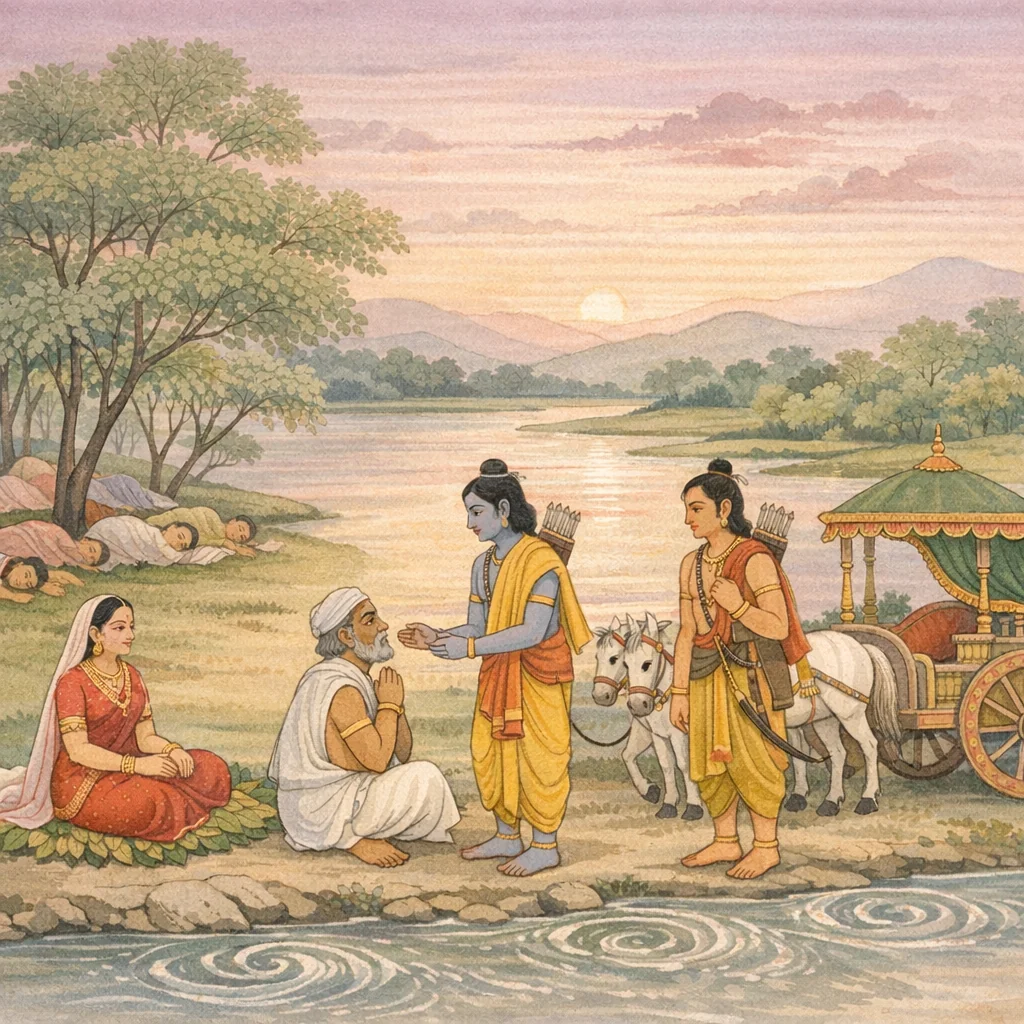
Sarga 46 frames the first night of exile as a disciplined, carefully managed transition from civic space to wilderness. Rāma shelters on the lovely bank of the Tamasa, addresses Lakṣmaṇa with composed instruction, and chooses austerity—living on water alone despite available forest foods—signaling voluntary restraint rather than deprivation. Sumantra tends the horses, performs twilight observance (sandhyā-upāsanā), and prepares a leaf-bed on the riverbank; Rāma sleeps with Sītā and Lakṣmaṇa. Lakṣmaṇa keeps vigil, praising Rāma’s virtues to Sumantra until sunrise. At dawn Rāma observes the citizens asleep under trees, interprets their loyalty as potentially self-harming resolve, and articulates a principle of rājyadharma: subjects should be relieved of suffering, not burdened by the prince’s predicament. He then proposes a tactical departure while they sleep. To prevent pursuit, Rāma instructs Sumantra to drive north briefly and loop back, confusing the paurāḥ. The party boards the yoked chariot, crosses the fast-flowing Tamasa with whirlpools, and reaches an auspicious, “thornless” highway toward the forest (tapo-vana), marking exile as both moral choice and logistical operation.
Shlokas
Verse 1
ततस्तु तमसातीरं रम्यमाश्रित्य राघवः।सीतामुद्वीक्ष्य सौमित्रिमिदं वचनमब्रवीत्।।2.46.1।।
Thereafter Rāma, taking shelter on the lovely bank of the Tamasā, glanced at Sītā and then spoke these words to Saumitri (Lakṣmaṇa).
Verse 2
इयमद्य निशा पूर्वा सौमित्रे प्रहिता वनम्।वनवासस्य भद्रं ते स नोत्कण्ठितुमर्हसि।।2.46.2।।
O Saumitri, this is the first night since we have been sent to the forest for exile; may you be well—do not give way to longing or distress.
Verse 3
पश्य शून्यान्यरण्यानि रुदन्तीव समन्ततः।यथानिलयमायद्भिर्निलीनानि मृगद्विजैः।।2.46.3।।
Look—these forests are empty on every side, as though they were weeping; for the beasts and the birds, returning to their own haunts, have hidden themselves away.
Verse 4
अद्यायोध्या तु नगरी राजधानी पितुर्मम।सस्त्रीपुंसा गतानस्माञ्शोचिष्यति न संशयः।।2.46.4।।
There is no doubt that today Ayodhyā—my father’s capital city—will grieve for us who have departed, men and women alike.
Verse 5
अनुरक्ता हि मनुजा राजानं बहुभिर्गुणैः।त्वां च मां च नरव्याघ्र शत्रुघ्न भरतौ तथा।।2.46.5।।
O best of men, the people are indeed devoted—because of many virtues—to the king, to you, to me, and likewise to Bharata and Śatrughna.
Verse 6
पितरं चानुशोचामि मातरं च यशस्विनीम्।अपि वान्धौ भवेतां तु रुदन्तौ तावभीक्ष्णशः।।2.46.6।।
I grieve for my father and for my illustrious mother: by weeping again and again, the two of them might even become blind.
Verse 7
भरतः खलु धर्मात्मा पितरं मातरं च मे।धर्मार्थकामसहितैर्वाक्यैर्वाश्वासयिष्यति।।2.46.7।।
Bharata, truly righteous in spirit, will indeed console my father and mother with words aligned with dharma, artha, and kāma.
Verse 8
भरतस्यानृशंसत्वं विचिन्त्याहं पुनः पुनः।नानुशोचामि पितरं मातरं चापि लक्ष्मण।।2.46.8।।
Reflecting again and again on Bharata’s kindness and lack of cruelty, I do not remain anxious about my father and mother, O Lakṣmaṇa.
Verse 9
त्वया कार्यं नरव्याघ्र मामनुव्रजता कृतम्।अन्वेष्टव्या हि वैदेह्या रक्षणार्थे सहायता।।2.46.9।।
O best of men, you have done a worthy deed by accompanying me; for otherwise, help would indeed have had to be sought for Vaidehī’s protection.
Verse 10
अद्भिरेव तु सौमित्रे वत्स्याम्यद्य निशामिमाम्।एतध्दि रोचते मह्यं वन्येऽपि विविधे सति।।2.46.10।।
“O Saumitri, tonight I shall subsist on water alone. This is what I choose, even though many kinds of forest foods are available.”
Verse 11
एवमुक्त्वा तु सौमित्रिं सुमन्त्रमपि राघवः।अप्रमत्तस्त्वमश्वेषु भव सौम्येत्युवाच ह।।2.46.11।।
Having spoken thus to Lakṣmaṇa, Rāma also addressed Sumantra: “Gentle friend, be vigilant regarding the horses.”
Verse 12
सोऽश्वान्सुमन्त्रः संयम्य सूर्येऽस्तं समुपागते।प्रभूतयवसान् कृत्वा बभूव प्रत्यनन्तरः।।2.46.12।।
As the sun set, Sumantra tethered the horses, provided them with abundant fodder, and stayed seated close by them.
Verse 13
उपास्य तु शिवां सन्ध्यां दृष्ट्वा रात्रिमुपस्थिताम्।रामस्य शयनं चक्रे सूतः सौमित्रिणा सह।।2.46.13।।
After worshipping the auspicious twilight and seeing night descend, the charioteer prepared a sleeping place for Rama, together with Saumitri (Lakshmana).
Verse 14
तां शय्यां तमसातीरे वीक्ष्य वृक्षदलैः कृताम्।रामः सौमित्रिणा सार्धं सभार्यस्संविवेश ह।।2.46.14।।
Seeing that leaf-bed made on the bank of the Tamasa, Rama lay down there with Lakshmana and with his wife (Sita).
Verse 15
सभार्यं सम्प्रसुप्तं तं भ्रातरं वीक्ष्य लक्ष्मणः।कथयामास सूताय रामस्य विविधान् गुणान्।।2.46.15।।
Seeing his brother asleep with his wife, Lakshmana spoke to the charioteer, recounting Rama’s many virtues.
Verse 16
जाग्रतो ह्येव तां रात्रिं सौमित्रेरुदितो रविः।सूतस्य तमसातीरे रामस्य ब्रुवतो गुणान्।।2.46.16।।
As Saumitri stayed awake through that night on the Tamasa’s bank—speaking of Rama’s virtues in the charioteer’s presence—the sun rose.
Verse 17
गोकुलाकुलतीरायास्तमसाया विदूरतः।अवसत्तत्र तां रात्रिं रामः प्रकृतिभिस्सह।।2.46.17।।
Not far from the Tamasa’s bank, crowded with herds of cattle, Rama spent that night there together with his people.
Verse 18
उत्थाय स महातेजाः प्रकृतीस्ता निशाम्य च।अब्रवीद्भ्रातरं रामो लक्ष्मणं पुण्यलक्षणम्।।2.46.18।।
Rising, that radiant Rama observed those subjects and then spoke to his brother Lakshmana, whose marks were auspicious.
Verse 19
अस्मद्व्यपेक्षान् सौमित्रे निरपेक्षान् गृहेष्वपि।वृक्षमूलेषु संसुप्तान् पश्य लक्ष्मण साम्प्रतम्।।2.46.19।।
O Saumitri, look now, Lakshmana—these people, out of concern for us, have become indifferent even to their homes and lie asleep at the roots of trees.
Verse 20
यथैते नियमं पौराः कुर्वन्त्यस्मन्निवर्तने। अपि प्राणान्न्यसिष्यन्ति न तु त्यक्ष्यन्ति निश्चयम्।।2.46.20।।
Seeing how these citizens have taken a vow regarding our return, it seems they would surrender even their lives, yet not abandon their determination.
Verse 21
यावदेव तु संसुप्ता स्तावदेव वयं लघु।रथमारुह्य गच्छामः पन्थानमकुतोभयम्।।2.46.21।।
So long as they remain fast asleep, we shall swiftly mount the chariot and proceed on the road without fear or obstruction.
Verse 22
अतो भूयोऽपि नेदानीमिक्ष्वाकुपुरवासिनः।स्वपेयुरनुरक्ता मां वृक्षमूलानि संश्रिताः।।2.46.22।।
Therefore, the devoted people of Ikṣvāku’s city, having taken shelter at the roots of trees out of love for me, would not sleep again tonight.
Verse 23
पौरा ह्यात्मकृताद्दुःखाद्विप्रमोच्या नृपात्मजैः।न तु खल्वात्मना योज्या दुःखेन पुरवासिनः।।2.46.23।।
Indeed, the citizens should be freed by the king’s sons from sufferings they bring upon themselves; but the people of the city should not be made to share suffering on our account.
Verse 24
अब्रवील्लक्ष्मणो रामं साक्षाद्धर्ममिवस्थितम्।रोचते मे तथा प्राज्ञ क्षिप्र मारुह्यतामिति।।2.46.24।।
Lakṣmaṇa said to Rama, who stood like Dharma embodied: “Wise one, this course pleases me; let us quickly mount (the chariot).”
Verse 25
अथ रामोऽब्रवीच्छ्रीमान्सुमन्त्रं युज्यतां रथः।गमिष्यामि ततोऽरण्यं गच्छ शीघ्रमितः प्रभो।।2.46.25।।
Then the illustrious Rama said to Sumantra: “O master charioteer, let the chariot be yoked; from here I shall swiftly depart for the forest.”
Verse 26
सूतस्तत स्सत्त्वरितः स्यन्दनं तैर्हयोत्तमैः।योजयित्व्राऽथ रामाय प्राञ्जलिः प्रत्यवेदयत्।।2.46.26।।
Thereupon the charioteer, hurrying, harnessed the chariot with those excellent horses, and then, with folded hands, reported to Rama.
Verse 27
अयं युक्तो महाबाहो रथस्ते रथिनां वर।त्वमारोहस्व भद्रं ते ससीत स्सहलक्ष्मणः।।2.46.27।।
“O mighty-armed one, best among chariot-warriors, this chariot of yours is harnessed. Mount it—may good befall you—together with Sītā and Lakṣmaṇa.”
Verse 28
तं स्यन्दनमधिष्ठाय राघव स्सपरिच्छदः।शीघ्रगामाकुलावर्तां तमसामतरन्नदीम्।।2.46.28।।
Mounting that chariot with their necessary belongings, Rāghava crossed the river Tamasā, swift-flowing and turbulent with eddies.
Verse 29
स सन्तीर्य महाबाहुः श्रीमान् शिवमकण्टकम्।प्रापद्यत महामार्गमभयं भयदर्शिनाम्।।2.46.29।।
Having crossed over, the illustrious mighty-armed Rama took to the great highway—auspicious and free of hindrance—one that inspires confidence even in those prone to fear.
Verse 30
मोहनार्थं तु पौराणां सूतं रामोऽब्रवीद्वचः।उदङ्मुखः प्रयाहि त्वं रथमास्थाय सारथे।।2.46.30।।मुहूर्तं त्वरितं गत्वा निवर्तय रथं पुनः।यथा न विद्युः पौरा मां तथा कुरु समाहितः।।2.46.31।।
To misdirect the citizens, Rama spoke to the charioteer: “O charioteer, mount the chariot and proceed facing north.”
Verse 31
मोहनार्थं तु पौराणां सूतं रामोऽब्रवीद्वचः।उदङ्मुखः प्रयाहि त्वं रथमास्थाय सारथे।।2.46.30।।मुहूर्तं त्वरितं गत्वा निवर्तय रथं पुनः।यथा न विद्युः पौरा मां तथा कुरु समाहितः।।2.46.31।।
“Go swiftly for a short while, then turn the chariot back again; act with full attention so that the citizens do not learn where I have gone.”
Verse 32
रामस्य वचनं श्रुत्वा तथा चक्रे स सारथिः।प्रत्यागम्य च रामस्य स्यन्दनं प्रत्यवेदयत्।।2.46.32।।
Hearing Rama’s words, the charioteer did exactly so; returning, he reported to Rama about the chariot’s readiness.
Verse 33
तौ सम्प्रयुक्तं तु रथं समास्थितौतदा ससीतौ रघुवंशवर्धनौ।प्रचोदयामास ततस्तुरङ्गमान्स सारथिर्येन पथा तपोवनम्।।2.46.33।।
Then the two scions who uphold the Raghu line, together with Sītā, mounted the well-yoked chariot; and the charioteer urged the horses onward along the road leading to the forest of austerities.
Verse 34
तत स्समास्थाय रथं महारथःससारथिर्दाशरथिर्वनं ययौ।उदङ्मुखं तं तु रथं चकार सप्रयाणमाङ्गल्य निमित्तदर्शनात्।।2.46.34।।
Thereafter the great warrior, Daśaratha’s son, set out for the forest with his charioteer; and, seeing auspicious omens for the journey, Sumantra directed the chariot northward.
Frequently Asked Questions
Rāma confronts the risk that the citizens’ devotion will translate into self-inflicted hardship; he therefore chooses a quiet, tactical departure while they sleep, balancing compassion for dependents with the necessity of completing exile.
Exile is framed as intentional dharma-practice: restraint in consumption, vigilance in responsibility, and the principle that a leader should not allow followers to suffer on account of his personal fate.
The Tamasa River and its bank serve as the liminal threshold from Ayodhyā to the forest; cultural markers include sandhyā worship, the leaf-bed tradition, and the auspicious convention of setting out northward as a favorable journey-sign.