Sarga 39
एकोनचत्वारिंशः सर्गः — Dasaratha’s Lament, Sumantra’s Commission, and Sita’s Vow of Marital Dharma
अयोध्याकाण्ड
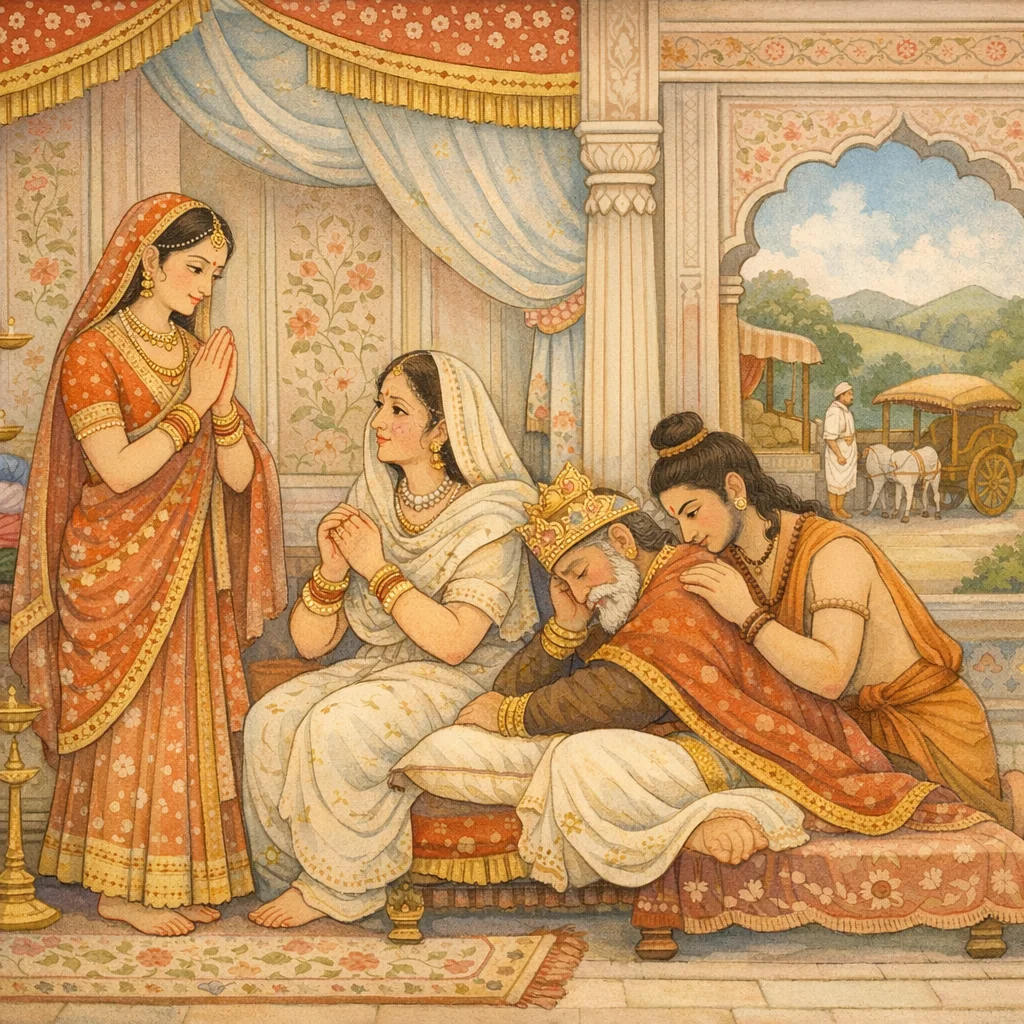
Sarga 39 stages the immediate domestic and administrative aftermath of Rāma’s appearance in ascetic dress. Daśaratha and his queens collapse under grief; the king, overwhelmed, cannot meet Rāma’s gaze or reply. Regaining partial composure, he laments karmic causality and the suffering produced by Kaikeyī’s stratagem, then issues logistical commands to Sumantra: prepare a journey-ready chariot with the finest horses and escort Rāma beyond the city limits. The narrative shifts to court procedure as the king summons a treasury officer to provision Sītā for the forest term; ornaments and garments are brought, and Sītā is described as radiantly adorned, illuminating the palace like dawn. A central discourse follows between Kauśalyā and Sītā: Kauśalyā articulates an orthodox ethic of spousal fidelity and warns against abandoning a husband in misfortune; Sītā responds with folded hands, rejecting any comparison with fickle conduct and affirming that husband is a woman’s daivatam. Rāma then consoles Kauśalyā, emphasizing the finite term of exile (fourteen years) and requests forgiveness from all the queens for any unintended harshness. The palace, once festive with musical resonance, becomes filled with collective wailing, marking Ayodhyā’s transition from coronation expectancy to ritualized bereavement.
Shlokas
Verse 1
रामस्य तु वचः शृत्वा मुनिवेशधरं च तम्।समीक्ष्य सह भार्याभी राजा विगतचेतनः।।2.39.1।।नैनं दुःखेन सन्तप्तः प्रत्यवैक्षत राघवम्।न चैनमभिसम्प्रेक्ष्य प्रत्यभाषत दुर्मनाः।।2.39.2।।
Hearing Rāma’s words and seeing him dressed in the garb of an ascetic, the king, together with his wives, lost consciousness. Tormented by grief, the dejected Daśaratha could not look upon Rāghava, and even after looking, could not reply.
Verse 2
रामस्य तु वचः शृत्वा मुनिवेशधरं च तम्।समीक्ष्य सह भार्याभी राजा विगतचेतनः।।2.39.1।।नैनं दुःखेन सन्तप्तः प्रत्यवैक्षत राघवम्।न चैनमभिसम्प्रेक्ष्य प्रत्यभाषत दुर्मनाः।।2.39.2।।
Tormented by grief, the king could not look at Rāghava (Rāma); and though he gazed upon him, his mind cast down, he could not reply.
Verse 3
स मुहूर्तमिवासंज्ञो दुःखितश्च महीपतिः।विललाप महाबाहू राममेवानुचिन्तयन्।।2.39.3।।
Overwhelmed with grief, the mighty-armed king—lord of the earth—fell as if senseless for a moment and then lamented, his mind fixed only upon Rāma.
Verse 4
मन्ये खलु मया पूर्वं विवत्सा बहवःकृताः।प्राणिनो हिंसिता वापि तस्मादिदमुपस्थितम्।।2.39.4।।
“Surely, in the past I must have made many bereft of their children, or else harmed living beings; therefore, I think this (present misfortune) has come upon me.”
Verse 5
न त्वेवानागते काले देहाच्च्यवति जीवितम्।कैकेय्या क्लिश्यमानस्य मृत्युर्मम न विद्यते।।2.39.5।।योऽहं पावकसङ्काशं पश्यामि पुरतः स्थितम्।विहाय वसने सूक्ष्मे तापसाच्छादमात्मजम्।।2.39.6।।
“Unless the appointed time has arrived, life does not depart from the body. Though I am tormented by Kaikeyī, death does not come to me.”
Verse 6
न त्वेवानागते काले देहाच्च्यवति जीवितम्।कैकेय्या क्लिश्यमानस्य मृत्युर्मम न विद्यते।।2.39.5।।योऽहं पावकसङ्काशं पश्यामि पुरतः स्थितम्।विहाय वसने सूक्ष्मे तापसाच्छादमात्मजम्।।2.39.6।।
“I—who see my own son standing before me, radiant like fire, having cast off his fine garments and clothed in an ascetic’s dress—still do not meet my end.”
Verse 7
एकस्याः खलु कैकेय्याः कृतेऽयं क्लिश्यते जनः।स्वार्थे प्रयतमानायाः संश्रित्य निकृतिं त्विमाम्।।2.39.7।।
“Indeed, because of Kaikeyī alone, people are suffering—she, striving for her own advantage, has resorted to this deceit.”
Verse 8
एवमुक्त्वा तु वचनं बाष्पेण पिहितेन्द्रियः।रामेति सकृदेवोक्त्वा व्याहर्तुं न शशाक ह।।2.39.8।।
Having spoken thus, his senses veiled by tears, he uttered “Rāma” only once—and was unable to speak further.
Verse 9
संज्ञां तु प्रतिलभ्यैव मुहूर्तात्स महीपतिः।नेत्राभ्यामश्रुपूर्णाभ्यां सुमन्त्रमिदमब्रवीत्।।2.39.9।।
Regaining consciousness after a moment, the king—his eyes brimming with tears—said this to Sumantra.
Verse 10
औपवाह्यं रथं युक्त्वा त्वमायाहि हयोत्तमैः।प्रापयैनं महाभागमितो जनपदात्परम्।।2.39.10।।
Harness the finest horses to a chariot fit for travel; come at once, and convey this high-souled Rāma from here to a place beyond the city limits.
Verse 11
एवं मन्ये गुणवतां गुणानां फलमुच्यते।पित्रा मात्रा च यत्साधुर्वीरो निर्वास्यते वनम्।।2.39.11।।
I think this is what people call the ‘reward’ of virtues in the virtuous—that such a righteous and heroic son is banished to the forest by his own father and mother.
Verse 12
राज्ञो वचनमाज्ञाय सुमन्त्रः शीघ्रविक्रमः।योजयित्वाऽययौ तत्र रथमश्वैरलङ्कृतम्।।2.39.12।।
Understanding the king’s command, swift-moving Sumantra yoked the horses and went there with the chariot, splendidly equipped with its steeds.
Verse 13
तं रथं राजपुत्राय सूत: कनकभूषितम्।आचचक्षेऽञ्जलिं कृत्वा युक्तं परमवाजिभिः।।2.39.13।।
With palms joined, the charioteer informed the prince that the chariot—adorned with gold and harnessed with excellent horses—was ready.
Verse 14
राजा सत्वरमाहूय व्यापृतं वित्तसंञ्चये।उवाच देशकालज्ञो निश्चितं सर्वत श्शुचिम्।।2.39.14।।
The king, discerning what was fitting in place and time, quickly summoned the officer engaged in the treasury—firm in resolve and wholly trustworthy—and spoke to him.
Verse 15
वासांसि च महार्हाणि भूषणानि वराणि च।वर्षाण्येतानि सङ्ख्याय वैदेह्याः क्षिप्रमानय।।2.39.15।।
Calculate the years (of exile) and quickly bring for Vaidehī precious garments as well as excellent ornaments.
Verse 16
नरेन्द्रेणैवमुक्तस्तु गत्वा कोशगृहं ततः।प्रायच्छत्सर्वमाहृत्य सीतायै सममेव तत्।।2.39.16।।
Thus instructed by the king, he went to the treasury-house, brought everything, and handed it over in full to Sītā.
Verse 17
सा सुजाता सुजातानि वैदेही प्रस्थिता वनम्।भूषयामास गात्राणि तैर्विचित्रैर्विभूषणैः।।2.39.17।।
Vaidehī, noble-born and ready to depart for the forest, adorned her fair limbs with those varied and gleaming ornaments.
Verse 18
व्यराजयत वैदेही वेश्म तत्सुविभूषिता।उद्यतोंऽशुमतः काले खं प्रभेव विवस्वतः।।2.39.18।।
So richly adorned, Vaidehī made that palace shine—like the sky at dawn, lit by the radiance of the rising sun.
Verse 19
तां भुजाभ्यां परिष्वज्य श्वश्रूर्वचनमब्रवीत्।अनाचरन्ती कृपणं मूर्ध्न्युपाघ्राय मैथिलीम्।।2.39.19।।
Embracing Maithilī with both arms and kissing her on the forehead, her mother-in-law spoke—though Sītā’s own conduct gave no occasion for pity.
Verse 20
असत्य स्सर्वलोकेऽस्मिन्सततं सत्कृताः प्रियैः।भर्तारं नानुमन्यन्ते विनिपातगतं स्त्रियः।।2.39.20।।
In this world, women who—though continually honoured by their beloved—do not stand by (lit. do not consent to follow) their husband when he falls into calamity are deemed untrue (faithless).
Verse 21
एष स्वभावो नारीणामनुभूय पुरा सुखम्।अल्पामप्यापदं प्राप्य दुष्यन्ति प्रजहत्यपि।।2.39.21।।
Having once enjoyed happiness, this is (said to be) the nature of women: on meeting even a slight adversity, they reproach—and may even abandon (their husbands).
Verse 22
असत्यशीला विकृता दुर्ग्राह्यहृदयास्सदा।युवत्यः पापसंङ्कल्पाः क्षणमात्राद्विरागिणः।।2.39.22।।
Young women of evil intent are said to be untrue in conduct, distorted in nature, ever hard to fathom in heart, and capable of turning cold in affection in a mere moment.
Verse 23
न कुलं न कृतं विद्या न दत्तं नापि सङ्ग्रहः।स्त्रीणां गृह्णाति हृदयमनित्यहृदया हि ताः।।2.39.23।।
Neither lineage nor past favours, nor learning, nor gifts, nor even amassed wealth wins a woman’s heart—for (it is said) their hearts are indeed inconstant.
Verse 24
साध्वीनां हि स्थितानां तु शीले सत्ये श्रुते शमे।स्त्रीणां पवित्रं परमं पतिरेको विशिष्यते।।2.39.24।।
But for virtuous women who remain firm in chastity, truth, sacred learning, and self-control, the husband alone stands out as their highest sanctity—the supreme purifier.
Verse 25
स त्वया नावमन्तव्यः पुत्रः प्रव्राजितो मम।तव दैवतमस्त्वेष निर्धनः सधनोऽपि वा।।2.39.25।।
My son, though sent away into exile, must not be treated with contempt by you; let him be your very deity—whether he is without wealth or possessed of wealth.
Verse 26
विज्ञाय वचनं सीता तस्या धर्मार्थसंहितम्।कृताञ्जलिरुवाचेदं श्वश्रूमभिमुखे स्थिताम्।।2.39.26।।
Understanding those words as aligned with dharma and prudent purpose, Sītā—hands folded—spoke this, standing before her mother-in-law.
Verse 27
करिष्ये सर्वमेवाहमार्या यदनुशास्ति माम्।अभिज्ञास्मि यथा भर्तुर्वर्तितव्यं श्रुतं च मे।।2.39.27।।
“I shall do exactly all that you, venerable lady, instruct me. I already know—and have heard before—how one must conduct oneself toward one’s husband.”
Verse 28
न मामसज्जनेनार्या समानयितुमर्हति।धर्माद्विचलितुं नाहमलं चन्द्रादिव प्रभा।।2.39.28।।
“The venerable lady should not compare me to the wicked. I am not capable of swerving from dharma—just as radiance does not depart from the moon.”
Verse 29
नातन्त्री वाद्यते वीणा नाचक्रो वर्तते रथः।नापतिस्सुखमेधेत या स्यादपि शतात्मजा।।2.39.29।।
A vīṇā without strings cannot be played; a chariot without wheels cannot move. So too, a woman without her husband does not flourish in happiness, even if she has a hundred sons.
Verse 30
मितं ददाति हि पिता मितं माता मितं सुतः।अमितस्य हि दातारं भर्तारं का न पूजयेत्।।2.39.30।।
A father gives happiness only in measure; a mother gives in measure; a son gives in measure. But a husband is held to be a giver of boundless happiness—what woman would not honor such a husband?
Verse 31
साहमेवं गता श्रेष्ठा श्रुतधर्मपरावरा।आर्ये किमवमन्येऽहं स्त्रीणां भर्ता हि दैवतम्।।2.39.31।।
Trained in these ideals, and instructed in the range of dharma, how could I, O noble lady, ever slight him? For a woman, her husband is indeed her divinity.
Verse 32
सीताया वचनं श्रुत्वा कौशल्या हृदयङ्गमम्।शुद्धसत्त्वा मुमोचाश्रु सहसा दुःखहर्षजम्।।2.39.32।।
Hearing Sītā’s heart-touching words, Kauśalyā—pure in disposition—suddenly shed tears born of both grief and joy.
Verse 33
तां प्राञ्जलिरभिक्रम्य मातृमध्येऽतिसत्कृताम्। रामः परमधर्मात्मा मातरं वाक्यमब्रवीत्।।2.39.33।।
Rāma, supremely devoted to dharma, approached his mother—highly honored among the mothers—with folded hands and spoke to her.
Verse 34
अम्ब मा दुःखिता भूस्त्वं पश्य त्वं पितरं मम।।क्षयो हि वनवासस्य क्षिप्रमेव भविष्यति।।2.39.34।।
“Mother, do not grieve. Do look after my father. For the end of this forest-exile will come swiftly.”
Verse 35
सुप्तायास्ते गमिष्यन्ति नव वर्षाणि पञ्च च।सा समग्रमिह प्राप्तं मां द्रक्ष्यसि सुहृद्वृतम्।।2.39.35।।
“For you, those nine years and five besides will pass as though in sleep. Then you will see me returned here in full safety, surrounded by my well-wishers.”
Verse 36
एतावदभिनीतार्थमुक्त्वा स जननीं वचः।त्रयश्शतशतार्धाश्च ददर्शा वेक्ष्य मातरः।।2.39.36।।
Having spoken to his mother these words, refined in meaning and measured in scope, he then looked toward the other mothers—three hundred and fifty in number.
Verse 37
ता श्चापि स तथैवार्ता मातृ़र्दशरथात्मजः।धर्मयुक्तमिदं वाक्यं निजगाद कृताञ्जलिः।।2.39.37।।
And to those mothers too—equally distressed—the son of Daśaratha, with folded hands, spoke these words grounded in dharma.
Verse 38
संवासात्परुषं किञ्चिदज्ञानाद्वापि यत्कृतम्।तन्मे समनुजानीत सर्वाश्चामन्त्रयामि वः।।2.39.38।।
“If I have done anything harsh—whether through our long familiarity or through ignorance—please pardon me. I now take leave of you all.”
Verse 39
वचनं राघवस्यैतध्दर्मयुक्तं समाहितम्।शुश्रुवुस्ताः स्त्रियंस्सर्वा श्शोकोपहतचेतसः।।2.39.39।।
All those women, their minds struck down by grief, listened to these words of Rāghava—virtuous and composed.
Verse 40
जज्ञेऽथ तासां सन्नादः क्रौञ्चीनामिव निस्वनः।मानवेन्द्रस्य भार्याणामेवं वदति राघवे।।2.39.40।।
As Rāghava spoke thus, a loud wail arose from the wives of the lord of men, sounding like the cry of female krauñcī-birds.
Verse 41
मुरजपणवमेघघोषवत्दशरथवेश्म बभूव यत्पुरा।विलपितपरिदेवनाकुलंव्यसनगतं तदभूत्सुदुःखितम्।।2.39.41।।
Daśaratha’s palace, which formerly resounded like thunderclouds with the sounds of mṛdaṅgas and paṇavas, now—overtaken by calamity—became utterly sorrowful, filled with wailing and lamentation.
Frequently Asked Questions
The chapter confronts the dharma-sankat of enforced exile: Daśaratha must implement a painful, vow-driven decision while still acting as king and father—ordering Rāma’s escorted departure and arranging provisions—despite emotional incapacity.
Through Kauśalyā and Sītā, the Sarga formalizes an ethic of steadfast marital solidarity: virtue is tested in adversity, and Sītā frames loyalty to her husband as non-negotiable dharma, not contingent on comfort or status.
The narrative foregrounds Ayodhyā’s royal palace and the city boundary (a place ‘outside the city’) as liminal spaces where private grief becomes public transition; culturally, it highlights court logistics (treasury, chariotry) and the ritualized leave-taking of the royal household.