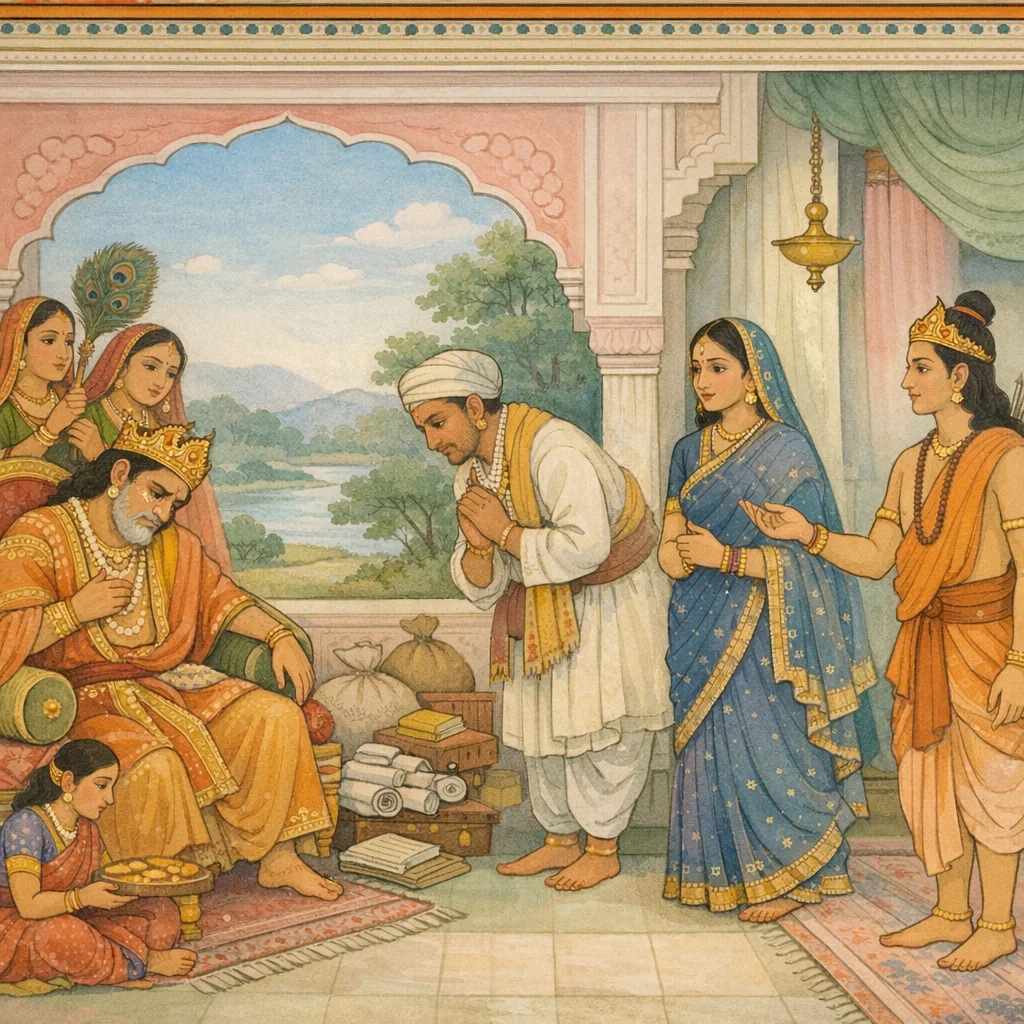
Sarga 36
अयोध्याकाण्डे षट्त्रिंशः सर्गः — Daśaratha’s orders for Rama’s escort; Kaikeyi’s fear; the Asamañjasa precedent
अयोध्याकाण्ड
Sarga 36 intensifies the coronation-crisis into a procedural and moral confrontation. Daśaratha, “afflicted by the promise,” weeps and repeatedly addresses Sumantra, issuing detailed logistical commands to furnish Rāma for the forest journey: a fourfold army with valuables, attendants, carts, weapons, forest-guides and hunters, and even the granary and treasury to accompany him. The chapter then pivots to Kaikeyī’s reaction: as Daśaratha speaks, fear overtakes her and her voice chokes; she argues that Bharata will not accept a kingdom emptied of people and prosperity. Daśaratha condemns her cruelty, while Kaikeyī escalates by citing a dynastic precedent—Sagara’s exclusion of his eldest son Asamañjasa. An aged minister, Siddhārtha, counters by narrating Asamañjasa’s crimes against citizens’ children and challenges Kaikeyī to state any real fault in Rāma; otherwise exile would be adharma that burns even Indra’s splendor. The sarga concludes with Daśaratha’s grief-stricken rebuke of Kaikeyī’s ‘vile path’ and his declaration that he will follow Rāma, abandoning kingdom and wealth, leaving Kaikeyī to “enjoy” rule with Bharata—an utterance heavy with moral irony and despair.
Shlokas
Verse 1
ततस्सुमन्त्रमैक्ष्वाकः पीडितोऽत्र प्रतिज्ञया।सबाष्पमतिनिश्श्वश्य जगादेदं पुनः पुनः।।।।
Then Daśaratha, scion of the Ikṣvākus—tormented in this matter by his pledge—sighed deeply again and again and, with tears, spoke these words to Sumantra.
Verse 2
सूत रत्नसुसम्पूर्णा चतुर्विधबला चमूः।राघवस्यानुयात्रार्थं क्षिप्रं प्रतिविधीयताम्।।।।
“O charioteer, let the army—complete in its four divisions and well supplied—be arranged at once to accompany Rāghava on his journey.”
Verse 3
रूपाजीवाश्च वादिन्यो वणिजश्च महाधनाः।शोभयन्तु कुमारस्य वाहिनीं सुप्रसारिताः।।।।
Let courtesans who live by their beauty, sweet‑speaking women, and wealthy merchants with their wares well displayed lend splendor to the prince’s procession.
Verse 4
ये चैनमुपजीवन्ति रमते यैश्च वीर्यतः।तेषां बहुविधं दत्त्वा तानप्यत्र नियोजय ।।।।
And those who made their living by serving him, and the gallant youths with whom he used to sport—give them gifts of many kinds and appoint them here as well (in this following/entourage).
Verse 4
ये चैनमुपजीवन्ति रमते यैश्च वीर्यतः।तेषां बहुविधं दत्त्वा तानप्यत्र नियोजय ।।।।
And those who made their living by serving him, and the gallant youths with whom he used to sport—give them gifts of many kinds and appoint them here as well (in this following/entourage).
Verse 5
आयुधानि च मुख्यानि नागरा श्शकटानि च।अनुगच्छन्तु काकुत्स्थं व्याधाश्चारण्य गोचराः।।।।
Let the principal weapons, citizens/guards, and carts follow Kākutstha (Rāma); and let hunters and forest‑rangers—those accustomed to woodland routes—go along as well.
Verse 6
निघ्नन् मृगान् कुञ्जरांश्च पिबंश्चारण्यकं मधु।नदीश्च विविधाः पश्यन्न राज्यस्य स्मरिष्यति।।।।
Slaying antelopes and elephants, drinking honey found in the forest, and beholding many kinds of rivers, Rāma will (so delight in the wilderness that he) will not even recollect the kingdom.
Verse 7
धान्यकोशश्च यः कश्चिद्धनकोशश्च मामकः।तौ राममनुगच्छेतां वसन्तं निर्जने वने।।।।
Whatever stores of grain and whatever treasury are mine—let both follow Rāma, as he dwells in the lonely forest.
Verse 8
यजन् पुण्येषु देशेषु विसृजं श्चाप्तदक्षिणाः।ऋषिभिश्च समागम्य प्रवत्स्यति सुखं वने।।।।
Performing sacrifices in holy places, bestowing fitting sacrificial gifts, and associating with sages, he will live happily in the forest.
Verse 9
भरतश्च महाबाहुरयोध्यां पालयिष्यति।सर्वकामैः सह श्रीमान् रामः संसाध्यतामिति ।।।।
‘Let mighty-armed Bharata govern Ayodhyā; and let the illustrious Rāma be duly provided for with every comfort’—so (it was said).
Verse 10
एवं ब्रुवति काकुत्स्थे कैकेय्या भय मागतम्।मुखं चाप्यगमच्छोषं स्वरश्चापि न्यरुध्यत।।।।
As Daśaratha of the Kakutsthas spoke thus, fear came upon Kaikeyī; her face grew dry and pale, and even her voice became choked.
Verse 11
सा विषण्णा च सन्त्रस्ता मुखेन परिशुष्यता।राजानमेवाभिमुखी कैकेयी वाक्यमब्रवीत्।।।।
Dejected and frightened, her face parched, Kaikeyī turned toward the king and spoke.
Verse 12
राज्यं गतजनं साधो पीतमण्डां सुरामिव।निरास्वाद्यतमं शून्यं भरतो नाभिपत्स्यते।।।।
O righteous king, Bharata will not accept a kingdom deserted by its people, emptied and joyless—like wine whose very essence has been drained away.
Verse 13
कैकेय्यां मुक्तलज्जायां वदन्त्यामतिदारुणाम्।राजा दशरथो वाक्यमुवाचायतलोचनाम्।।।।
As Kaikeyī—casting off shame—spoke words of extreme cruelty, King Daśaratha replied to that large-eyed queen.
Verse 14
वहन्तं किं तुदसि मां नियुज्य धुरि माऽहिते।अनार्ये कृत्यमारब्धं किं न पूर्वमुपारुधः।।।।
O wicked woman, after yoking me to the burden, why do you prod me as I pull it forward? O ignoble one—if this deed was begun, why did you not restrain me at the very start?
Verse 15
तस्यैतत्क्रोधसंयुक्तमुक्तं श्रुत्वा वराङ्गना।कैकेयी द्विगुणं क्रुद्धा राजानमिदमब्रवीत्।।।।
Hearing these anger-laden words of his, Kaikeyī—the fair lady—grew twice as furious and said this to the king.
Verse 16
वैव वंशे सगरो ज्येष्ठं पुत्रमुपारुधत्।असमञ्ज इति ख्यातं तथायं गन्तुमर्हति।।।।
In your very own lineage, Sagara barred his eldest son—well known as Asamañja. So too, this Rāma deserves to be sent away in the same manner.
Verse 17
एवमुक्तो धिगित्येव राजा दशरथोऽब्रवीत्।व्रीडितश्च जनस्सर्व स्सा च तं नावबुध्यत।।।।
Thus addressed, King Daśaratha could only say, “Shame!” All those present felt ashamed—yet she (Kaikeyī) did not grasp it.
Verse 18
तत्र वृद्धो महामात्रस्सिद्धार्थो नाम नामतः।शुचिर्बहुमतो राज्ञः कैकेयी मिदमब्रवीत्।।।।
There an aged high minister—Siddhārtha by name, pure in conduct and greatly esteemed by the king—spoke these words to Kaikeyī.
Verse 18
तत्र वृद्धो महामात्रस्सिद्धार्थो नाम नामतः।शुचिर्बहुमतो राज्ञः कैकेयी मिदमब्रवीत्।।।।
There an aged high minister—Siddhārtha by name, pure in conduct and greatly esteemed by the king—spoke these words to Kaikeyī.
Verse 19
असमञ्जो गृहीत्वा तु क्रीडतः पथि बालकान्।सरय्वाः प्रक्षिपन्नप्सु रमते तेन दुर्मतिः।।।।
Asamañja, wicked in mind, would seize the children playing in the street and amuse himself by hurling them into the waters of the Sarayū.
Verse 20
तं दृष्ट्वा नागरा स्सर्वे कृद्धा राजानमब्रुवन्।असमञ्जं वृणीष्वैकमस्मान्वा राष्ट्रवर्धन।।।।
Seeing this, all the city-dwellers, enraged, spoke to the king: “O increaser of the kingdom—choose one: either Asamañja alone, or us.”
Verse 21
तानुवाच ततो राजा किन्निमित्तमिदं भयम्।ताश्चापि राज्ञा सम्पृष्टा वाक्यं प्रकृतयोऽब्रुवन्।।।।
Then the king said to them, “For what reason is there this fear?” And when questioned by the king, the subjects replied with these words.
Verse 22
डक्रीडतस्त्वेष नः पुत्रान् बालानुद्भ्रान्तचेतनः।सरय्वां प्रक्षिपन्मौर्ख्यादतुलां प्रीतिमश्नुते।।।।
“This man, his mind deranged, throws our little sons—while they are at play—into the Sarayū; and out of sheer folly he derives incomparable pleasure from it.”
Verse 23
स तासां वचनं श्रुत्वा प्रकृतीनां नराधिपः।तं तत्याजाहितं पुत्रं तेषां प्रियचिकीर्षया।।।।
Hearing the words of his subjects, the king—wishing to do what was pleasing to them—abandoned that harmful son.
Verse 24
तं यानं शीघ्रमारोप्य सभार्यं सपरिच्छदम्।यावज्जीवं विवास्योऽयमिति स्वानन्वशात्पिता।।।।
The father quickly put him, together with his wife and whatever belongings they had, into a carriage and ordered his own attendants: “This man is to be banished for life.”
Verse 25
स फालपिटकं गृह्य गिरिदुर्गाण्यलोडयत्।दिश स्सर्वास्त्वनुचरन् स यथा पापकर्मकृत्।।।।
Taking up a spade and a basket, he wandered through every direction, digging about even in mountain fastnesses—like one marked out as an evildoer.
Verse 26
इत्येनमत्यजद्राजा सगरो वै सुधार्मिकः।रामः किमकरोत्पापं येनैवमुपरुध्यते।।।।
“Thus the king Sagara—indeed most righteous—cast him off. What evil, then, has Rāma done that he should be restrained and driven out in this manner?”
Verse 27
न हि कञ्चन पश्यामो राघवस्यागुणं वयम्।दुर्लभो ह्यस्य निरय श्शशाङ्कस्येव कल्मषम्।।।।
We see not even the slightest fault in Rāghava (Rāma). Any blemish in him is as hard to find as the so‑called stain upon the moon.
Verse 28
अथवा देवि दोषं त्वं कञ्चित्पश्यसि राघवे।तमद्य ब्रूहि तत्वेन तदा रामो विवास्यताम्।।।।
Or else, O Queen—if you truly see any fault at all in Rāghava—say it plainly today; only then may Rāma be sent into exile.
Verse 29
अदुष्टस्य हि संत्यागः सत्पथे निरतस्य च।निर्दहेदपि शक्रस्य द्युतिं धर्मनिरोधनात्।।।
To cast away one who is innocent and steadfast on the righteous path would, by obstructing dharma itself, burn away even Indra’s radiance.
Verse 30
तदलं देवि रामस्य श्रिया विहतया त्वया।लोकतोऽपि हि ते रक्ष्यः परिवादः शुभानने।।।।
Enough, O Queen, of thwarting Rāma’s prosperity. O fair‑faced one, you must also protect yourself from the blame and censure of the world.
Verse 31
श्रुत्वा तु सिद्धार्थवचो राजा श्रान्ततरस्वनः।शोकोपहतया वाचा कैकेयीमिदमब्रवीत्।।।।
Having heard Siddhārtha’s well‑meant words, the king—his voice growing ever weaker—spoke to Kaikeyī in speech broken by grief.
Verse 32
एतद्वचो नेच्छसि पापवृत्ते हितं न जानासि ममात्मनो वा।आस्थाय मार्गं कृपणं कुचेष्टा चेष्टा हि ते साधुपथादपेता।।।।
O woman of sinful conduct, these words do not please you; you do not know what is truly beneficial—either for me or for yourself. Having taken up a base path, your actions, born of wicked intent, have indeed strayed from the way of the good.
Verse 33
अनुव्रजिष्याम्यहमद्य रामंराज्यं परित्यज्य सुखं धनं च।सहैव राज्ञा भरतेन च त्वंयथासुखं भुङ्क्ष्व चिराय राज्यम्।।।।
Forsaking this kingdom—its comforts and its wealth—I shall follow Rāma today. You, together with King Bharata, may enjoy the kingship at your pleasure for a long time.
Frequently Asked Questions
The central dharma-sankat is whether Rāma’s exile can be justified when no fault is found in him, even though Daśaratha is bound by a prior promise. Siddhārtha frames unjust banishment as a moral catastrophe that undermines righteousness itself.
Speech and vows are shown as ethically potent instruments: a promise may bind a king, but deploying it for adharma invites public censure and inner collapse. The sarga also teaches that precedent is valid only when the underlying ethical cause is comparable (Asamañjasa’s harm vs. Rāma’s innocence).
Ayodhyā functions as the civic stage where legitimacy is measured by citizens’ moral judgment, while the Sarayū River anchors the Asamañjasa episode as a public-safety grievance. The forest (vana) appears as the cultural space of exile, sacrifice, and ascetic association with ṛṣis.