Sarga 31
लक्ष्मणस्य वनानुगमन-प्रतिज्ञा तथा आयुध-संग्रहः (Lakshmana’s Vow to Follow Rama and the Retrieval of Divine Weapons)
अयोध्याकाण्ड
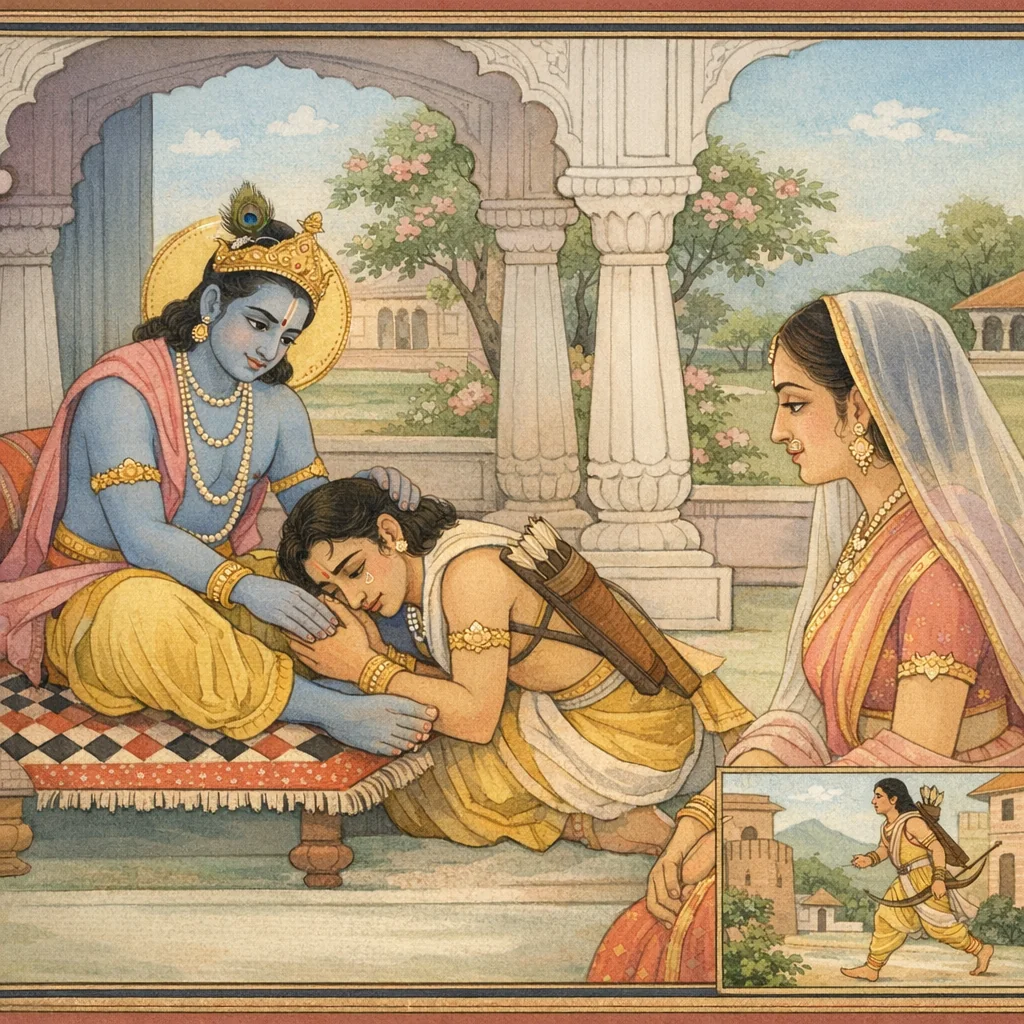
This sarga is structured as a tightly argued dialogue on dharma priorities during Rama’s impending forest exile. Lakshmana, arriving earlier and hearing Rama–Sita discourse, is overwhelmed with grief and clings to Rama’s feet, declaring unwavering accompaniment. Rama attempts a pragmatic ethical redirection: if Lakshmana goes, who will care for Kausalya and Sumitra, especially under the political vulnerability created by Dasaratha’s passion-bound state and Kaikeyi’s ascendance; Rama frames elder-service (गुरुपूजा/वृद्ध-सेवा) as an unequalled virtue and asks Lakshmana to remain as protector of the mothers. Lakshmana counters with a reasoned defense: Bharata, recognizing Rama’s tejas, will honor Kausalya and Sumitra; Kausalya’s independent sustenance (thousand villages) makes her materially secure; and Lakshmana’s dharma is fulfilled as Rama’s follower without ethical breach. He further offers operational support in exile—leading the way armed, collecting roots and fruits, and maintaining vigilance day and night. Rama, pleased, transitions from debate to logistics: Lakshmana should take leave of friends, retrieve the Varuna-gifted divine weapon set deposited and worshipped at Vasistha’s house (bows, armours, quivers with inexhaustible arrows, gold-plated swords), and return promptly. The chapter ends with Lakshmana’s execution of the task and Rama’s next instruction to summon Suyajna (Vasistha’s son) and other brahmins for rites and charitable distribution before departure, integrating dharma (दान, आचार) with the exile itinerary.
Shlokas
Verse 1
एवं शृत्वा तु संवादं लक्ष्मणः पूर्वमागतः।बाष्पपर्याकुलमुखः शोकं सोढुमशक्नुवन्।।।।स भ्रातुश्चरणौ गाढं निपीड्य रघुनन्दनः।सीतामुवाचातियशां राघवं च महाव्रतम्।।।।
Having heard that conversation, Lakṣmaṇa—who had arrived there earlier—stood with his face overwhelmed by tears, unable to endure the sorrow. Pressing his brother’s feet tightly, the delight of the Raghu line spoke to illustrious Sītā and to Rāghava, steadfast in his great vow.
Verse 2
एवं शृत्वा तु संवादं लक्ष्मणः पूर्वमागतः।बाष्पपर्याकुलमुखः शोकं सोढुमशक्नुवन्।।2.31.1।।स भ्रातुश्चरणौ गाढं निपीड्य रघुनन्दनः।सीतामुवाचातियशां राघवं च महाव्रतम्।।2.31.2।।
Having heard that conversation, Lakṣmaṇa—who had arrived there earlier—stood with his face overwhelmed by tears, unable to endure the sorrow. Pressing his brother’s feet tightly, the delight of the Raghu line spoke to illustrious Sītā and to Rāghava, steadfast in his great vow.
Verse 3
यदि गन्तुं कृताबुद्धिर्वनं मृगगजायुतम्।अहं त्वानुगमिष्यामि वनमग्रे धनुर्धरः।।।।
If you have resolved to go to the forest, rich with deer and elephants, I too will follow you to the woods—walking ahead, bow in hand.
Verse 4
मया समेतोऽरण्यानि बहूनि विचरिष्यसि।पक्षिभिर्मृगयूथैश्च संघुष्टानि समन्ततः।।।।
Accompanied by me, you will roam many forests—echoing on all sides with the calls of birds and the sounds of herds of wild animals.
Verse 5
न देवलोकाक्रमणं नामरत्वमहं वृणे।ऐश्वर्यं वापि लोकानां कामये न त्वया विना।।।।
Without you, I would choose neither conquest of the gods’ realm nor immortality; nor do I desire sovereignty over worlds—if you are not with me.
Verse 6
एवं ब्रुवाणस्सौमित्रिर्वनवासाय निश्चितः।रामेण बहुभिस्सान्त्वैर्निषिध्दः पुनरब्रवीत्।।।।
Thus speaking, Saumitri—resolved on forest-dwelling—though restrained by Rāma with many consoling words, spoke once again.
Verse 7
अनुज्ञातश्च भवता पूर्वमेव यदस्म्यहम्।किमिदानीं पुनरिदं क्रियते मन्निवारणम्।।।।
Since you had already granted me permission earlier, why is this restraint being placed upon me again now?
Verse 8
यदर्थं प्रतिषेधो मे क्रियते गन्तुमिच्छतः।एतदिच्छामि विज्ञातुं संशयो हि ममानघ।।।।
O sinless one, I wish to know for what reason I am being restrained, even though I desire to go; for this has indeed raised doubt in my mind.
Verse 9
ततोऽब्रवीन्महातेजा रामो लक्ष्मणमग्रतः।स्थितं प्राग्गामिनं वीरं याचमानं कृताञ्जलिम्।।।।
Then the radiant Rāma spoke to Lakshmaṇa before him—the heroic one standing with folded palms, imploring to go ahead as their forerunner.
Verse 10
स्निग्धो धर्मरतो वीरस्सततं सत्पथे स्थितः।प्रियः प्राणसमो वश्यो भ्राता चापि सखा च मे।।।।
Affectionate, devoted to dharma, and valiant—ever established on the good path—you are dear to me as life itself: obedient as a brother, and also my companion as a friend.
Verse 11
मयाऽद्य सह सौमित्रे त्वयि गच्छति तद्वनम्।को भरिष्यति कौसल्यां सुमित्रां वा यशस्विनीम्।।।।
O Saumitra, if you go with me today to that forest, who will care for Kausalyā—and for the illustrious Sumitrā?
Verse 12
अभिवर्षति कामैर्यः पर्जन्यः पृथिवीमिव।स कामपाशपर्यस्तो महातेजा महीपतिः।।।।
That mighty lord of the earth—who once, like Parjanya, showered the world with boons—has now been cast down, ensnared by the noose of desire.
Verse 13
सा हि राज्यमिदं प्राप्य नृपस्याश्वपते स्सुता।दुःखितानां सपत्नीनां न करिष्यति शोभनम्।।।।
For once the daughter of king Aśvapati gains this kingdom, she will do nothing good for her afflicted co-wives.
Verse 14
न स्मरिष्यति कौसल्यां सुमित्रां च सुदुःखिताम्।भरतो राज्यमासाद्य कैकेय्यां पर्यवस्थितः।।।।
When Bharata attains the kingdom, resting his confidence in Kaikeyī, he will not remember Kausalyā and the deeply sorrowing Sumitrā.
Verse 15
तामार्यां स्वयमेवेह राजानुग्रहणेन वा।सौमित्रे भर कौशल्यामुक्तमर्थमिमं चर।।।।
Therefore, O Saumitra, remain here and support that venerable Kausalyā—either by your own efforts or by securing the king’s favor; carry out this purpose I have stated.
Verse 16
एवं मम च ते भक्तिर्भविष्यति सुदर्शिता।धर्मज्ञ गुरुपूजायां धर्मश्चाप्यतुलो महान्।।।।
By acting thus, your devotion to me will be clearly shown; and, O knower of dharma, reverence to elders is itself a great virtue—unequalled.
Verse 17
एवं कुरुष्व सौमित्रे मत्कृते रघुनन्दन।अस्माभिर्विप्रहीणाया मातुर्नो न भवेत्सुखम्।।।।
Do so, O Saumitra, for my sake, O delight of the Raghus—for if our mother is separated from us, she will have no happiness.
Verse 18
एवमुक्तस्तु रामेण लक्ष्मण श्श्लक्ष्णया गिरा।प्रत्युवाच तदा रामं वाक्यज्ञो वाक्यकोविदम्।।।।
Thus addressed by Rāma—skilled and discerning in speech—Lakṣmaṇa, himself eloquent, then replied in gentle words to Rāma.
Verse 19
तवैव तेजसा वीर भरतः पूजयिष्यति।कौसल्यां च सुमित्रां च प्रयतो नात्र संशयः।।।।
Because of your very power, O hero, Bharata will surely honor Kausalyā and Sumitrā with humility—there is no doubt of it.
Verse 20
कौशल्या बिभृयादार्या सहस्रमपि मद्विधान्।यस्यास्सहस्रं ग्रामाणां सम्प्राप्त मुपजीवनम्।।।।
Noble Kausalyā could support even a thousand men like me, for she has obtained sustenance from a thousand villages.
Verse 21
तदात्मभरणे चैव मम मातुस्तथैव च।पर्याप्ता मद्विधानां च भरणाय यशस्विनी।।।।
That illustrious lady is fully capable of supporting herself—and likewise my mother—and even of maintaining men like me.
Verse 22
कुरुष्व मामनुचरं वैधर्म्यं नेह विद्यते।कृतार्थोऽहं भविष्यामि तव चार्थः प्रकल्पते।।।।
Make me your attendant and follower; in this there is no breach of dharma. I will find my purpose fulfilled—and your aim too will be accomplished.
Verse 23
धनुरादाय सशरं खनित्रपिटकाधरः।अग्रतस्ते गमिष्यामि पन्थानमनुदर्शयन्।।।।
Taking up the bow with arrows, and carrying a spade and a basket, I will go ahead of you, showing you the path.
Verse 24
आहरिष्यामि ते नित्यं मूलानि च फलानि च।वन्यानि यानि चान्यानि स्वाहाराणि तपस्विनाम्।।।।
Every day I will gather for you roots and fruits, and whatever other forest foods are suitable fare for ascetics.
Verse 25
भवांस्तु सह वैदेह्या गिरिसानुषु रंस्यते।अहं सर्वं करिष्यामि जाग्रत स्स्वपतश्च ते।।।।
You, with Vaidehī, may find delight upon the mountain slopes; I will do everything for you—whether you are awake or asleep.
Verse 26
रामस्त्वनेन वाक्येन सुप्रीतः प्रत्युवाच तम्।व्रजापृच्छस्व सौमित्रे सर्वमेव सुहृज्जनम्।।।।
You, with Vaidehī, may find delight upon the mountain slopes; I will do everything for you—whether you are awake or asleep.
Verse 27
ये च राज्ञो ददौ दिव्ये महात्मा वरुण स्स्वयम्।जनकस्य महायज्ञे धनुषी रौद्रदर्शने।।।।अभेद्यकवचे दिव्ये तूणी चाक्षयसायकौ।आदित्यविमलौ चोभौ खड्गौ हेमपरिष्कृतौ।।।।सत्कृत्य निहितं सर्वमेतदाचार्यसद्मनि।सर्वमायुधमादाय क्षिप्रमाव्रज लक्ष्मण।।।।
And those two divine bows—fearsome to behold—which the great-souled Varuṇa himself bestowed upon the king at Janaka’s grand sacrifice—
Verse 28
ये च राज्ञो ददौ दिव्ये महात्मा वरुण स्स्वयम्।जनकस्य महायज्ञे धनुषी रौद्रदर्शने।।2.31.27।।अभेद्यकवचे दिव्ये तूणी चाक्षयसायकौ।आदित्यविमलौ चोभौ खड्गौ हेमपरिष्कृतौ।।2.31.28।।सत्कृत्य निहितं सर्वमेतदाचार्यसद्मनि।सर्वमायुधमादाय क्षिप्रमाव्रज लक्ष्मण।।2.31.29।।
—two divine, impenetrable armours; two quivers with inexhaustible arrows; and two swords, gold-adorned, both radiant and pure like the sun.
Verse 29
ये च राज्ञो ददौ दिव्ये महात्मा वरुण स्स्वयम्।जनकस्य महायज्ञे धनुषी रौद्रदर्शने।।2.31.27।।अभेद्यकवचे दिव्ये तूणी चाक्षयसायकौ।आदित्यविमलौ चोभौ खड्गौ हेमपरिष्कृतौ।।2.31.28।।सत्कृत्य निहितं सर्वमेतदाचार्यसद्मनि।सर्वमायुधमादाय क्षिप्रमाव्रज लक्ष्मण।।2.31.29।।
All this has been reverently kept in our preceptor’s residence. Gather up the whole armoury and return swiftly, O Lakṣmaṇa.
Verse 30
स सुहृज्जनमामन्त्र्यवनवासाय निश्चितः।इक्ष्वाकुगुरुमागम्य जग्राहायुधमुत्तमम्।।।।
Resolved upon life in the forest, Lakṣmaṇa took leave of his friends; then, reaching the Ikṣvāku preceptor, he received the excellent weapons.
Verse 31
तद्धिव्यं राजशार्दूल सत्कृतं माल्यभूषितम्।रामाय दर्शयामास सौमित्रिस्सर्वमायुधम्।।।।
Then Saumitri (Lakṣmaṇa), O tiger among princes, displayed to Rāma all that divine weaponry—duly honoured and adorned with garlands.
Verse 32
तमुवाचात्मवान् रामः प्रीत्या लक्ष्मणमागतम्।काले त्वमागत सौम्य काङ्क्षिते मम लक्ष्मण।।।।
Self-possessed Rāma spoke affectionately to Lakṣmaṇa as he arrived: “Gentle one, you have come at the very time I was hoping for, my Lakṣmaṇa.”
Verse 33
अहं प्रदातुमिच्छामि यदिदं मामकं धनम्।ब्राह्मणेभ्यस्तपस्विभ्यस्त्वया सह परन्तप।।।।
I wish to give away this wealth of mine to ascetic brahmins—together with you, O subduer of foes.
Verse 34
वसन्तीह दृढं भक्त्या गुरुषु द्विजसत्तमाः।तेषामपि च मे भूयस्सर्वेषाञ्चोपजीविनाम्।।।।
Here dwell the best of brahmins, firmly devoted to their teachers; and there are also many others who depend upon me for their livelihood.
Verse 35
वशिष्ठपुत्रं तु सुयज्ञमार्यंत्वमानयाशु प्रवरं द्विजानाम्।अभिप्रयास्यामि वनं समस्तानभ्यर्च्य शिष्टानपरान् द्विजातीन्।।।।
Bring quickly the venerable Suyajña, son of Vasiṣṭha—foremost among brahmins. After paying homage to him and to all other distinguished brahmins, I shall set out for the forest.
Frequently Asked Questions
The central dharma-sankat is whether Lakshmana should accompany Rama into exile or remain in Ayodhya to safeguard and serve the elder queens (Kausalya and Sumitra) amid political instability. Rama argues for elder-service as paramount in the immediate crisis; Lakshmana argues that accompaniment is not a breach of virtue and that the mothers’ welfare can be secured otherwise, thus prioritizing direct service to Rama in exile.
Dharma is shown as layered and context-sensitive: emotional devotion must be articulated through reasoned duty. The sarga teaches that vows and service (to elders, to one’s leader, to ascetics via charity) are not merely sentiments but structured obligations requiring foresight, resource planning, and respectful speech—Lakshmana’s bhakti and Rama’s prudence converge into an actionable dharmic plan.
Culturally, the key landmark is the ācārya-sadman (Vasistha’s residence) as a repository of sanctified royal weaponry and ritual authority, underscoring preceptor-centered custodianship. Geographically, the ‘forest’ (वनम्) functions as the imminent transition-space, while Ayodhya remains the implied courtly backdrop where leave-taking, charity preparations, and household responsibilities are negotiated.