Sarga 18
अष्टादशः सर्गः — Kaikeyī Discloses the Boons: Exile to Daṇḍaka and Bharata’s Consecration
अयोध्याकाण्ड
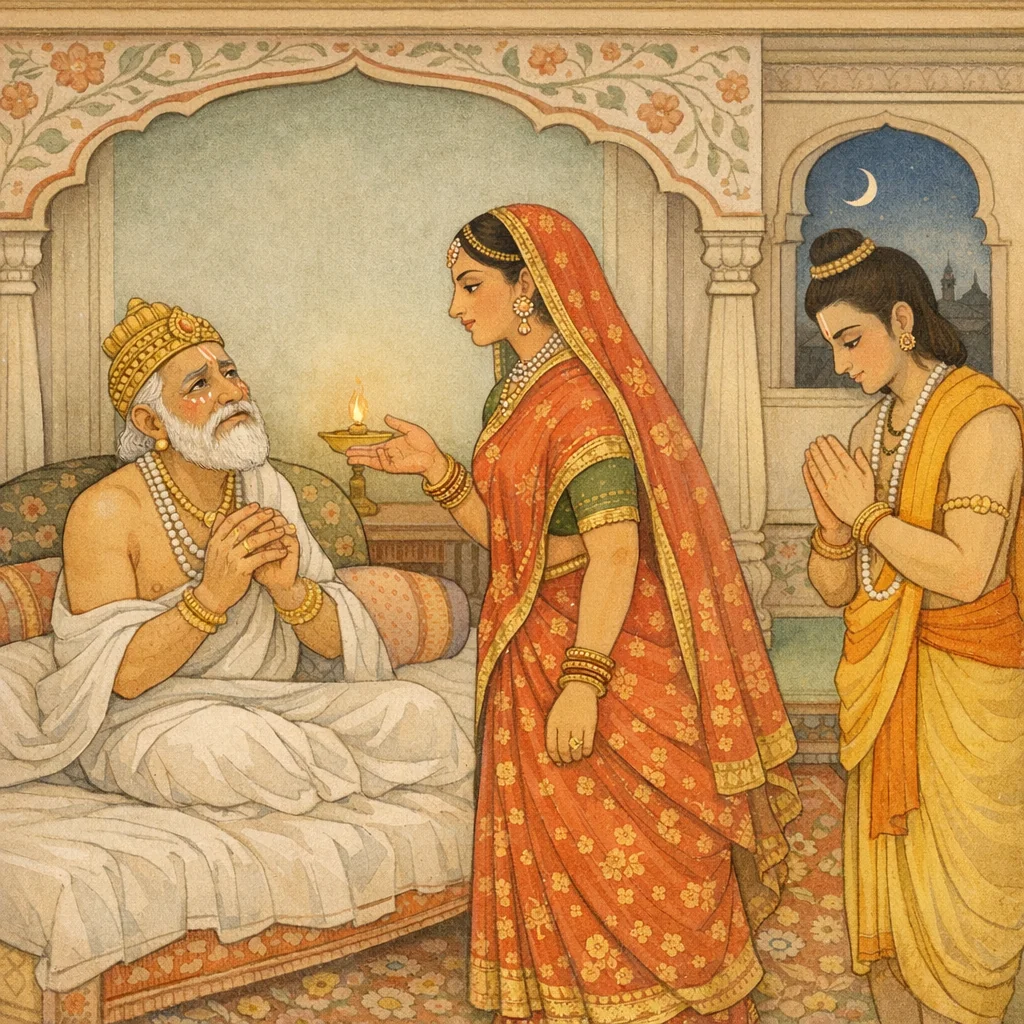
Rāma enters the inner chamber and beholds Daśaratha reclined on an auspicious couch, wretched and pale, seated beside Kaikeyī. After saluting first his father and then Kaikeyī, Rāma sees the king unable to look at him or speak beyond uttering “Rāma,” overwhelmed by tears and heavy breathing. Rāma’s inquiry unfolds as a structured diagnostic: he asks whether he has unknowingly offended, whether the king suffers bodily or mental affliction, whether any misfortune has befallen Bharata, Śatrughna, or the queens, and whether Kaikeyī has spoken harshly and shaken the king’s mind. Kaikeyī reframes the silence as fear of speaking an unpleasant truth to a beloved son and demands that Rāma fulfill a promise earlier granted to her as two boons. Rāma asserts uncompromising obedience—declaring he would enter fire, drink poison, or drown if commanded by his father-guru and wellwisher—then asks to hear the king’s desired command. Kaikeyī finally states the boon-claims: Bharata’s consecration and Rāma’s departure to Daṇḍaka forest for fourteen years, renouncing the planned abhiṣeka and living as an ascetic in jaṭā and ajina. The sarga closes by contrasting Rāma’s steadiness under harsh speech with Daśaratha’s intense anguish at the calamity falling upon his son, crystallizing the book’s dharma-centered crisis around truth, vows, and succession.
Shlokas
Verse 1
स ददर्शासने रामो निषण्णं पितरं शुभे।कैकेयीसहितं दीनं मुखेन परिशुष्यता।।।।
There Rāma saw his father seated upon an auspicious couch; Kaikeyī was beside him, and the king looked wretched, his face pale and dried with distress.
Verse 2
स पितुश्चरणौ पूर्वमभिवाद्य विनीतवत्।ततो ववन्दे चरणौ कैकेय्या स्सुसमाहितः।।।।
With humility and a composed mind, he first bowed in reverence at his father’s feet; then he saluted the feet of Kaikeyī.
Verse 3
रामेत्युक्त्वा तु वचनं बाष्पपर्याकुलेक्षणः।शशाक नृपतिर्दीनो नेक्षितुं नाभिभाषितुम्।।।।
Having uttered only the word “Rāma,” the king—his eyes clouded with tears—was so overcome with misery that he could neither look at him nor speak further.
Verse 4
तदपूर्वं नरपतेर्दृष्ट्वा रूपं भयावहम्।रामोऽपि भयमापन्नः पदा स्पृष्ट्वेव पन्नगम्।।।।
Seeing his father the king in a terrifying, unprecedented condition, even Rāma was seized by fear—as though he had stepped upon a serpent.
Verse 5
इन्द्रियैरप्रहृष्टैस्तं शोकसन्तापकर्शितम्।निश्श्वसन्तं महाराजं व्यथिताकुलचेतसम्।।।।ऊर्मिमालिनमक्षोभ्यं क्षुभ्यन्तमिव सागरम्।उपप्लुतमिवादित्यमुक्तानृतमृषिं यथा।।।।
With senses grown joyless, the great king—wasted by grief and burning distress—breathed heavily, his mind shaken and confused. Though by nature unshakable, he seemed to churn like the sea crowned with waves; like the sun eclipsed; like an ascetic brought low by speaking untruth.
Verse 6
इन्द्रियैरप्रहृष्टैस्तं शोकसन्तापकर्शितम्।निश्श्वसन्तं महाराजं व्यथिताकुलचेतसम्।।2.18.5।।ऊर्मिमालिनमक्षोभ्यं क्षुभ्यन्तमिव सागरम्।उपप्लुतमिवादित्यमुक्तानृतमृषिं यथा।।2.18.6।।
With senses grown joyless, the great king—wasted by grief and burning distress—breathed heavily, his mind shaken and confused. Though by nature unshakable, he seemed to churn like the sea crowned with waves; like the sun eclipsed; like an ascetic brought low by speaking untruth.
Verse 7
अचिन्त्यकल्पं हि पितुस्तं शोकमुपधारयन्।बभूव संरब्धतर स्समुद्र इव पर्वणि।।।।
As Rāma contemplated that unimaginable grief of his father, he grew still more disturbed—like the ocean heaving on the full-moon tide.
Verse 8
चिन्तयामास च तदा रामः पितृहिते रतः।किं स्विदद्यैव नृपतिर्न मां प्रत्यभिनन्दति।।।।
Then Rāma—devoted to his father’s good—pondered: “Why is it that today the king does not return my greeting?”
Verse 9
अन्यदा मां पिता दृष्ट्वा कुपितोऽपि प्रसीदति।तस्य मामद्य संप्रेक्ष्य किमायासः प्रवर्तते।।।।
“At other times, even if my father is angry, he becomes calm on seeing me; but today, though he looks upon me, why does this distress arise in him?”
Verse 10
स दीन इव शोकार्तो विषण्णवदनद्युतिः।कैकेयीमभिवाद्यैव रामो वचनमब्रवीत्।।।।
Rāma, looking like a man crushed by grief, his face dim with sorrow, first saluted Kaikeyī and then spoke.
Verse 11
कच्चिन्मया नापराद्धमज्ञानाद्येन मे पिता।कुपितस्तन्ममाचक्ष्व त्वं चैवैनं प्रसादय।।।।
Have I, unknowingly, committed some offense, because of which my father is angry? Tell me that—and you yourself please soothe him.
Verse 12
अप्रसन्नमनाः किन्नु सदा मां प्रति वत्सलः।विवर्णवदनो दीनो न हि मामभिभाषते।।।।
He who has always been affectionate toward me—why is his mind displeased now? Why is his face pale and downcast, and why does he not speak to me?
Verse 13
शरीरो मानसो वापि कच्चिदेनं न बाधते।सन्तापोवाऽभितापो वा दुर्लभं हि सदा सुखम्।।।।
Is he troubled by some bodily illness, or by a mental anguish—some affliction or intense distress? For lasting happiness is indeed hard to find.
Verse 14
कच्चिन्न किञ्चिद्भरते कुमारे प्रियदर्शने।शत्रुघ्ने वा महासत्त्वे मात्रूणां वा ममाशुभम्।।।।
I hope no misfortune has befallen the handsome prince Bharata, or mighty Śatrughna, or any of my mothers.
Verse 15
अतोषयन्महाराजमकुर्वन्वा पितुर्वचः।मुहूर्तमपि नेच्छेयं जीवितुं कुपिते नृपे।।।।
If I have ever displeased the great king—my father—or failed to carry out his command, and the king has become angry, I would not wish to live even for a moment.
Verse 16
यतोमूलं नरः पश्येत्प्रादुर्भावमिहात्मनः।कथं तस्मिन्नवर्तेत प्रत्यक्षे सति दैवते।।।।
When a man sees before him the very source from which he came into being in this world, how could he fail to act in accordance with that visible divinity?
Verse 17
कच्चित्ते परुषं किञ्चिदभिमानात्पतिता मम।उक्तो भवत्या कोपेन यत्रास्य लुलितं मनः।।।।
Did you, from wounded pride, say something harsh to my father in anger—something by which his mind has been shaken?
Verse 18
एतदाचक्ष्व मे देवि तत्त्वेन परिपृच्छतः।किं निमित्तमपूर्वोयं विकारो मनुजाधिपे।।।।
O queen, as I keep asking, tell me this truthfully: for what reason has this unprecedented change come upon the lord of men (the king)?
Verse 19
एवमुक्ता तु कैकेयी राघवेण महात्मना।उवाचेदं सुनिर्लज्जा धृष्टमात्महितं वचः।।।।
Thus addressed by the great-souled Rāghava, Kaikeyī—utterly shameless—spoke these bold words, aimed at her own advantage.
Verse 20
न राजा कुपितो राम व्यसनं नास्य किञ्चन।किञ्चिन्मनोगतंत्वस्य त्वद्भयान्नाभिभाषते।।।।
O Rāma, the king is not angry, nor has any misfortune befallen him. Yet, fearing you, he cannot utter what lies in his mind.
Verse 21
प्रियं त्वामप्रियं वक्तुं वाणी नास्योपवर्तते।तदवश्यं त्वया कार्यं यदनेनाश्रुतं मम।।।।
Because you are dear to him, speech does not allow him to tell you what is unpleasant. Therefore you must surely do what he once promised to me.
Verse 22
एष मह्यं वरं दत्त्वा पुरा मामभिपूज्य च।स पश्चात्तप्यते राजा यथाऽन्यः प्राकृतस्तथा।।।।
This king, having earlier honoured me and granted me a boon, now repents afterward—like any ordinary man.
Verse 23
अतिसृज्य ददानीति वरं मम विशांपतिः।स निरर्थं गतजले सेतुं बन्धितुमिच्छति।।।।
Having freely bestowed the boon on me, saying “I will give,” the lord of men now wishes—vainly—to build a dam where the water has already drained away.
Verse 24
धर्ममूलमिदं राम विदितं च सतामपि।तत्सत्यं न त्यजेद्राजा कुपितस्त्वत्कृते यथा।।।।
O Rāma, this is the very root of dharma, known even to the virtuous: the king must not abandon that truth—even if he is angered—on your account.
Verse 25
यदि तद्वक्ष्यते राजा शुभं वा यदि वाऽशुभम्।करिष्यसि ततस्सर्वमाख्यास्यामि पुनस्त्वहम्।।।।
If you will do whatever the king declares—whether pleasant or unpleasant—then afterward I will tell you everything.
Verse 26
यदि त्वभिहितं राज्ञा त्वयि तन्न विपत्स्यते।ततोऽहमभिधास्यामि न ह्येष त्वयि वक्ष्यति।।।।
If what the king has said will not be violated by you, then I will speak; for he himself will not tell you.
Verse 27
एतत्तु वचनं श्रुत्वा कैकेय्या समुदाहृतम्।उवाच व्यथितो रामस्तां देवीं नृपसन्निधौ।।।।
Hearing these words spoken by Kaikeyī, Rāma—distressed—addressed that queen in the king’s presence.
Verse 28
अहो धिङ्नार्हसे देवि वक्तुं मामीदृशं वचः।अहं हि वचनाद्राज्ञः पतेयमपि पावके।।।।भक्षयेयं विषं तीक्ष्णं मज्जेयमपि चार्णवे।नियुक्तो गुरुणा पित्रा नृपेण च हितेन च।।।।
Alas—shame! O Queen, it does not befit you to speak such words to me. For at the king’s command I would leap even into fire; I would swallow deadly poison, or drown myself in the ocean—when enjoined by him, my father, my revered guide, and my well-wisher.
Verse 29
अहो धिङ्नार्हसे देवि वक्तुं मामीदृशं वचः।अहं हि वचनाद्राज्ञः पतेयमपि पावके।।2.18.28।।भक्षयेयं विषं तीक्ष्णं मज्जेयमपि चार्णवे।नियुक्तो गुरुणा पित्रा नृपेण च हितेन च।।2.18.29।।
Alas—shame! O Queen, it does not befit you to speak such words to me. For at the king’s command I would leap even into fire; I would swallow deadly poison, or drown myself in the ocean—when enjoined by him, my father, my revered guide, and my well-wisher.
Verse 30
तद्ब्रूहि वचनं देवि राज्ञो यदभिकाङ्क्षितम्।करिष्ये प्रतिजाने च रामो द्विर्नाभिभाषते।।।।
“Therefore, O Queen, tell me plainly what the king desires. I will do it—I vow it; Rāma does not speak in two ways (he does not go back on his word).”
Verse 31
तमार्जवसमायुक्तमनार्या सत्यवादिनम्।उवाच रामं कैकेयी वचनं भृशदारुणम्।।।।
Then Kaikeyī—ignoble in conduct—spoke to Rāma, who was devoted to straightforwardness and truth, words of extreme cruelty.
Verse 32
पुरा दैवासुरे युद्धे पित्रा ते मम राघव।रक्षितेन वरौ दत्तौ सशल्येन महारणे।।।।
“In the past, O Rāghava, in the great war between gods and demons, when your father was wounded and I protected him, he granted me two boons.”
Verse 33
तत्र मे याचितो राजा भरतस्याभिषेचनम्।गमनं दण्डकारण्ये तव चाद्यैव राघव।।।।
“Therefore I have asked the king for Bharata’s consecration—and for your departure today itself to the Daṇḍaka forest, O Rāghava.”
Verse 34
यदि सत्यप्रतिज्ञं त्वं पितरं कर्तुमिच्छसि।आत्मानं च नरश्रेष्ठ मम वाक्यमिदं शृणु।।।।
“If you wish to make your father true to his pledge—and yourself as well, O best of men—then listen to these words of mine.”
Verse 35
सन्निदेशे पितुस्तिष्ठ यथा तेन प्रतिश्रुतम्।त्वयाऽरण्यं प्रवेष्टव्यं नव वर्षाणि पञ्च च।।।।
“Stand by your father’s command, as he promised: you must enter the forest for nine years and five more (fourteen years).”
Verse 36
भरतस्त्वभिषिच्येत यदेतदभिषेचनम्।त्वदर्थे विहितं राज्ञा तेन सर्वेण राघव।।।।
“And with these very preparations for consecration—made by the king for your sake—let Bharata be anointed, O Rāghava.”
Verse 37
सप्त सप्त च वर्षाणि दण्डकारण्यमाश्रितः।अभिषेकमिमं त्यक्त्वा जटाजिनधरो वस।।।।
“Renouncing this consecration, take refuge in the Daṇḍaka forest and live for seven and seven years—wearing matted hair and a deer-skin.”
Verse 38
भरतः कोसलपुरे प्रशास्तु वसुधामिमाम्।नानारत्न समाकीर्णां सवाजिरथकुञ्जराम्।।।।
“Let Bharata rule this land from Kosala’s city (Ayodhyā)—this realm filled with many kinds of jewels, and rich in horses, chariots, and elephants.”
Verse 39
एतेन त्वां नरेन्द्रोऽयं कारुण्येन समाप्लुतः।शोकसंक्लिष्ट वदनो न शक्नोति निरीक्षितुम्।।।।
“For this reason the king, overwhelmed with compassion, his face strained by grief, cannot bear to look upon you.”
Verse 40
एतत्कुरु नरेन्द्रस्य वचनं रघुनन्दन।सत्येन महता राम तारयस्व नरेश्वरम्।।।।
“Do this—fulfil the king’s pledged word, O delight of the Raghus. By your great steadfastness to truth, O Rāma, save the lord of men.”
Verse 41
इतीव तस्यां परुषं वदन्त्यांन चैव रामः प्रविवेश शोकम्।प्रविव्यथे चापि महानुभावोराजा तु पुत्रव्यसनाभितप्तः।।।।
Even as she spoke such harsh words, Rāma did not sink into sorrow. But the noble king—scorched by the calamity befalling his son—was wracked with pain.
Frequently Asked Questions
The sarga presents a dharma-sankat where Daśaratha’s prior promise (two boons) collides with the planned coronation; Rāma must choose whether vow-keeping and filial obedience override personal and political entitlement to kingship.
Truth is treated as dharma’s root: Rāma models maryādā by committing to fulfill the father’s word even under manipulation, illustrating that ethical legitimacy arises from self-governed restraint and fidelity to pledged speech.
Daṇḍakāraṇya is named as the exile destination, while Ayodhyā/Kosala is framed as the seat of royal consecration (abhiṣeka); ascetic markers—jaṭā and ajina—signal the cultural transition from courtly life to forest discipline.