Sarga 17
रामस्य राजमार्गगमनम् (Rama’s Progress along the Royal Highway)
अयोध्याकाण्ड
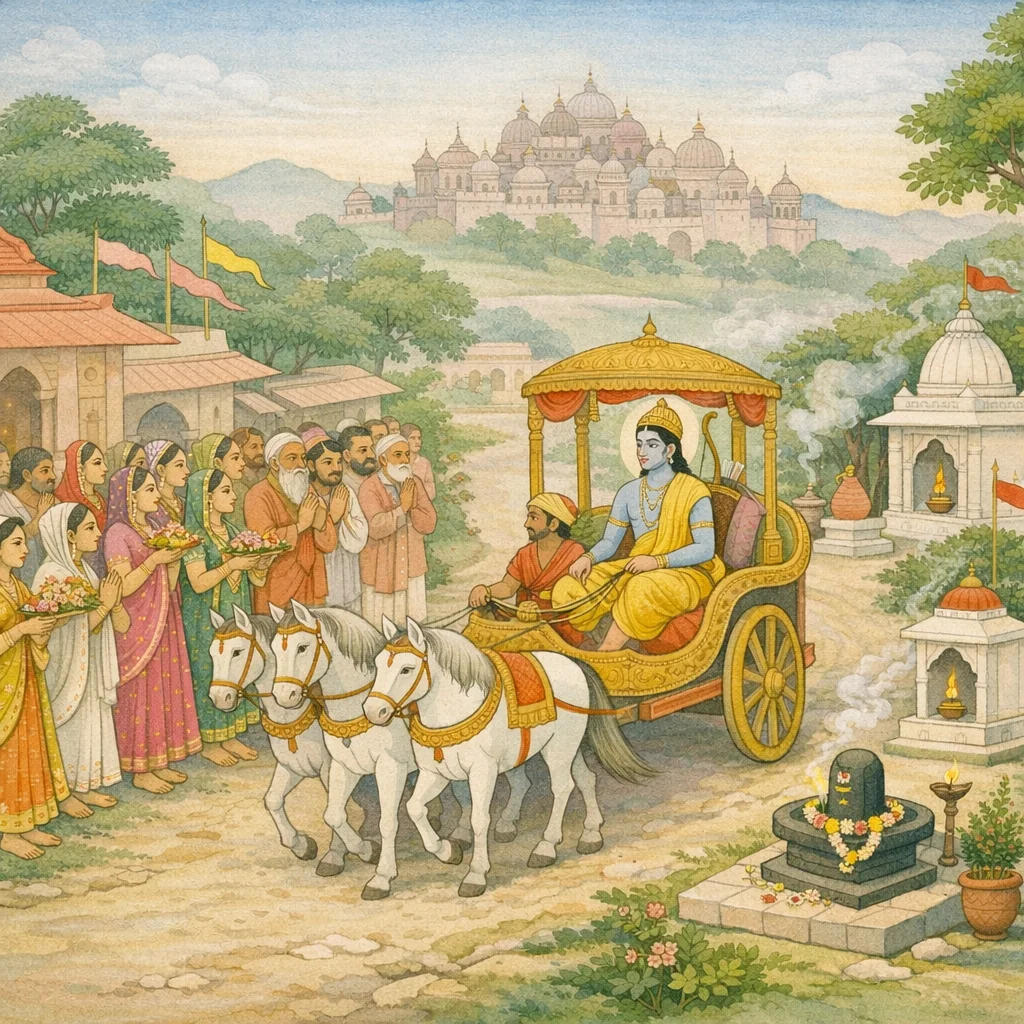
Sarga 17 presents a civic panorama as Rāma rides in a chariot through Ayodhyā amid rejoicing companions and a populace densely gathered to witness him. The city and royal road are described as ceremonially adorned—banners and pennants, incense and agaru, heaps of sandal and perfumes, silken cloth, pearls and crystal objects, flowers, and food offerings—creating an urban ritual field akin to a divine pathway. Citizens voice aspirations that the mere sight of Rāma enthroned and proceeding in public would surpass even bodily needs, framing kingship as a moral and aesthetic ideal. Rāma hears blessings and praise yet remains composed and inwardly detached, honoring people according to rank while continuing onward. The text emphasizes the magnetic ethical charisma (dharma and compassion) that prevents onlookers from withdrawing eyes or mind from him; it also notes his impartial mercy toward all varṇas and all ages. He proceeds with ritual circumambulation etiquette (keeping sacred junctions, temple-roads, monuments, and shrines to his right), reaches the royal residence whose towers are compared to clouds, Kailāsa peaks, and pale aerial chariots, crosses guarded courtyards, dismisses followers, and enters the private apartments near his father—while the waiting crowd anticipates his reemergence like the ocean awaiting the moonrise.
Shlokas
Verse 1
स रामो रथमास्थाय सम्प्रहृष्टसुहृज्जनः।पताकाध्वजसम्पन्नं महार्हागरुधूपितम्।।।।अपश्यन्नगरं श्रीमान्नानाजनसमाकुलम्।
Rama mounted the chariot, with his friends rejoicing; and the glorious one looked upon the city—adorned with flags and pennants, perfumed with costly agaru-incense, and crowded with people of every kind.
Verse 2
स गृहैरभ्रसङ्काशैः पाण्डुरैरुपशोभितम्।।।।राजमार्गं ययौ रामो मध्येनागरुधूपितम्।
Rama proceeded along the royal road, fragrant with agaru-incense, its way beautified by pale-white houses that looked like clouds.
Verse 3
चन्दनानां च मुख्यानामगरूणां च सञ्चयैः।।।।उत्तमानां च गन्धानां क्षौमकोशाम्बरस्य च।अविद्धाभिश्च मुक्ताभिरुत्तमैस्स्फाटिकैरपि।।।।शोभमानमसंबाधैस्तं राजपथमुत्तमम्।संवृतं विविधैःपुष्पैर्भक्ष्यैरुच्चावचैरपि।।।।
The royal highway was splendid and unconfined—heaped with choice sandal and agaru, fine perfumes, and bundles of white silk; it shone with pristine pearls and excellent crystal objects, and was strewn with many kinds of flowers and assorted foods.
Verse 4
चन्दनानां च मुख्यानामगरूणां च सञ्चयैः।।2.17.3।।उत्तमानां च गन्धानां क्षौमकोशाम्बरस्य च। अविद्धाभिश्च मुक्ताभिरुत्तमैस्स्फाटिकैरपि।।2.17.4।।शोभमानमसंबाधैस्तं राजपथमुत्तमम्। संवृतं विविधैःपुष्पैर्भक्ष्यैरुच्चावचैरपि।।2.17.5।।
This verse is a composite/pāda-carryover presentation repeating 2.17.3–2.17.5 in continuous form, describing the royal road adorned with fine sandal and agaru, perfumes, white silk, pristine pearls, crystal objects, flowers, and varied foods.
Verse 5
चन्दनानां च मुख्यानामगरूणां च सञ्चयैः।।2.17.3।।उत्तमानां च गन्धानां क्षौमकोशाम्बरस्य च। अविद्धाभिश्च मुक्ताभिरुत्तमैस्स्फाटिकैरपि।।2.17.4।।शोभमानमसंबाधैस्तं राजपथमुत्तमम्। संवृतं विविधैःपुष्पैर्भक्ष्यैरुच्चावचैरपि।।2.17.5।।
This entry repeats the same combined text spanning 2.17.3–2.17.5; it depicts the splendid, spacious royal road covered with perfumes, fine cloth, pearls and crystal, and strewn with flowers and varied foods.
Verse 6
ददर्श तं राजपथं दिवि देवपथं यथा।दध्यक्षतहविर्लाजैर्धूपैरगरुचन्दनैः।।।।नानामाल्योपगंधैश्च सदाऽभ्यर्चितचत्वरम्।
He saw that royal road like the gods’ pathway in heaven, where the crossroads were continually worshipped with curd, grains, oblations, puffed rice, incense, agaru and sandalwood, and with many garlands and fragrances.
Verse 7
अशीर्वादान्बहून् शृण्वन्सुहृद्भिस्समुदीरितान्।।।।यथार्हं चापि सम्पूज्य सर्वानेव नरान्ययौ।
Hearing many blessings spoken by his well-wishers, and honoring every person appropriately, he proceeded onward.
Verse 8
पितामहैराचरितं तथैव प्रपितामहैः।।।।अद्योपादाय तं मार्गमभिषिक्तोऽनुपालय।
“Consecrated today, uphold and protect the realm by adopting that very path practiced by your grandfathers and great-grandfathers.”
Verse 9
यथास्म पोषिताः पित्रा यथा सर्वैः पितामहैः।।।।ततस्सुखतरं रामे वत्स्यामस्सति राजनि।
“Just as we were cared for under your father and under all your forefathers, so too—when Rāma becomes king—we shall live with even greater happiness.”
Verse 10
अलमद्य हि भुक्तेन परमार्थैरलं च नः।।।।यदि पश्याम निर्यान्तं रामं राज्ये प्रतिष्ठितम्।
“Today, food is enough for us—and even life’s highest aims would feel fulfilled—if only we might see Rama set firm in the kingship and going forth in procession.”
Verse 11
अतो हि नः प्रियतरं नान्यत्किञ्चिद्भविष्यति।।।।यथाऽभिषेको रामस्य राज्येनामिततेजसः।
“For us, nothing will ever be dearer than Rama’s consecration to kingship—Rama of unmeasured brilliance.”
Verse 12
एताश्चान्याश्च सुहृदामुदासीनः कथाश्शुभाः।।।।आत्मसम्पूजनीश्शृण्वन्ययौ रामो महापथम्।
Hearing these and other auspicious words spoken by his well-wishers—words that praised him—Rama remained detached and continued along the great road.
Verse 13
न हि तस्मान्मनः कश्चिच्चक्षुषी वा नरोत्तमात्।।।।नर श्शक्नोत्यपाक्रष्टुमतिक्रान्तेऽपि राघवे।
Even when Rāghava had already passed by, no man could draw back his mind—or even his eyes—from that best of men.
Verse 14
यश्च रामं न पश्येत्तु यं च रामो न पश्यति।।।।निन्दित स्सर्वल्लोकेषु स्वात्माऽप्येनं विगर्हते।
Whoever does not behold Rama—or whom Rama does not behold—becomes censured among all people; even his own conscience condemns him.
Verse 15
सर्वेषु हि स धर्मात्मा वर्णानां कुरुते दयाम्।।।।चतुर्णां हि वयः स्थानां तेन ते तमनुव्रताः।
For that righteous-souled one shows compassion to all—across the four social orders and across the four stages of age; therefore the people were devoted to him.
Verse 16
चतुष्पथान्देवपथांश्चैत्यान्यायतनानि च।।।।प्रदक्षिणं परिहरन् जगाम नृपते स्सुतः।
The king’s son proceeded on, passing respectfully with them to his right—crossroads, temple-roads, sacred monuments, and shrines.
Verse 17
स राजकुलमासाद्य मेघसङ्घोपमै श्शुभैः।।।।प्रासादशृङ्गैर्विविधैःकैलास शिखरोपमैः।आवारयद्भिर्गगनं विमानैरिव पाण्डुरैः।।।।वर्धमानगृहैश्चापि रत्नजालपरिष्कृतैः।तत्पृथिव्यां गृहवरं महेन्द्रसदनोपमम्।।।।राजपुत्रः पितुर्वेश्म प्रविवेश श्रिया ज्वलन्।
Reaching the royal residence, the prince entered his father’s palace, radiant with splendor—an excellent mansion on earth like Indra’s abode. Its many palace-towers, auspicious and pale-white, seemed like masses of clouds, like the peaks of Kailāsa, and like aerial chariots, while the growing halls were adorned with lattices of gems and seemed to cover the sky.
Verse 18
स राजकुलमासाद्य मेघसङ्घोपमै श्शुभैः।।2.17.17।।प्रासादशृङ्गैर्विविधैःकैलास शिखरोपमैः। आवारयद्भिर्गगनं विमानैरिव पाण्डुरैः।।2.17.18।।वर्धमानगृहैश्चापि रत्नजालपरिष्कृतैः। तत्पृथिव्यां गृहवरं महेन्द्रसदनोपमम्।।2.17.19।।राजपुत्रः पितुर्वेश्म प्रविवेश श्रिया ज्वलन्।
This input line presents a composite repetition of verses 2.17.17–19; the sense remains: Rama reaches the royal residence and enters his father’s splendid palace, whose pale-white towers and gem-adorned halls resemble clouds, Kailāsa peaks, and aerial chariots, like Indra’s abode on earth.
Verse 19
स राजकुलमासाद्य मेघसङ्घोपमै श्शुभैः।।2.17.17।।प्रासादशृङ्गैर्विविधैःकैलास शिखरोपमैः। आवारयद्भिर्गगनं विमानैरिव पाण्डुरैः।।2.17.18।।वर्धमानगृहैश्चापि रत्नजालपरिष्कृतैः। तत्पृथिव्यां गृहवरं महेन्द्रसदनोपमम्।।2.17.19।।राजपुत्रः पितुर्वेश्म प्रविवेश श्रिया ज्वलन्।
This line again repeats the combined 2.17.17–19 description; its concluding point is that the prince entered his father’s palace, shining with splendor, like Indra’s dwelling on earth.
Verse 20
स कक्ष्या धन्विभिर्गुप्तास्तिस्रोऽतिक्रम्य वाजिभिः।।।।पदातिरपरे कक्ष्ये द्वे जगाम नरोत्तमः।
Crossing three courtyards guarded by bowmen while mounted, the best of men then proceeded on foot through the remaining two courtyards.
Verse 21
स सर्वा स्समतिक्रम्य कक्ष्या दशरथात्मजः।सन्निवर्त्य जनं सर्वं शुद्धान्तः पुरमभ्यगात्।।।।
Crossing all the palace enclosures, Rāma—son of Daśaratha—sent all his attendants back and entered the inner, private apartments.
Verse 22
तस्मिन् प्रविष्टे पितुरन्तिकं तदा जन स्स सर्वो मुदितो नृपात्मजे।प्रतीक्षते तस्य पुनः स्म निर्गमं यथोदयं चन्द्रमसस्सरित्पतिः।।।।
When the king’s son had entered his father’s presence, all the people rejoiced, and they waited for his reappearance—like the ocean awaiting the moon’s rise.
Frequently Asked Questions
Rather than a conflict-choice, the pivotal action is Rāma’s disciplined public conduct: he receives intense civic adoration and praise yet remains steady, honors people appropriately, and proceeds with ritual and social propriety—modeling restraint and legitimacy expected of an heir.
The citizens articulate kingship as a moral good—seeing a righteous ruler enthroned is portrayed as a supreme human fulfillment—while the narrative frames true excellence as compassion toward all and inner composure even when celebrated.
The sarga maps Ayodhyā’s sacred-urban infrastructure: the royal highway, worshipped crossroads, temple-roads, monuments (caitya), shrines (āyatana), the multi-courtyard palace complex, and the inner apartments—presented through ritual details (incense, offerings, circumambulation etiquette).