Sarga 110
लोकसमुत्पत्ति-वर्णनम् तथा इक्ष्वाकुवंश-प्रशंसा (Cosmogony and Ikshvaku Genealogy as Counsel to Rama)
अयोध्याकाण्ड
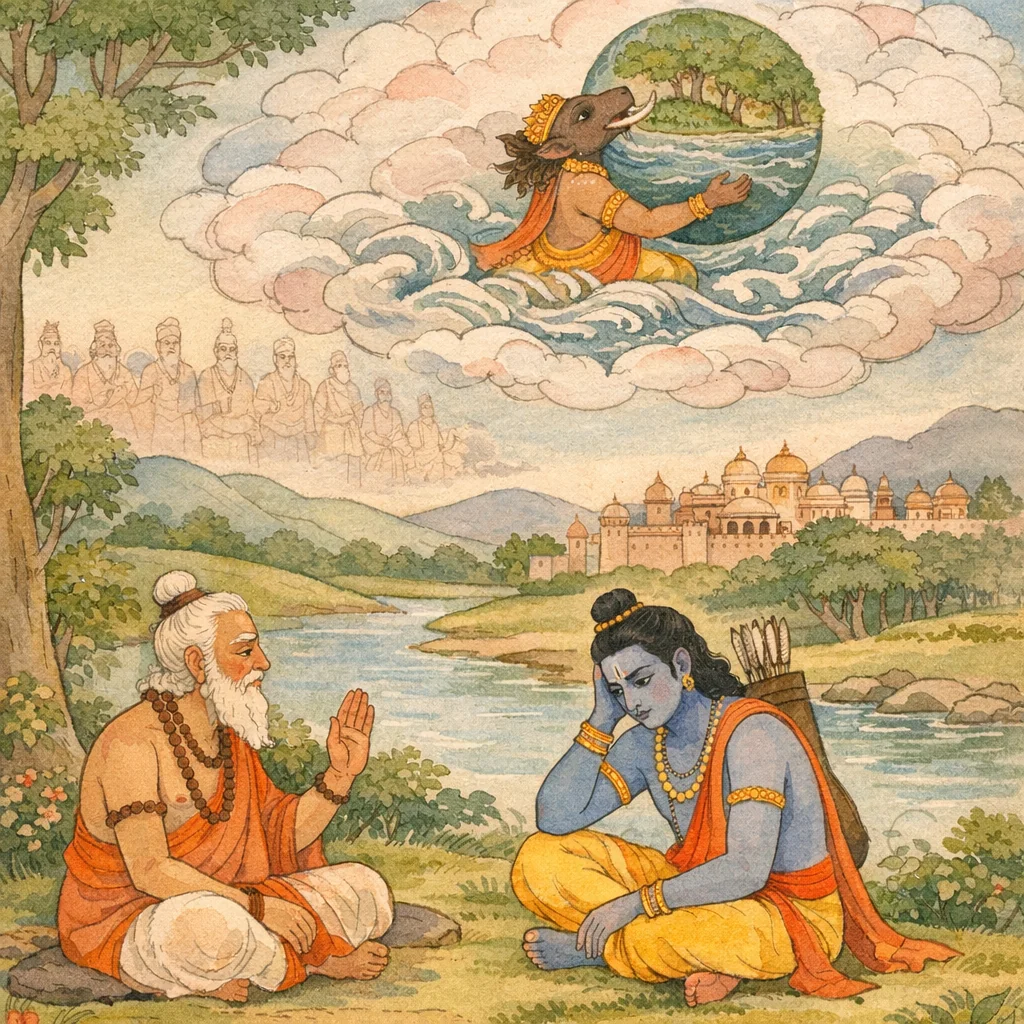
Sarga 110 is structured as corrective counsel to a wrathful Rāma. Vasiṣṭha reframes Jābāli’s earlier discourse as pragmatic persuasion intended to prompt Rama’s return, then pivots to an authoritative teaching: a brief cosmogony (primordial waters, emergence of Svayambhū Brahmā, the boar-lift of Earth) followed by a lineage chain from Manu and Ikṣvāku through celebrated kings of Ayodhyā. The genealogy functions as a legal-ethical proof: the Ikṣvāku norm consecrates the eldest son, and Rama, as Daśaratha’s senior heir, is urged to accept sovereignty and protect the people in continuity with ancestral rājadharma. The chapter blends cosmological origin, dynastic memory, and normative succession doctrine to argue that Rama’s acceptance of kingship preserves kuladharma (family tradition) and public welfare.
Shlokas
Verse 1
क्रुद्धमाज्ञाय रामं तु वसिष्ठः प्रत्युवाच ह।जाबालिरपि जानीते लोकस्यास्य गतागतिम्।।।।
Perceiving that Rāma was angered, Vasiṣṭha spoke up in reply, saying: “Jābāli too understands the coming and going—the course and destiny—of beings in this world.”
Verse 2
निवर्तयितुकामस्तु त्वामेतद्वाक्यमब्रवीत्।इमां लोकसमुत्पत्तिं लोकनाथ निबोध मे।।।।
O Lord of the worlds, he spoke these words to you only wishing to make you return. Now learn from me the account of the world’s origin.
Verse 3
सर्वं सलिलमेवासीत्पृथिवी यत्र निर्मिता।तत: समभवद्ब्रह्मा स्वयम्भूर्दैवतै: सह।।।।
In the beginning, all was water, from which the earth was formed; thereafter the Self-existent Brahmā came into manifestation, together with the gods.
Verse 4
स वराहस्ततो भूत्वा प्रोज्जहार वसुन्धराम्।असृजच्च जगत्सर्वं सह पुत्रैः कृतात्मभिः।।।।
Then he became the Boar (Varāha), lifted up the Earth, and brought forth the whole world together with his sons—souls made pure and self-controlled.
Verse 5
आकाशप्रभवो ब्रह्मा शाश्वतो नित्य अव्ययः।तस्मान्मरीचि: संजज्ञे मरीचेः कश्यप: सुतः।।।।
Brahmā—eternal, constant, and imperishable—arose from space; from him was born Marīci, and from Marīci, Kaśyapa, his son.
Verse 6
विवस्वान्काश्यपात् जज्ञे मनुर्वैवस्वत: स्वयम्।स तु प्रजापतिः पूर्वमिक्ष्वाकुस्तु मनो: सुतः।।।।
From Kaśyapa was born Vivasvān (the Sun), and from Vivasvān, Manu Vaivasvata. That Manu was the first Prajāpati; and Ikṣvāku was born as Manu’s son.
Verse 7
यस्येयं प्रथमं दत्ता समृद्धा मनुना मही।तमिक्ष्वाकुमयोध्यायां राजानं विद्धि पूर्वकम्।।।।
To Ikṣvāku—on whom Manu first bestowed this prosperous earth—know him as the earliest king in Ayodhyā.
Verse 8
इक्ष्वाकोस्तु सुत श्रीमान्कुक्षिरेवेति विश्रुतः।कुक्षेरथात्मजो वीरो विकुक्षिरुदपद्यत।।।।
Ikṣvāku had an illustrious son, famed by the name Kukṣi; and then to Kukṣi was born the heroic Vikukṣi.
Verse 9
विकुक्षेस्तु महातेजा बाणः पुत्र प्रतापवान्।बाणस्य तु महाबाहुरनरण्यो महातपा:।।।।
To Vikukṣi was born Bāṇa, mighty in splendor and power; and to Bāṇa was born Anaraṇya, great-armed and austere in discipline.
Verse 10
नानावृष्टिर्बभूवास्मिन्नदुर्भिक्षं सतां वरे।अनरण्ये महाराजे तस्करो नापि कश्चन।।।।
When the great king Anaraṇya—best among the virtuous—ruled this realm, there was no drought, no famine, and not even a single thief.
Verse 11
अनरण्यान्महाबाहुः पृथु राजा बभूव ह।तस्मात्पृथोमेहाराजस्त्रिशङ्कुरुदपद्यत।।।।स सत्यवचनाद् वीर: सशरीरो दिवं गतः।
From Anaraṇya was born the mighty-armed king Pṛthu; from Pṛthu, the great king Triśaṅku was born. That heroic Triśaṅku, by the power of his truthfulness, went to heaven with his body.
Verse 12
त्रिशङ्कोरभवत्सूनुर्दुन्धुमारो महायशाः।।।।दुन्धुमारान्महातेजा युवनाश्वो व्यजायत।
Triśaṅku’s son was the illustrious Dundhumāra; from Dundhumāra was born the greatly radiant Yuvanāśva.
Verse 13
युवनाश्वसुत श्श्रीमान्मान्धाता समपद्यत।।।।मान्धातुस्त महातेजा: सुसन्धिरुदपद्यत।सुसन्धेरपि पुत्रौ द्वौ ध्रुवसन्धिः प्रसेनजित्।।।।यशस्वी ध्रुवसन्धेस्तु भरतो रिपुसूदनः।
Yuvanāśva’s son was the majestic Māndhātṛ; from Māndhātṛ was born the mighty Susandhi. Susandhi had two sons—Dhruvasandhi and Prasēnajit. From Dhruvasandhi was born the renowned Bharata, slayer of enemies.
Verse 14
युवनाश्वसुत श्श्रीमान्मान्धाता समपद्यत।।2.110.13।।मान्धातुस्त महातेजा स्सुसन्धिरुदपद्यत।सुसन्धेरपि पुत्रौ द्वौ ध्रुवसन्धिः प्रसेनजित्।।2.110.14।।यशस्वी ध्रुवसन्धेस्तु भरतो रिपुसूदनः।
This verse stream repeats the preceding genealogical statement: Māndhātṛ is born from Yuvanāśva; Susandhi from Māndhātṛ; Susandhi’s two sons are Dhruvasandhi and Prasēnajit; and from Dhruvasandhi is born the renowned Bharata, slayer of enemies.
Verse 15
भरतात्तु महाबाहोरसितो नाम जायत।।।।यस्यैते प्रतिराजान उदपद्यन्त शत्रवः।हैहयास्तालजङ्घाश्च शूराश्च शशिबिन्दवः।।।।
From Bharata, the mighty-armed, was born a son named Asita. Against him arose hostile rival kings: the Haihayas, the Tālajaṅghas, and the valiant Śaśibindus.
Verse 16
भरतात्तु महाबाहोरसितो नाम जायत।।2.110.15।।यस्यैते प्रतिराजान उदपद्यन्त शत्रवः।हैहयास्तालजङ्घाश्च शूराश्च शशिबिन्दवः।।2.110.16।।
This verse stream repeats the statement that Bharata’s son Asita faced rival hostile kings—the Haihayas, Tālajaṅghas, and the valiant Śaśibindus.
Verse 17
तांस्तु सर्वान्प्रतिव्यूह्य युद्धे राजा प्रवासितः।स च शैलवरे रम्ये बभूवाभिरतो मुनिः।।।।
Though the king met all of them in battle, he was driven into exile. He then dwelt on a beautiful mountain-tract, living contentedly like a sage.
Verse 18
द्वे चास्य भार्ये गर्भिण्यौ बभूवतुरिति श्रुतिः।एका गर्भविनाशाय सपत्न्यै गरलं ददौ।।।।
It is said that he had two wives, and both became pregnant. One of them, seeking to destroy her co-wife’s embryo, gave her poison.
Verse 19
भार्गवश्च्यवनो नाम हिमवन्तमुपाश्रितः।तमृषिं समुपागम्य कालिन्दी त्वभ्यवादयत्।।2.110.19।।स तामभ्यवदद्विप्रो वरेप्सुं पुत्रजन्मनि।
There was a Bhārgava sage named Cyavana who had taken refuge on Himavat. Approaching that seer, Kāлиндī paid him reverence; and that brahmin then addressed her, as she longed for a boon—the birth of a son.
Verse 20
पुत्रस्ते भविता देवि महात्मा लोकविश्रुतः।।।।धार्मिकश्च सुशीलश्च वंशकर्ताऽरिसूदनः।
“O queen, you shall have a son—great-souled and renowned in the world—virtuous and of noble conduct, a continuer of the lineage and a destroyer of enemies.”
Verse 21
कृत्वा प्रदक्षिणं हृष्टा मुनिंतमनुमान्य च।।।।पद्मपत्रसमानाक्षं पद्मगर्भसमप्रभम्।तत: सा गृहमागम्य देवी पुत्रं व्यजायत।।।।
Delighted, the queen circumambulated the sage and, taking leave of him, returned home. Then she gave birth to a son with lotus-petal eyes, radiant like the lotus-born (Brahmā).
Verse 22
कृत्वा प्रदक्षिणं हृष्टा मुनिंतमनुमान्य च।।2.110.21।। पद्मपत्रसमानाक्षं पद्मगर्भसमप्रभम्। तत: सा गृहमागम्य देवी पुत्रं व्यजायत।।2.110.22।।
Delighted, she circumambulated the sage and took leave of him; returning home thereafter, the queen gave birth to a son with lotus-like eyes, radiant like the lotus-born (Brahmā).
Verse 23
सपत्न्या तु गरस्तस्यै दत्तो गर्भजिघांसया।गरेण सह तेनैव जात स्स सगरोऽभवत्।।।।
But her co-wife, wishing to destroy the embryo, gave her a poison. Born together with that ‘gara’ (poison), the child came to be known as Sagara.
Verse 24
स राजा सगरो नाम य: समुद्रमखानयत्।इष्ट्वा पर्वणि वेगेन त्रासयन इमाः प्रजाः।।।
That king, Sagara by name, was the one who had the ocean dug out; having performed a sacrifice on a festival full-moon day, he swiftly set the people in fear (by that mighty undertaking).
Verse 25
असमञ्जस्तु पुत्रोऽभूत्सगरस्येति न श्श्रुतम्।जीवन्नेव स पित्रा तु निरस्तः पापकर्मकृत्।।।।
We have heard that Sagara had a son named Asamañja. While his father yet lived, that doer of sinful deeds was banished by him.
Verse 26
अंशुमानिति पुत्रोऽभूदसमञ्जस्य वीर्यवान्।दिलीपोंशुमतः पुत्रो दिलीपस्य भगीरथः।।।।
Valiant Aṁśumān was born as Asamañja’s son. Dilīpa was Aṁśumān’s son, and Bhagīratha was Dilīpa’s son.
Verse 27
भगीरथात्ककुत्स्थस्तु काकुत्स्था येन विश्रुताः।ककुत्स्थस्य च पुत्रोऽभूद्रघुर्येन च राघवाः।।।।
From Bhagīratha was born Kakutstha, through whom your line became famed as the Kākuṭsthas. And to Kakutstha was born Raghu, through whom you are known as the Rāghavas.
Verse 28
रघोस्तु पुत्रस्तेजस्वी प्रवृद्धः पुरुषादकः।कल्माषपाद स्सौदास इत्येवं प्रथितो भुवि।।।।
Raghu’s illustrious son, grown to power, became famed in the world under the names Kalmāṣapāda and Saudāsa—known also as a devourer of men (for a time) through a sage’s curse.
Verse 29
कल्माषपादपुत्रोऽभूच्छङ्खणस्त्विति विश्रुतः।यस्तु तद्वीर्यमासाद्य सहसैन्यो व्यनीनशत्।।।।
Kalmāṣapāda’s son became famous by the name Śaṅkhaṇa; and whoever confronted his prowess was crushed, along with his army.
Verse 30
शङ्खणस्य च पुत्रोऽभूच्छूर श्रीमान्सुदर्शनः।सुदर्शनस्याग्निवर्णः अग्निवर्णस्य शीघ्रगः।।।।शीघ्रगस्य मरुः पुत्रो मरोः पुत्रः प्रशुश्रुवः।प्रशुश्रुवस्य पुत्रोभूदम्बरीषो महाद्युतिः।।।।अम्बरीषस्य पुत्रोभून्नहुषः सत्यविक्रमः।नहुषस्य च नाभागः पुत्रः परमधार्मिकः।।।।अजश्च सुव्रतश्चैव नाभागस्य सुतावुभौ।अजस्यैव च धर्मात्मा राजा दशरथस्सुतः।।।।
Śaṅkhaṇa’s son was the heroic and splendid Sudarśana; Sudarśana’s son was Agnivarṇa, and Agnivarṇa’s son Śīghraga. Śīghraga’s son was Maru; Maru’s son Praśuśruva; and Praśuśruva’s son was the radiant Ambarīṣa. Ambarīṣa’s son was Nahūṣa, whose prowess was true; Nahūṣa’s son was the supremely righteous Nābhāga. Nābhāga had two sons, Aja and Suvrata; and Aja’s son was the righteous king Daśaratha.
Verse 31
शङ्खणस्य च पुत्रोऽभूच्छूर श्रीमान्सुदर्शनः।सुदर्शनस्याग्निवर्णः अग्निवर्णस्य शीघ्रगः।।2.110.30।।शीघ्रगस्य मरुः पुत्रो मरोः पुत्रः प्रशुश्रुवः।प्रशुश्रुवस्य पुत्रोभूदम्बरीषो महाद्युतिः।।2.110.31।।अम्बरीषस्य पुत्रोभून्नहुषः सत्यविक्रमः।नहुषस्य च नाभागः पुत्रः परमधार्मिकः।।2.110.32।।अजश्च सुव्रतश्चैव नाभागस्य सुतावुभौ।अजस्यैव च धर्मात्मा राजा दशरथस्सुतः।।2.110.33।।
You are his eldest heir—widely renowned as Rāma. Therefore, O king, accept your own kingdom and look after the people.
Verse 32
शङ्खणस्य च पुत्रोऽभूच्छूर श्रीमान्सुदर्शनः।सुदर्शनस्याग्निवर्णः अग्निवर्णस्य शीघ्रगः।।2.110.30।।शीघ्रगस्य मरुः पुत्रो मरोः पुत्रः प्रशुश्रुवः।प्रशुश्रुवस्य पुत्रोभूदम्बरीषो महाद्युतिः।।2.110.31।।अम्बरीषस्य पुत्रोभून्नहुषः सत्यविक्रमः।नहुषस्य च नाभागः पुत्रः परमधार्मिकः।।2.110.32।।अजश्च सुव्रतश्चैव नाभागस्य सुतावुभौ।अजस्यैव च धर्मात्मा राजा दशरथस्सुतः।।2.110.33।।
Among all the Ikṣvākus, it is the eldest who becomes king; while the eldest lives, a younger son is not consecrated to the kingdom.
Verse 33
शङ्खणस्य च पुत्रोऽभूच्छूर श्रीमान्सुदर्शनः।सुदर्शनस्याग्निवर्णः अग्निवर्णस्य शीघ्रगः।।2.110.30।।शीघ्रगस्य मरुः पुत्रो मरोः पुत्रः प्रशुश्रुवः।प्रशुश्रुवस्य पुत्रोभूदम्बरीषो महाद्युतिः।।2.110.31।।अम्बरीषस्य पुत्रोभून्नहुषः सत्यविक्रमः।नहुषस्य च नाभागः पुत्रः परमधार्मिकः।।2.110.32।।अजश्च सुव्रतश्चैव नाभागस्य सुतावुभौ।अजस्यैव च धर्मात्मा राजा दशरथस्सुतः।।2.110.33।।
O greatly renowned one, you should not today abandon the eternal family-dharma of the Rāghavas. Rule this earth—rich in treasures and broad in realms—just as your father did.
Verse 34
तस्य ज्येष्ठोऽसि दायादो राम इत्यभिविश्रुतः।तद्गृहाण स्वकं राज्यमवेक्षस्व जनं नृप।।।।
You are his eldest heir—widely renowned as Rāma. Therefore, O king, accept your own kingdom and look after the people.
Verse 35
इक्ष्वाकूणां हि सर्वेषां राजा भवति पूर्वजः।पूर्वजे नापरः पुत्रो ज्येष्ठो राज्येऽभिषिच्यते।।।।
Among all the Ikṣvākus, it is the eldest who becomes king; while the eldest lives, a younger son is not consecrated to the kingdom.
Verse 36
स राघवाणां कुलधर्ममात्मनः सनातनं नाद्य विहन्तुमर्हसि।प्रभूतरत्नामनुशाधि मेदिनीं प्रभूतराष्ट्रां पितृवन्महायशः।।।।
O greatly renowned one, you should not today abandon the eternal family-dharma of the Rāghavas. Rule this earth—rich in treasures and broad in realms—just as your father did.
Frequently Asked Questions
Rama’s anger and refusal to be swayed is met with Vasistha’s intervention: the dilemma is whether Rama should return and accept kingship. Vasistha frames acceptance of the throne as a dharmic obligation grounded in lawful succession and public protection.
The chapter teaches that tradition and social order are not merely custom but ethical infrastructure: cosmogony and genealogy establish authority, and rājadharma requires the rightful heir to govern for lokasaṅgraha (welfare of the people).
Ayodhya is foregrounded as the dynastic seat of the Ikshvakus; Himavat appears as Chyavana’s refuge; and the ocean (samudra) is referenced through Sagara’s excavation motif—each serving as a cultural anchor for lineage memory and royal legitimacy.