Adhyaya 23
Preta-lakṣaṇa and Svapna-nimitta: Dream Portents of Preta-affliction and the Prescribed Remedies
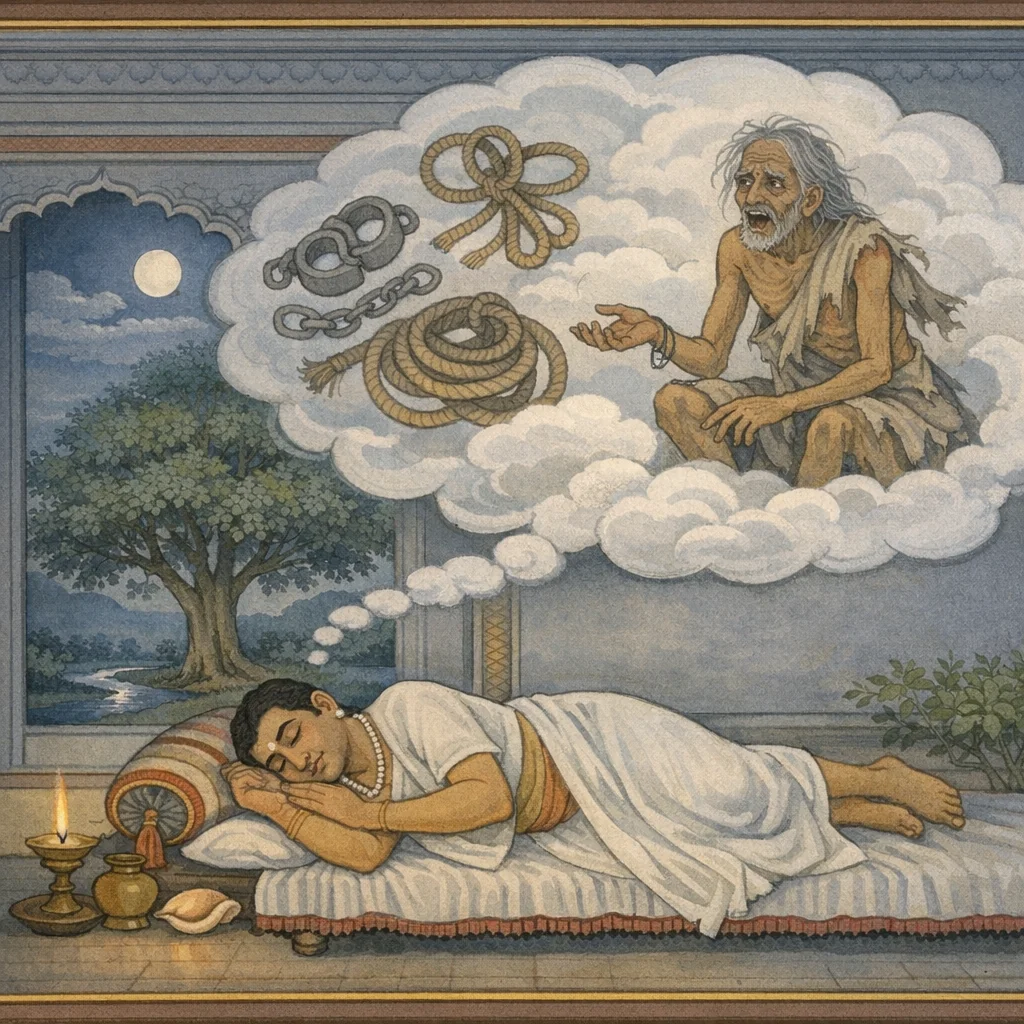
Following the wider after-death and preta teaching of the surrounding Preta-kalpa, Garuḍa asks Viṣṇu how pretas act when they become piśāca-like in fixation, and whether they can communicate. Viṣṇu explains the preta’s subtle-body presence—returning to its dwelling, perceiving family, and appearing in distorted forms—then lists dream portents of distress: repeated bondage-visions; an ancestor in wretched clothes begging for food; food being snatched away; intense thirst and drinking; riding bulls or moving through the sky; going to a tīrtha while hungry; and abnormal speech in voices linked with animals, brāhmaṇas, devas, spirits, pretas, or night-roamers as a death-omen. Seeing living relatives as dead is also attributed to preta-affliction. The chapter then turns diagnosis into remedy, prescribing prāyaścitta: bathing (at home or at a tīrtha), offering tarpaṇa at an auspicious tree, giving black grains, honoring a Veda-knower, performing homa as one is able, and arranging full recitation. It concludes by promising that faithful reading or hearing of these signs destroys the marks of preta-affliction and prepares for the next unit’s ritual clarifications.
Shlokas
Verse 1
प्रेतत्वोत्पत्तितन्मुक्तिपेञ्चप्रेतोपाख्यान निरूपणं नाम द्वाविंशो ऽध्यायः गरुड उवाच / किङ्किं कुर्वन्ति वै प्रेताः पिशाचत्वेव्यवस्थिताः / वदन्ति वा कदाचित्किं तद्वदस्व सुरेश्वर
Garuḍa said: “When beings become pretas and remain fixed in a piśāca-like state, what do they do? Do they ever speak anything? Tell me, O Lord of the gods.”
Verse 2
श्रीभगवानुवाच / तेषां स्वरूपं वक्ष्यामि चिह्नं स्वप्नं यथातथम् / क्षुत्पिपासार्दितास्ते वै प्रविशेयुः स्ववेश्मनि
The Blessed Lord said: “I shall describe their true form, their identifying marks, and the nature of their dreams, exactly as they are. Afflicted by hunger and thirst, they indeed enter their own dwelling.”
Verse 3
प्रतिष्ठा वायुदेहेषु शयानांस्तु स्ववंशजान् / तत्र यच्छन्ति लिङ्गानि दर्शयन्ति खगेश्वर
O Khageśvara, Lord of birds, those lying there in airy, subtle bodies establish recognition of their own lineage; and there they bestow signs and reveal distinguishing marks.
Verse 4
स्वपुत्रस्वकलत्राणि स्वबन्धुन्तत्र गच्छति / हयो गजो वृषो मर्त्योदृश्यते विकृताननः
There the departed goes, seeing as if present his own sons, his own wife, and his own relatives. The mortal is beheld with a distorted face—appearing now like a horse, now like an elephant, now like a bull.
Verse 5
शयानं विपरीतं तु आत्मानं च विपर्ययम् / उत्थितः पश्यति यस्तु तद्विन्द्यात्प्रेतनिर्मितम्
But if, having risen, one beholds one’s own self lying there, inverted and as if lifeless, one should know that vision to be fashioned by the preta—the departed one’s subtle post-death state.
Verse 6
स्वप्ने नरौ हि निगडैर्बध्यते बहुधा यदि / अन्नं च याचते स्वप्ने कुवेषः पूर्वजो मृतः
If, in a dream, a man is seen again and again bound in fetters, and a dead forefather—clad in wretched garments—begs for food in that dream, it is taken as a sign that the ancestor suffers in the preta-state and needs rites of relief.
Verse 7
स्वप्ने यो भुज्यमानस्य गृहीत्वान्नं पलायते / आत्मनस्तु परो वापि तृषार्तस्तु जलं पिबेत्
If, in a dream, someone snatches away the food of one who is eating and runs off—or if oneself or another, tormented by thirst, drinks water—these are regarded here as significant dream-signs.
Verse 8
वृषभारोहणं स्वप्ने वृषभैः सह गच्छति / उत्पत्य गगनं याति तीर्थे याति क्षुधातुरः
If one dreams of mounting a bull and going along with bulls, or of suddenly rising and moving through the sky, or of going to a tīrtha, a sacred ford, while tormented by hunger—these are taken as significant dream-omens.
Verse 9
स्ववाचा वदते यस्तु गोवृषद्विजावाजिषु / लिङ्गे गजे तथा देवे भूते प्रेते निशाचरे
But one who speaks as though in the voice of cows, bulls, Brahmins, or horses—and likewise speaks strangely concerning the liṅga, an elephant, a deva, a bhūta (spirit-being), a preta, or a night-roamer—such abnormal speech is deemed an evil omen, a sign of impending death.
Verse 10
स्वप्नमध्ये तु पक्षीन्द्र प्रेतलिङ्गान्यनेकधा / स्वकलत्रं स्वबन्धुं वा स्वसुतं स्वपतिं विभुम् / विद्यमानं मृतं पश्येत्प्रेतदोषेण निश्चितम्
In dreams, O lord of birds (Garuda), one may behold many signs of a preta. One may see one’s wife, kinsman, son, or husband—though truly alive—as if dead; this is certainly due to affliction connected with a preta.
Verse 11
याचते यः परं स्वप्ने क्षुत्तृड्भ्यां च परिप्लुतः / तीर्थे गत्वा दहेत्पिण्डान्प्रेतदौषैर्न संशयः
If, in a dream, one sees someone overwhelmed by hunger and thirst, begging intensely, then one should go to a sacred tīrtha and offer piṇḍas, consigning them by rite; this is certainly due to affliction connected with a preta—without doubt.
Verse 12
निर्गच्छेद्वा गृहाद्वापि स्वप्ने पुत्रस्तथा पशुः / पिता भ्राता कलत्रं च प्रेतदोषैस्तु पश्यति
In dreams, one may see the son—or even an animal—leaving the house; likewise one may see the father, brother, or wife. Such visions arise from afflictions connected with a preta.
Verse 13
चिह्नान्येतानि पक्षीन्द्र प्रायश्चित्तं निवेदयेत् / कृत्वा स्नानं गृहे तीर्थे श्रीवृक्षे तर्पणं जलैः
“These are the signs, O lord of birds (Garuda). One should then undertake the prescribed expiation (prāyaścitta). Having bathed—at home or at a sacred tīrtha—one should offer tarpaṇa, water-libations, at the auspicious tree (śrī-vṛkṣa).”
Verse 14
कृष्णधान्यानि पूजां च प्रदद्याद्वेदपारगे / होमं कुर्याद्यथाशक्ति सम्पूर्णं वाचयेत्सुधीः
The wise person should offer black grains and render due worship to one learned in the Vedas; he should perform homa, the fire-offering, according to his capacity, and have the complete sacred recitation duly read aloud.
Verse 15
एतद्धि श्रद्धया यस्तु प्रेतलिङ्गनिदर्शनम् / पठते शृणुते वापि प्रेतचिह्नं विनश्यति
Indeed, whoever with faith recites—or even merely hears—this description of the signs of a preta, the marks of the preta-state are destroyed.
Frequently Asked Questions
The text treats this as a sign of a forebear’s distressed preta-condition, prompting rites of relief—especially going to a tīrtha for piṇḍa offerings and performing tarpaṇa—along with prāyaścitta and supportive acts like dāna, homa, and Vedic recitation.
Within the chapter’s logic, these dreams indicate hunger/thirst and unsettledness in the preta-state. Tarpaṇa (water-libations) and piṇḍa (ritual food offerings) directly address that symbolic deficit and re-establish the dhārmic bond of care between the living and the departed.
It is classified as an ariṣṭa-lakṣaṇa—an ominous indicator associated with severe disturbance, including impending death. The chapter lists voices of cows, bulls, horses, brāhmaṇas, devas, pretas, and night-roamers as markers of such inauspicious disruption.
Read Garuda Purana in the Vedapath app
Scan the QR code to open this directly in the app, with audio, word-by-word meanings, and more.